
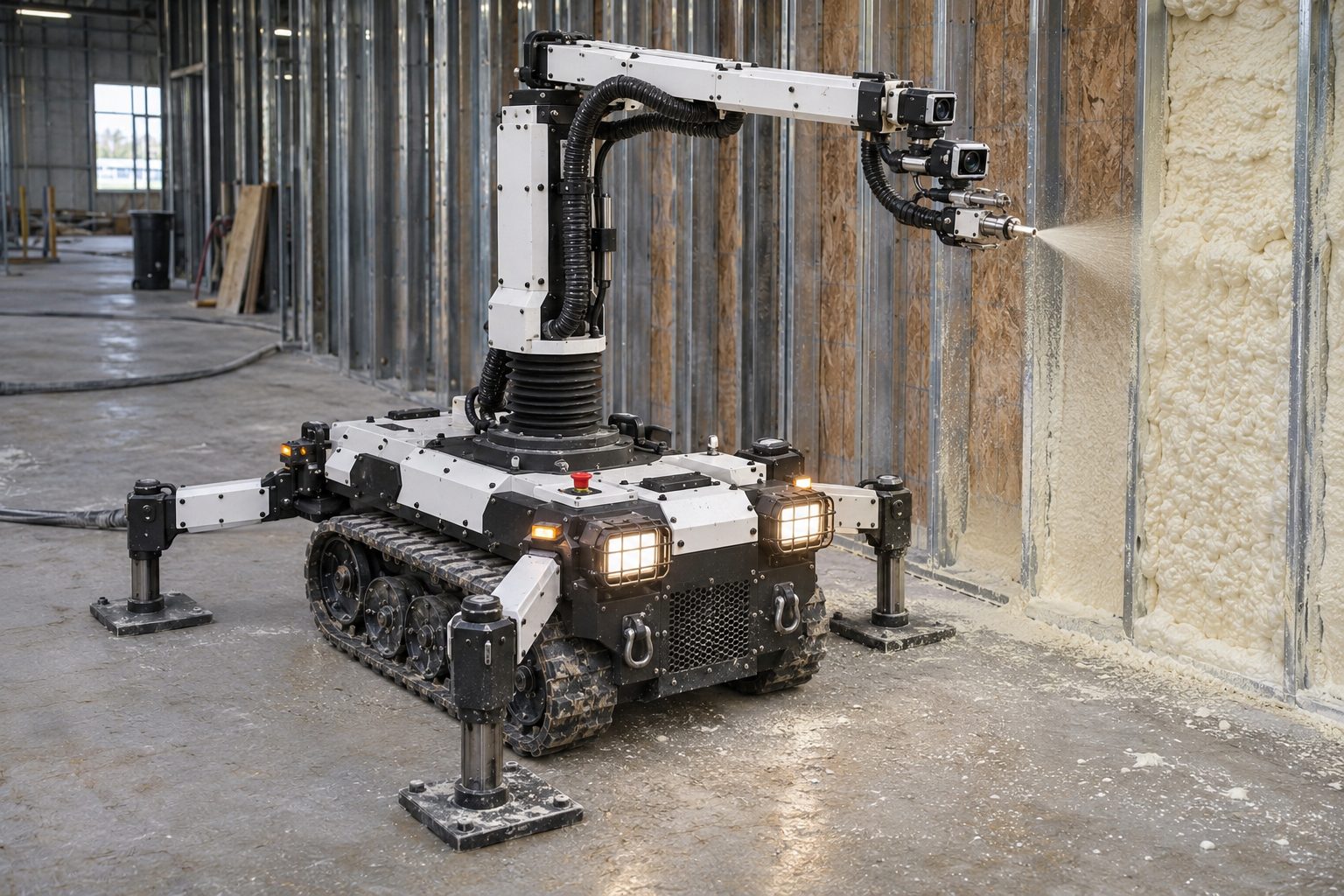
Foam on the wall. Crew outside the zone.
Spray foam is skilled work in a place nobody should breathe. This tool rides STE Site Hand Tradesman and its boom, and takes the gun into the zone. The installer runs the job from outside the spray zone and signs the daily work record.
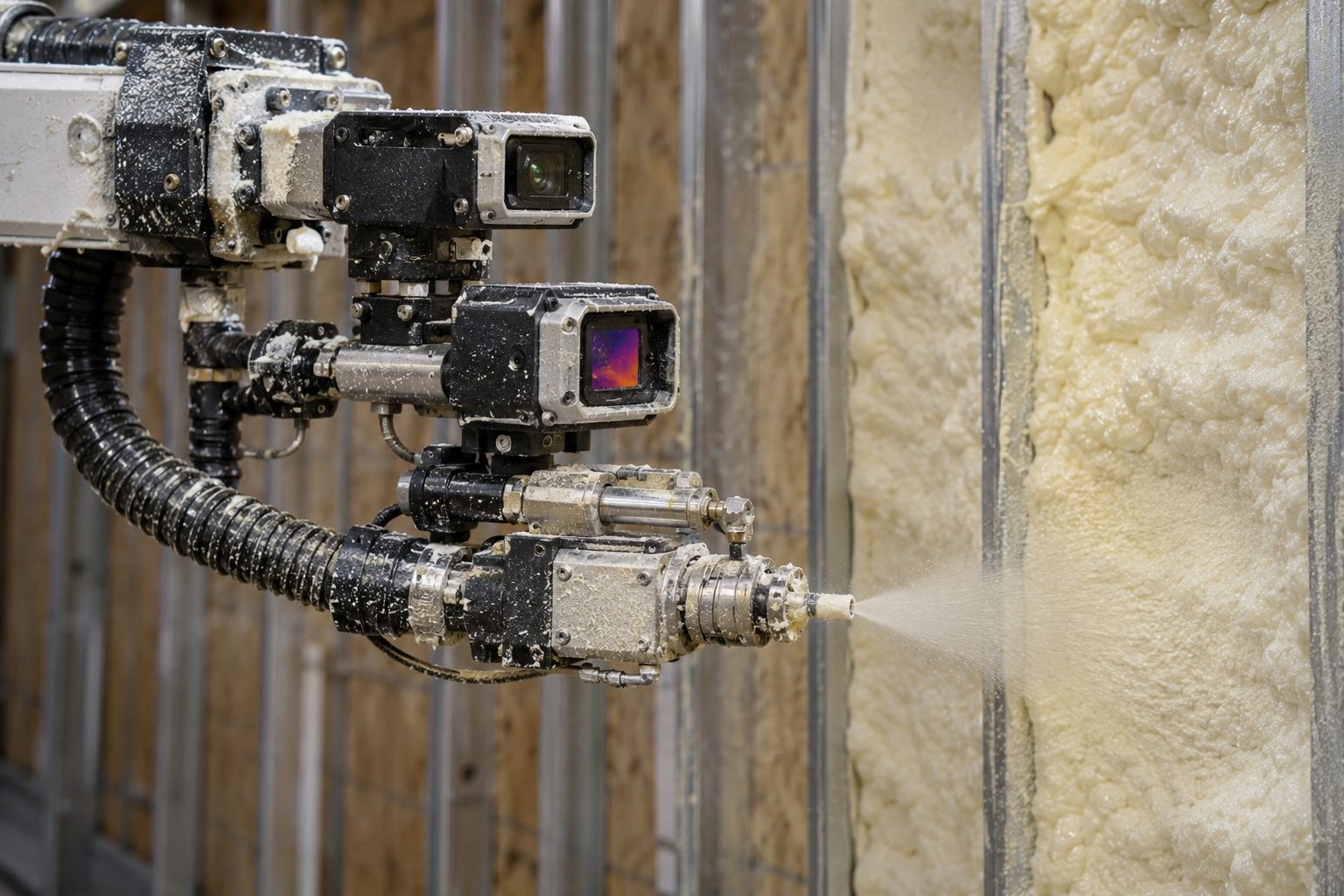
An automatic gun on the Tradesman's boom.
An automatic foam gun, a depth scanner and a thermal camera on the tool plate of the Tradesman, at the end of the coating boom. The gun has an air-actuated valve. It is not a hand-held trigger gun.
The Site Hand is designed to spray closed cell and open cell foam in a contained zone while the crew stays outside it. It is for interior walls, ceilings and the underside of roof decks, in buildings under construction or empty.
- Open stud and steel-girt wall cavities.
- Concrete and block walls.
- Ceilings and the underside of roof decks.
- Closed cell or open cell foam, by product.
The installer still owns the job.
The robot holds the gun. The installer makes the calls, from the truck or from outside the containment, with camera views and the proportioner readout on a tablet.
- One. The installer checks the substrate.
- Two. The installer enters the product and the thickness.
- Three. The robot scans the surface and lays out its passes. The installer approves them on the tablet.
- Four. The robot sprays a pass, scans it, waits for the foam to cool and goes back over the thin spots.
- Five. The installer signs the daily work record. A helper probes depth for the record.
- After. People trim and finish after the re-entry time.
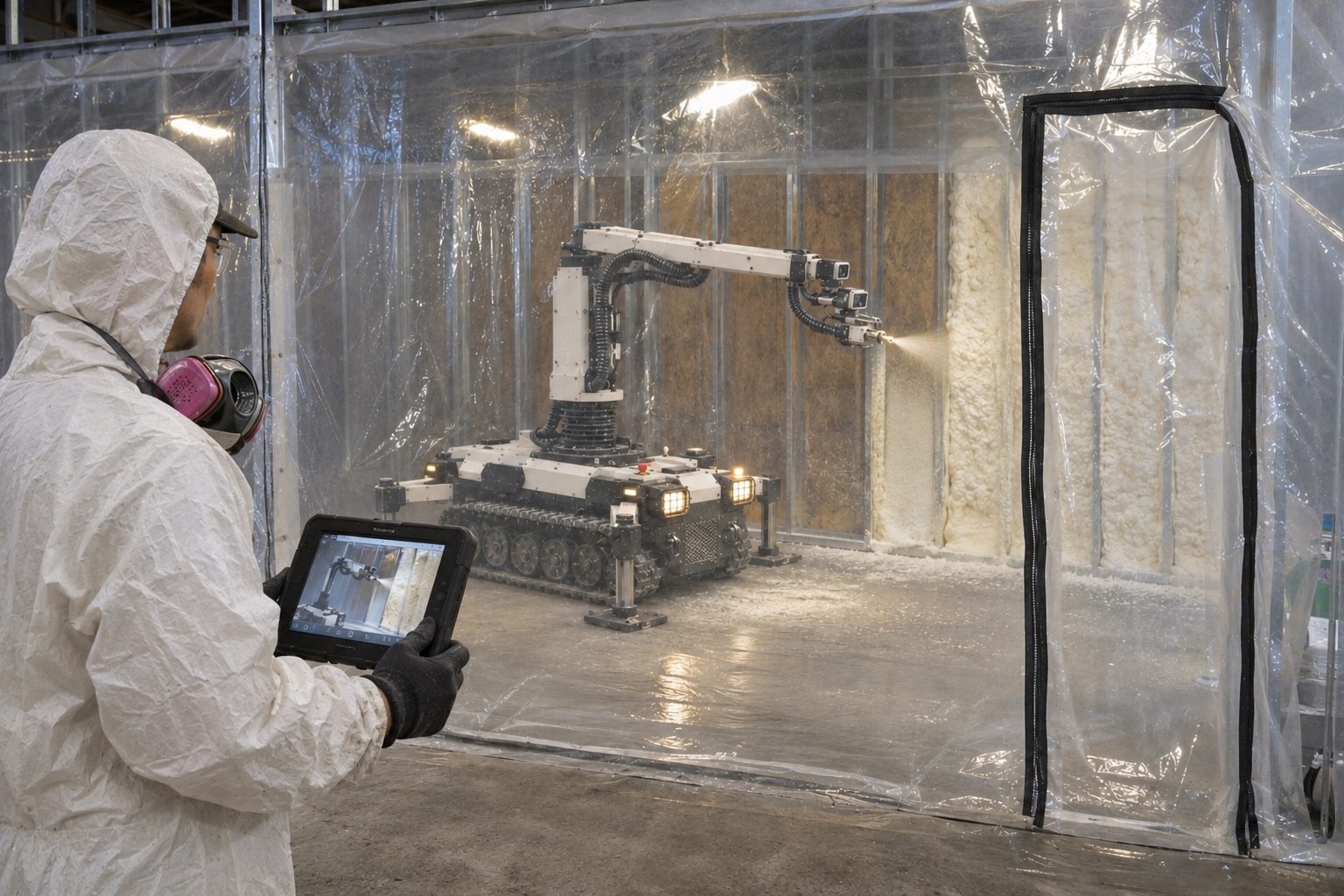
It measures what it sprays.
The tool is designed to scan the surface before and after every pass, so foam depth is measured cell by cell and recorded. The depth map uses 25 mm cells, with a tolerance of ± 6 mm.
A thermal camera on the tool watches the rise and the heat of the foam, and holds the next pass until the cooling wait is met.
- Closed cell. 40 mm a pass is the target. No more than 50 mm in one pass, or 100 mm in successive passes.
- Open cell. At least 25 mm a pass.
- Fan and overlap. A 300 mm spray fan, overlapped by half.
- The record. Pressures, temperatures, ratio and lot numbers are logged every 10 seconds, and the daily work record is written up from the log.
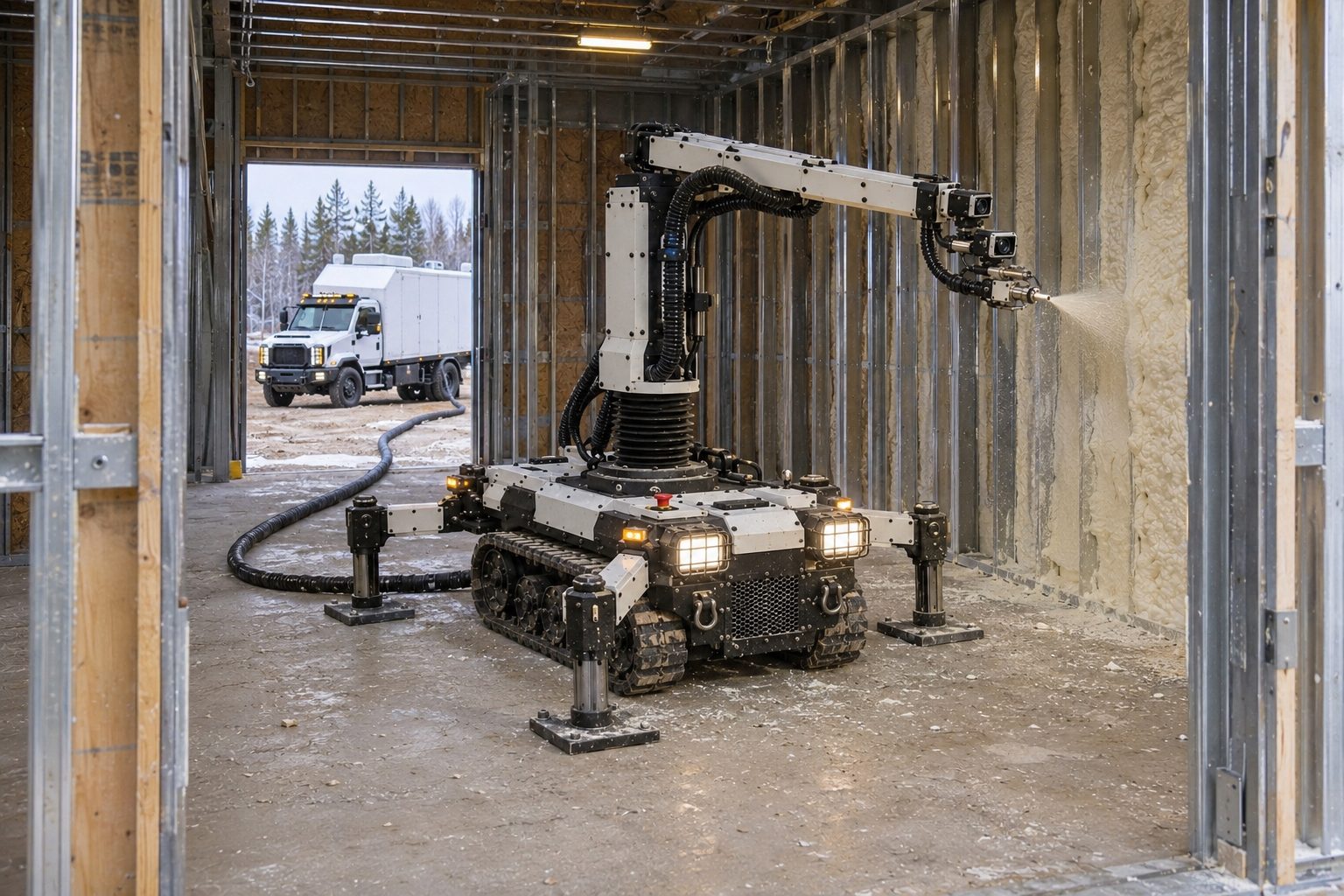
The truck is the rig.
Everything that heats, pumps and stores chemical stays on the truck. Only the hose and the robot go into the zone.
The truck is a Class 6 crew cab with an insulated, heated rig body and three drum sets. The heated hose pays out 61 m to the robot from a powered reel.
- Proportioner. Electric, on the truck, with heat.
- Drums. Two air-driven transfer pumps, with an agitator on the B side. Drums are kept at 15 to 30 °C.
- Breathing air. A filter panel with a CO and oxygen monitor, and two supplied-air hose stations. They are for entry only.
- Zone kit. Poly sheet walls on zip poles, one entry with a curtain sensor, signs at the rope-off line, and two non-sparking fans ducted outdoors.
Spray foam robot, the numbers.
From the spray foam data sheet. Flow, depth and area are what the tool is designed to do. The Tradesman's own figures are on its page.
| Item | Value |
|---|---|
| Gun height | 0.15 to 6 m |
| Gun stand-off from the surface | 450 to 600 mm |
| Width, maximum | 760 mm |
| Stowed height with the boom, maximum | 1,980 mm |
| Heated hose from the truck | 61 m |
| Spray tool mass | 23 kg |
| Wrist payload | 8 kg |
| Foam flow, design case | 10 kg/min |
| Closed cell, thickness per pass | 40 mm target, 50 mm maximum |
| Closed cell, successive passes | 100 mm maximum |
| Open cell, per pass | 25 mm minimum |
| Spray fan width and overlap | 300 mm, 50 % |
| Foam depth map | 25 mm cells, ± 6 mm |
| Area per day at the design depth, calculated | 325.6 m² |
| Substrate temperature, closed cell design case | -10 to 30 °C |
| Robot supply | 3 kW, DC |
| Proportioner supply, on the truck | 208 V three-phase, 59 A, 21.3 kVA |
| Rope-off distance | 8 m indoors, 3 m outdoors |
| Re-entry time after spraying | 24 h |
| Containment | Negative pressure of 5 Pa, exhaust to outdoors |
How it stays safe.
One rule runs the job. Nobody is inside the spray zone while the robot is spraying.
- Bounded zone only. Spraying is designed to run only inside the bounded zone. The gun valve sits on the safety controller's tool permit, not on the planning computer.
- One sensed entry. The containment has one way in, with a curtain sensor on it. Sensing can only remove authority. It never adds any.
- Any stop stops motion. AI plans, rules govern, humans authorize, safety has veto.
- Pads before the boom. The outrigger pads plant the carrier before the boom is raised.
- Going in. Anyone who enters the spray zone wears a positive-pressure supplied-air respirator.
- What it does not do. The robot does not ventilate the building. Exhaust, rope-off and re-entry stay with the installer and the building, and an installer is on the job site.
Where it fits, and where it does not.
The carrier is 760 mm wide, so it goes through a standard door. No base climbs stairs, so floors change by elevator or hoist.
- It fits. Interior walls, ceilings and roof deck undersides up to a gun height of 6 m, in buildings under construction or empty.
- Not for occupied buildings.
- Not for closed-cavity injection, or for one-component cans.
- Not for crawl spaces and attics.
- Not above the gun height without a lift.
The truck carries the rig, the robot carries the gun to the wall, and the installer runs the job from outside the zone. Tell us the building: wall and ceiling areas, heights and the foam you use.