

Through the door. Up the elevator. Under the ceiling.
STE Site Hand Tradesman is the indoor trades size. It is 760 mm wide for doors and 1,300 mm long for passenger elevators, and it plants on four outrigger pads before it reaches. It is the base for the overhead drilling column, the coating boom and the spray foam tool.
Sized for the building, not the other way round.
The Tradesman is designed to pass an 813 mm (32 in) door leaf with 25 mm to spare each side, and to ride a passenger elevator car of 1,400 mm. No base climbs stairs, so floors change by elevator or hoist.
It is for the indoor trades and the truck crew: doors, elevators and vaulted ceilings.
- Standard top. A two-arm torso on a lift mast. The lift is 1,200 mm, taking the shoulders from 900 mm up to 2,100 mm.
- Reach top. A telescoping mast designed to reach a tool height of 6,000 mm (236 in), with the head set 500 mm off the mast.
- Ten configurations. Bare, Standard or Reach, on tracks or wheels, with an optional rear mount. Each stays inside the 670 kg mass limit.
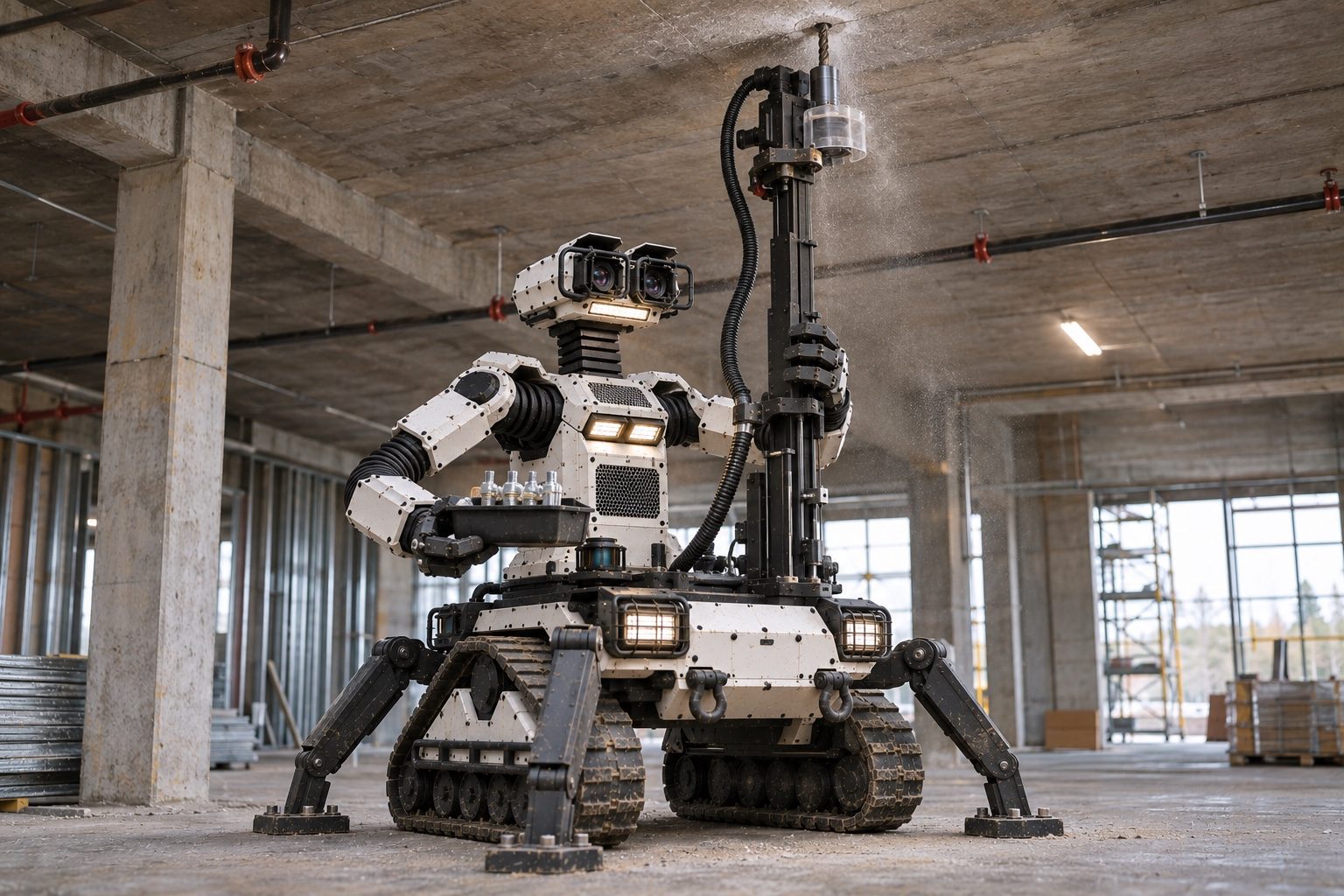
Tradesman, the numbers.
From the Tradesman data sheet. Speeds, grades and stop distance are what the machine is designed to do.
| Item | Value |
|---|---|
| Stowed size, L × W × H | 1,300 × 760 × 1,450 mm (51 × 30 × 57 in) |
| Mass limit, any configuration | 670 kg (1,477 lb) |
| Lift stroke, Standard top | 1,200 mm (47.2 in) |
| Shoulder height, mast down to up | 900 mm (35.4 in) to 2,100 mm (82.7 in) |
| Reach top | Tool height 6,000 mm (236.2 in), head offset 500 mm (19.7 in) |
| Running gear | Track pods. Wheel pods optional. |
| Curb climb, on tracks | 200 mm (7.9 in) |
| Grade on tracks, soft ground | 22.8 % |
| Travel speed on tracks, M2 and M3 | 1.2 m/s (2.7 mph) |
| Base speed in M1, beside a person | Held to 0.3 m/s (0.7 mph) |
| Wheel pods, top speed | Governed to 2.45 m/s (5.5 mph) |
| Truck ramp, dry and firm | 17° (30 %) |
| Scanners and protective field | 2 scanners. Field radius 3.19 m (10.5 ft) on tracks, 3.03 m (9.9 ft) on wheels. |
| Stop distance, on tracks | Designed to stop within 0.84 m (2.8 ft) |
| Outrigger legs | Span 2,400 × 1,800 mm. Feet 340 mm square. Pad pressure 23.3 kPa (3.4 psi). |
| Power | 400 V bus, 3 kW continuous working power |
| Battery | One swappable lithium iron phosphate pack in the base |
| Corded mode | Tether of 30 m (98 ft) |
| Colour | White body with black trim |
Plant the pads, then reach.
The Tradesman has swing-out outrigger legs with a load cell in each pad. The legs are designed to level the base on a slope of up to 10 %, and the base is designed to keep a running stability margin from the pad loads.
The mast is designed to rise only on loaded pads with the base level. The base is designed not to drive with the mast up.
- Soft feet indoors. Swappable plastic feet, 340 mm square, for finished floors.
- Cribbing outdoors. The same pads sit on timber where the ground is soft.
- Arms on wheels. On wheel pods, arm work is designed to happen only on loaded pads.
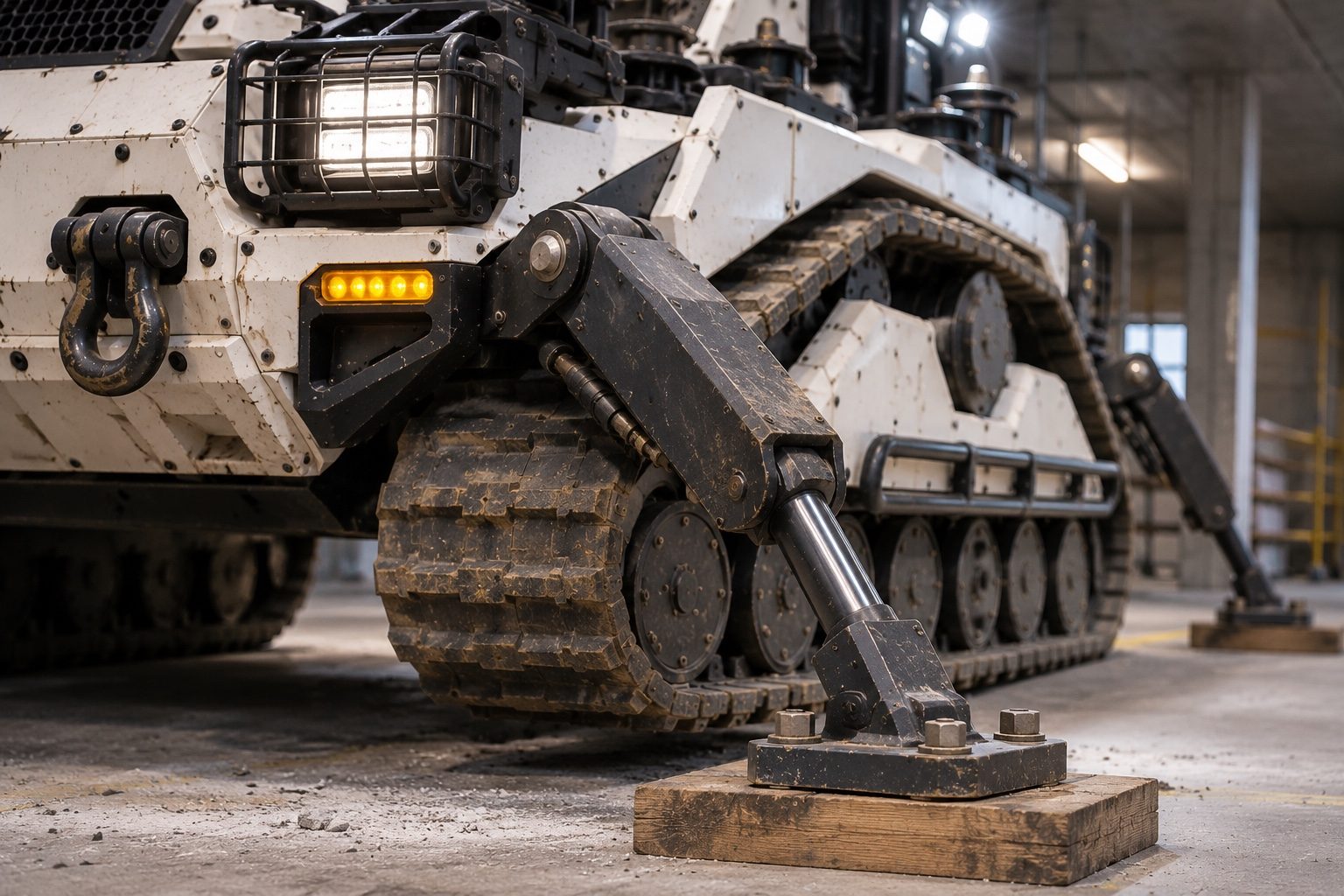
Tracks, or wheels for firm ground.
Track pods are the base fit, with a pivoting pod for curbs. They are for soft, wet or steep ground. Wheel pods are the option for slabs, yards and lanes, where speed matters more than grip.
The wheel pods have two speeds: a low range for torque and a high range governed to 2.45 m/s.
- Rear mount. A rear gimbal mount is a fitted option. Each base ships with the hard points and the wiring for it already in place.
- Battery as ballast. The pack rides low in the base. It swaps out, and it is heated for cold starts.

The tools it carries.
Each one locks onto the same interface and reports what it is.
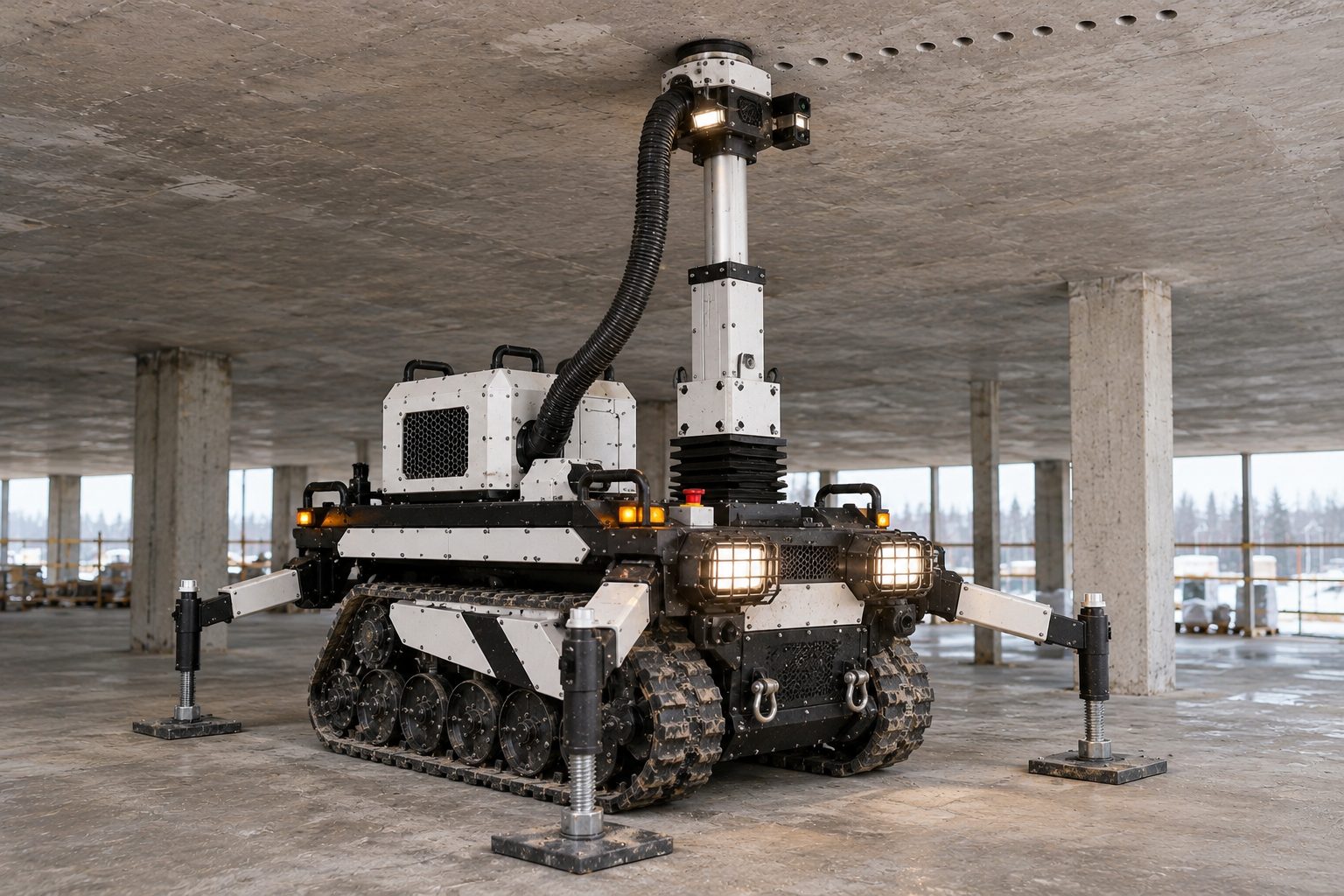
Drilling column
Anchor holes in the soffit, from the drawings, with the dust taken at the bit.
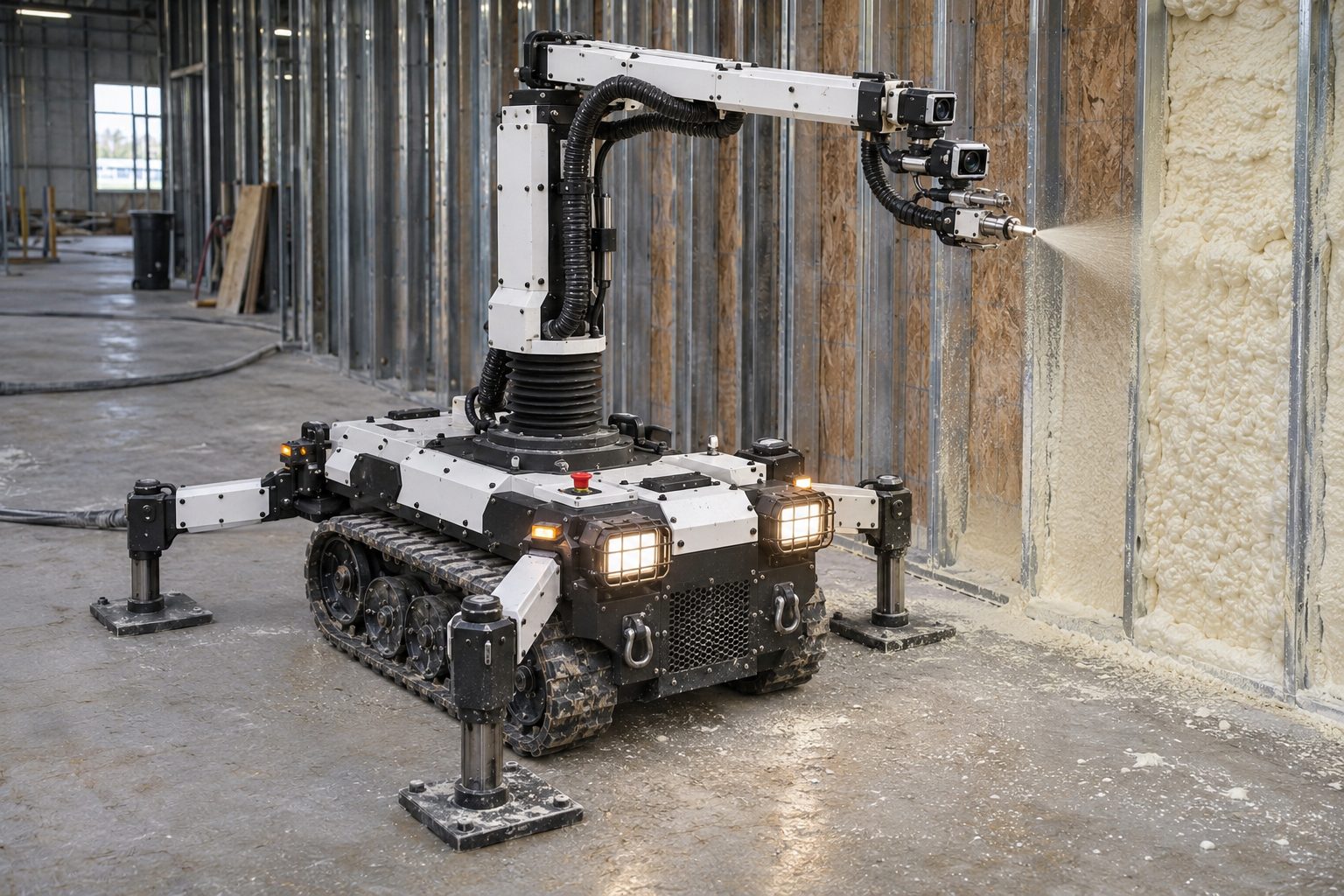
Spray foam tool
Foam sprayed in a contained zone, fed by hose from the truck, while the crew stays outside.
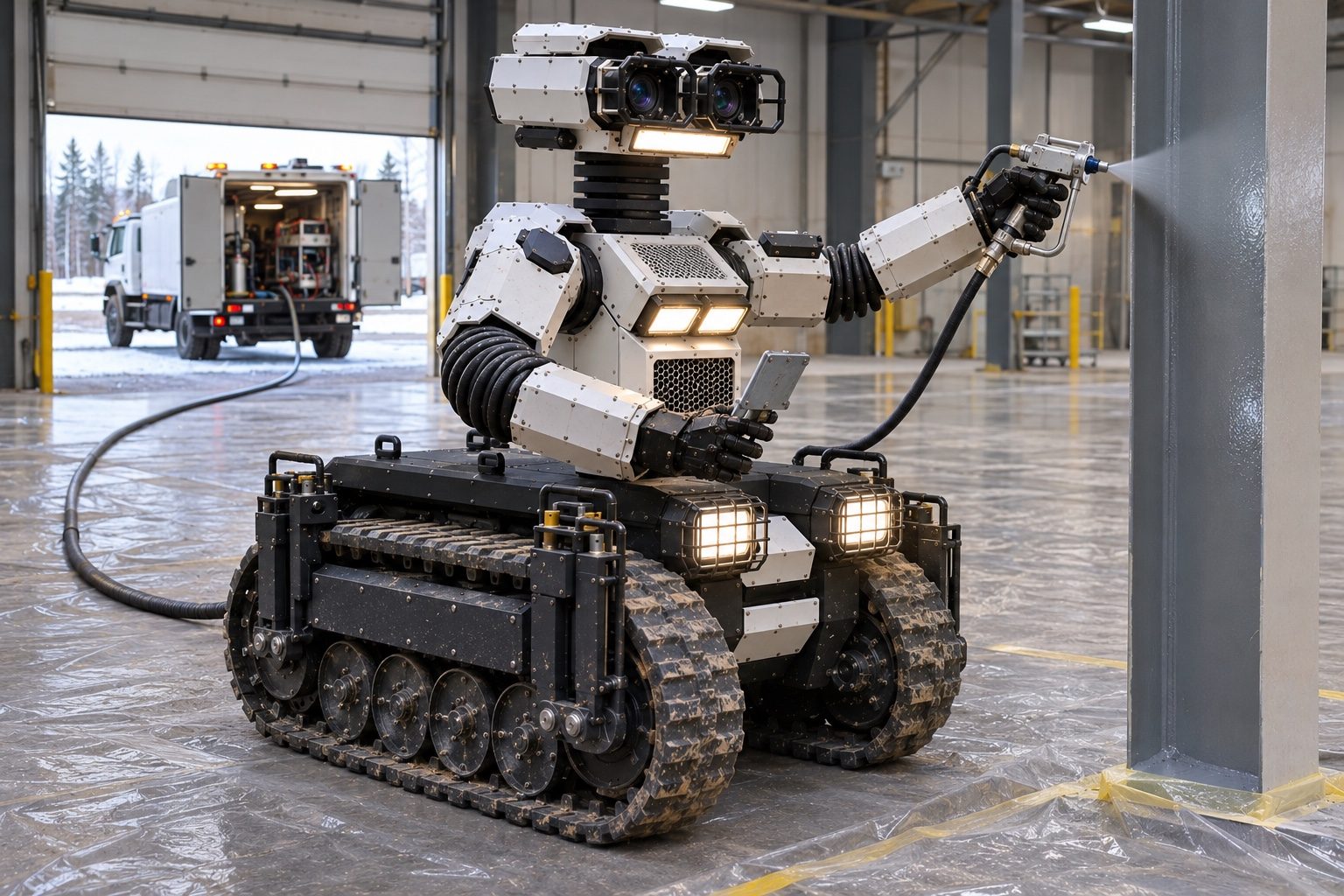
Coating boom
A tilting mast with an arm, a wrist and a coating head, fed from the truck.
The Tradesman is the one for work inside a building. For outdoor ground, tank shells and blasting, look at the Heavy.