
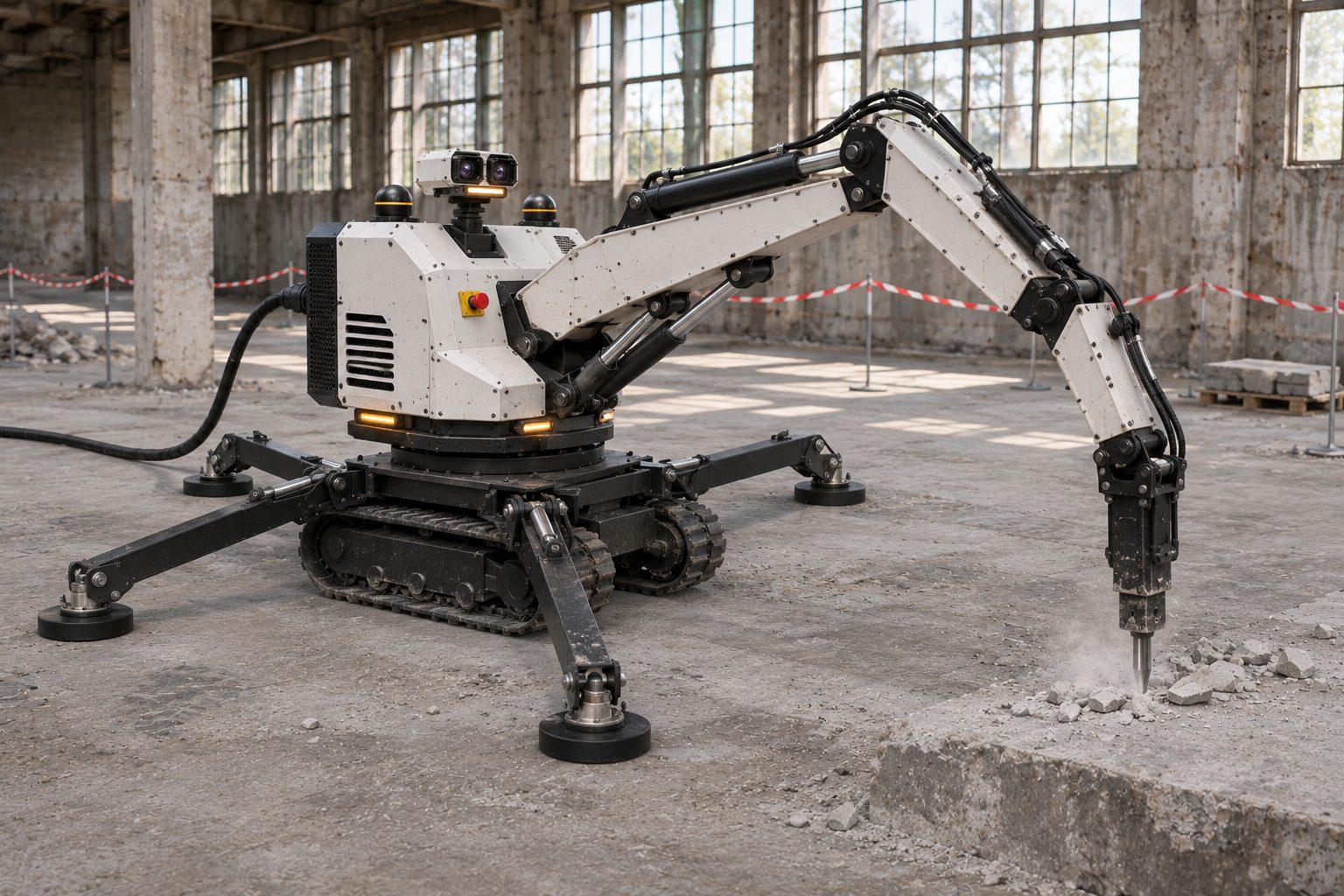
Through the door. Breaks to the plan.
Three tracked electric demolition robots, from 0.8 t to 4.0 t class. Each one runs from site power on a trailing cable and walks cable-free on its own battery. Your crew drives it by radio remote the way they do today, or a supervisor authorizes a plan and the robot breaks it bay by bay inside a barricaded zone that radar watches.
This is Rex.
Rex is our demolition hand. Rex is a tracked electric demolition robot in three sizes, each designed to pass a door. Your crew drives it by radio remote, the way they do today. Or a supervisor authorizes a plan, and Rex is designed to break it bay by bay inside a barricaded zone that radar watches. Either way, your people stand back from the breaking.
Breaking concrete from a distance.
Breaking concrete indoors is hard, dusty work. Crews already do it from a distance, standing back with a remote. These robots keep that control and add a second way to work.
Each one is a tracked carrier with four outriggers, an upper that slews all the way round, and a three-section arm with a tilt joint and a breaker at the tip. Power comes down a trailing cable from the site supply. A 51.2 V walk pack moves the robot between set-ups with the cable off.
The people run the work. The machine takes the hours.
- Who it is for. Demolition and renovation contractors, and plants that reline kilns, furnaces and foundry vessels.
- Where it works. Inside buildings and plants, on floors that carry it, behind a barricade.
- What it runs on. Site three-phase power. No engine, no exhaust in the room.
- Who is in charge. The crew, in every mode. A person at the zone outranks every remote station and every computer.
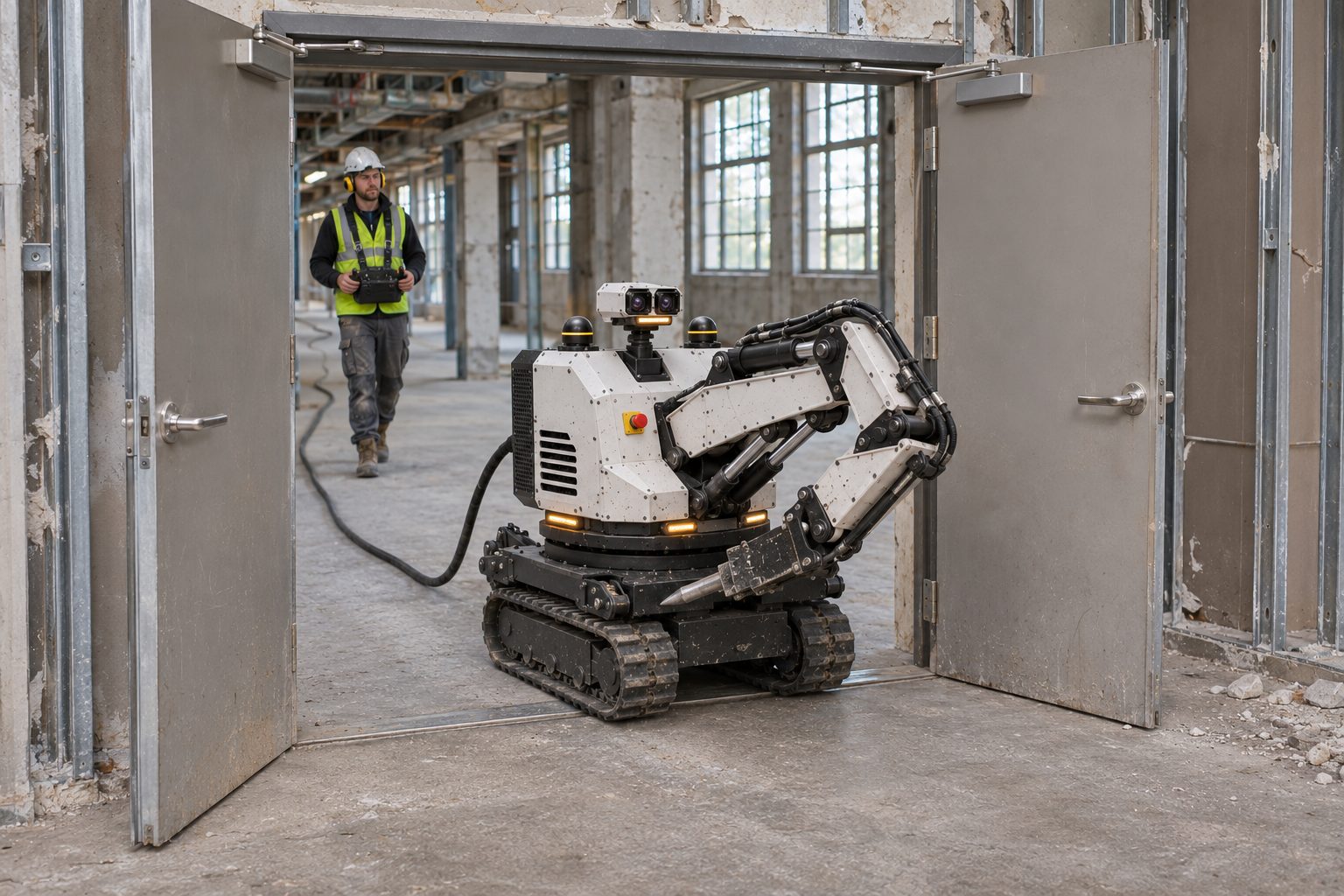
Watch Rex work.
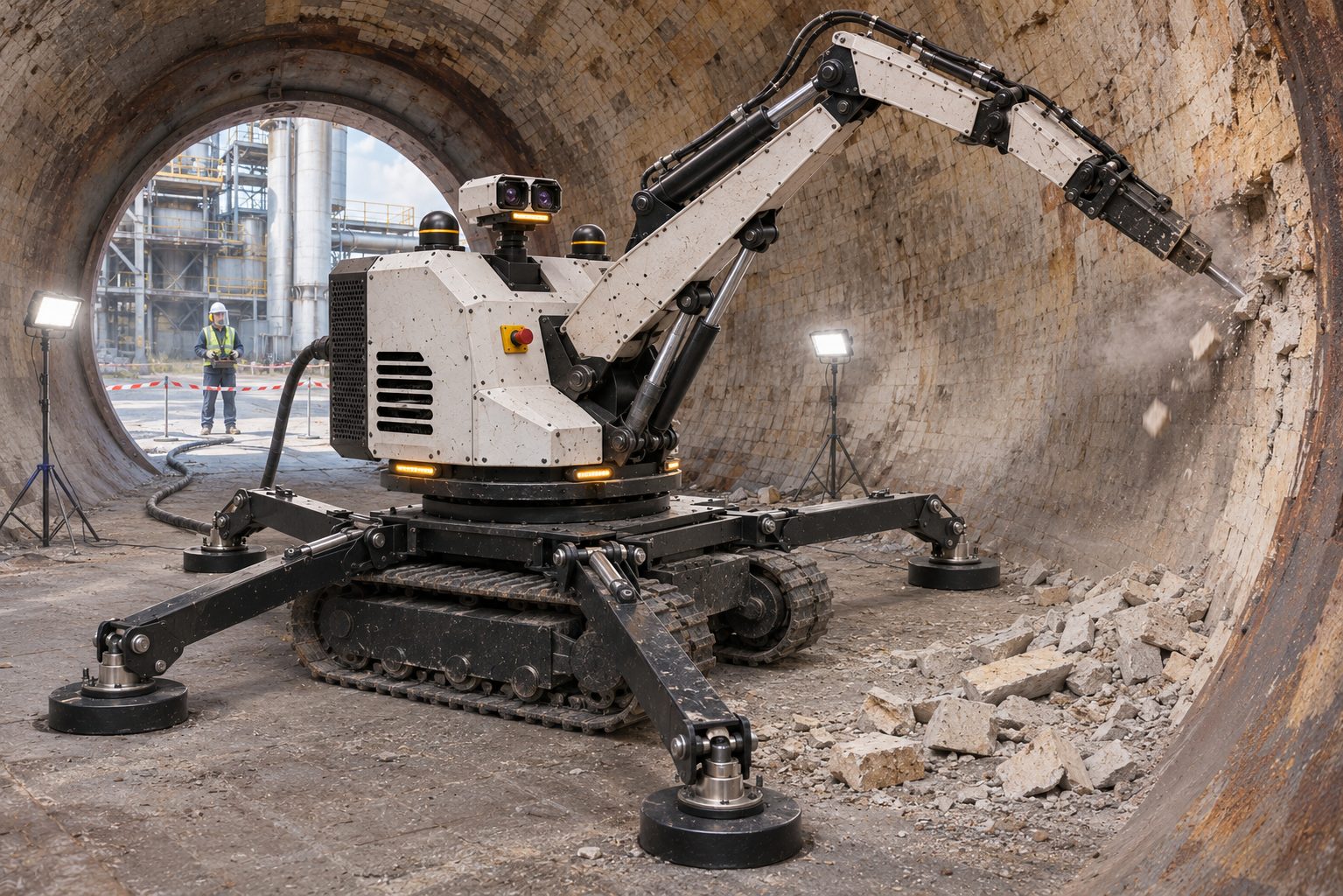
Rex driving in through a standard doorway, then breaking out a kiln lining with the operator well back.
Three sizes, one platform.
Pick the size by the door it has to pass and the work on the other side. Every model shares the machine controller, the safety controller, the autonomy computer, the sensor set, the radio remote, the walk pack and the tool coupler family.
D08 Compact
The narrowest of the three, 700 mm wide. For interior strip-out and renovation in occupied buildings, and for kiln and refractory relining through the tightest access. Reach 3.70 m, rated tool 100 kg.
D16 Core
The middle of the line, 780 mm wide. For refractory and foundry relining, plant and process demolition, and interior demolition on floors that carry it. Reach 4.80 m, rated tool 250 kg.
D40 Heavy
For heavy breaking: foundations, machine bases, thick walls and slabs on grade, where mass and reach matter. It comes in by a roll-up door and a ramp or crane, not a freight lift. Reach 6.45 m, rated tool 550 kg.
The three models, side by side.
Dimensions, reach and tool ratings from the data sheets. Masses, loads and zone radii are calculated values. Measure the clear opening and the door head on site before you choose.
| Model | D08 Compact | D16 Core | D40 Heavy |
|---|---|---|---|
| Machine class | 0.8 t | 1.6 t | 4.0 t |
| Width, tracks and outriggers in | 700 mm (27.6 in) | 780 mm (30.7 in) | 1,200 mm (47.2 in) |
| Travel pose, height by length | 1.15 m by 1.38 m | 1.34 m by 1.83 m | 1.79 m by 2.47 m |
| Door it is designed to pass | 32 in (813 mm) door leaf, 737 mm clear | 36 in (914 mm) commercial door leaf, 838 mm clear | 1.30 m clear opening, double door or roll-up |
| Horizontal reach, tool tip | 3.70 m (12 ft 2 in) | 4.80 m (15 ft 9 in) | 6.45 m (21 ft 2 in) |
| Tip height, maximum | 4.20 m (13 ft 9 in) | 5.38 m (17 ft 8 in) | 7.21 m (23 ft 8 in) |
| Depth below the tracks | 1.76 m (5 ft 9 in) | 2.27 m (7 ft 5 in) | 3.06 m (10 ft) |
| Rated tool mass | 100 kg (220 lb) | 250 kg (551 lb) | 550 kg (1,213 lb) |
| Machine mass, no tool, calculated | 808 kg (1,781 lb) | 1,747 kg (3,851 lb) | 4,055 kg (8,940 lb) |
| Supply, three-phase | 208, 480 or 600 V | 480 or 600 V | 480 or 600 V |
| Trailing cable | 50 m, cable reel optional | 50 m, cable reel optional | 75 m, cable reel standard |
| Main motor | 7.5 kW (10 hp) | 15.0 kW (20 hp) | 30.0 kW (40 hp) |
| Walk pack | 51.2 V, 2.56 kWh | 51.2 V, 2.56 kWh | 51.2 V, 2.56 kWh |
| Cable-free walk, calculated | 150 m | 150 m | 150 m |
| Travel speed, calculated | 2.5 km/h | 2.5 km/h | 3.0 km/h |
| Pad load, maximum, calculated | 7.7 kN (1,731 lbf) | 17.4 kN (3,912 lbf) | 39.2 kN (8,813 lbf) |
| Work zone radius, supervised autonomy, calculated | 10.5 m (34 ft 5 in) | 11.6 m (38 ft 1 in) | 13.3 m (43 ft 8 in) |
| Work zone radius, remote modes, calculated | 12.2 m (40 ft) | 13.6 m (44 ft 7 in) | 15.5 m (50 ft 10 in) |
Getting it to the work.
The arm folds into a Z for travel, inside its joint limits, and the robot walks in on its own tracks.
- Doors. The D08 is designed to pass a 32 in door leaf and the D16 a 36 in commercial door leaf. Both are designed to pass a standard 2.03 m (6 ft 8 in) door head. The D40 needs a 1.30 m clear opening and a 2.44 m (8 ft) roll-up door.
- Lifts. By calculated mass, the D08 is sized for a passenger lift or a freight lift and the D16 for a freight lift. The D40 is too heavy for typical freight lifts. The lift rating is the building owner's to give.
- Floors. The robot sets up and levels itself on four independent outrigger legs, then reports pad loads and track pressure for the site engineer's floor check. The floor is the site engineer's to judge. Mats are sized on site from the pad load.
- Tracks only. Working on the tracks with the outriggers up is designed to be allowed only inside a reduced reach. The controller enforces it from live joint angles, slew angle and pad loads, in every mode, radio remote included.
- Power. Plug the trailing cable into the site's three-phase supply. For a move, the walk pack takes over, and it is there to power a controlled stop if the mains fail.
Four ways to run one.
Radio remote comes first. It works with the autonomy computer switched off, so the crew keeps the control it has today.
Radio remote
The crew drives it, line of sight, choosing every bite. The autonomy computer can be off.
Assisted remote
The operator still drives. The controller adds set-up, levelling, the stability envelope and the arm limits.
Tele-operation
An option. An authorized operator drives from a station on the site network, with an enable switch and an E-stop. It is designed to stop if the link is lost.
Supervised autonomy
The supervisor authorizes one plan at a time. The robot is designed to break bay by bay and pause at each bay for the supervisor's go.
Supervised autonomy, step by step.
In supervised autonomy the robot does the repetitive part and a person makes the calls. Nothing moves before the supervisor authorizes the plan.
A scan maps the face. It does not judge what a structure can lose. That judgement stays with people who know buildings.
Tele-operation and supervised autonomy run only inside a barricaded, signed work zone that safety-rated imaging radar watches. Nobody is inside the zone while the robot works on its own, and the crew outside carries the wireless stop.
- Scan. The robot maps the work face with lidar and cameras.
- Mark. The supervisor marks what comes down and the no-go volumes.
- Plan. The planner proposes a breaking sequence inside those marks.
- Authorize. The supervisor authorizes that one plan.
- Set up. The robot sets its outriggers, levels and reports its pad loads.
- Break. It breaks one bay, inside the zone and inside its rules.
- Review. It pauses at every bay. The supervisor stops it or gives the go for the next one.
Who holds authority.
AI plans. Rules govern. Humans authorize. Safety has veto. A higher rung overrides a lower one, and sensing can only remove authority: it can stop, hold or slow the robot, and it never grants motion.
- 1. Hard stops. The E-stops, the wireless stop and a separate safety controller. They stop everything, in every mode.
- 2. The person at the zone. The wireless stop and the radio remote. They stop or drive, with a veto over every remote station.
- 3. The authorized remote station. The tele-operator, or the supervisor who authorizes one plan at a time.
- 4. The rule-based controller. It allows motion only inside the envelopes, limits and set-up rules.
- 5. The planner. It scans and proposes a sequence. It never owns a stop.
- Wireless stop. The crew holds the stop. The lanyard is designed to stop the robot in every mode without the remote or the network. Losing its heartbeat is a stop.
- Zone radar. Radar, because dust blinds optics. The robot is designed to stop on any intrusion the radar detects.
- Lost link. Losing the radio or network heartbeat for longer than 200 ms is designed to be a stop.
- Outside its rules. The robot is designed to lower and clear the tool, fold to the travel pose, stop and hold, unload the hydraulics, show stopped on its beacon and call a person.
What comes with it.
The same equipment on all three sizes.
- On every robot. Radio remote, wireless stop lanyard, Eddie Brain autonomy computer, zone radar set, walk pack, outrigger pad load cells and work lights.
- Options. A tele-operation station. A cable reel on the D08 and D16, standard on the D40. A dust-control water spray at the breaker.
- Kits. Tool quick-coupler set, pin and bush service kit, work zone kit, label set and transport kit.
- The books. A twelve-volume documentation set, with the operator's, maintenance, repair and parts manuals among them.
- One livery. White hoods, covers and arm, black base, frame and tracks. Red only on the emergency stop.
Three electric demolition robots that fit the door, run from site power and keep the radio remote. When the supervisor authorizes a plan, the robot is designed to break it bay by bay behind a barricade, pausing at every bay. Any stop stops motion.