
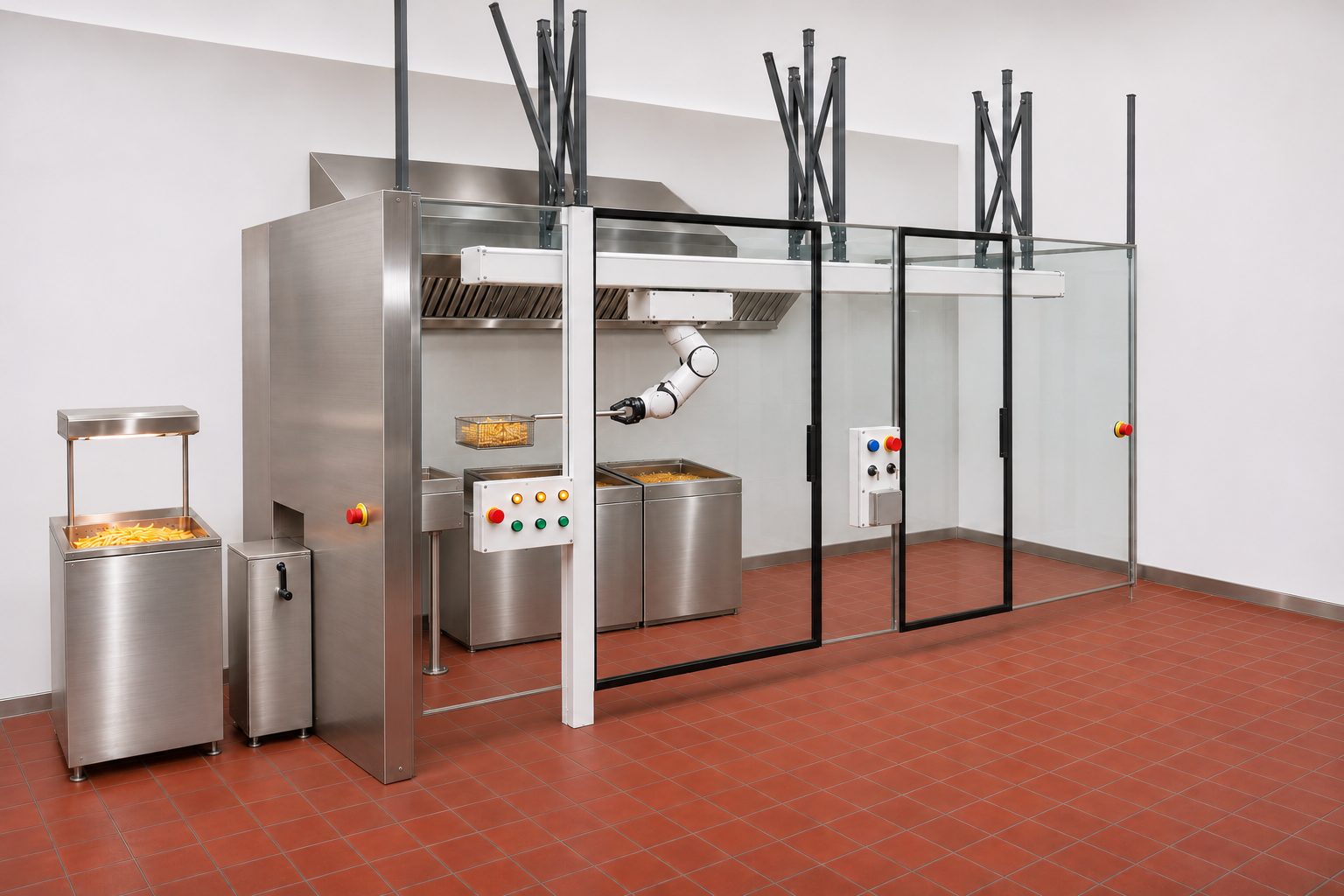
A helping hand for the kitchen you already run.
STE Kitchen Hand is designed to bring AI into a commercial kitchen as it runs today: first one order queue for the crew, then a guarded rail robot at the store's own fryers.
This is Maddi.
Maddi is our kitchen hand. Maddi is designed to work the fry station, starting with fries. When the orders stack up, somebody still has to drop, shake and dump baskets, shift after shift, over hot oil. Maddi is designed to take that job from the same order queue the crew works from. The crew builds the food and looks after the customer.
A retrofit, not a new restaurant.
Kitchen Hand is designed to go into the store you have. It is designed to work your own fryers and drinks tower through their own controls. The site survey confirms what your station needs, and that your kitchen has the room for the guarded cell.
The crew keeps the jobs people do best: building the food and serving customers.
- Your store. An existing commercial kitchen, fitted where it stands.
- Your equipment. The store's own fryers and drinks tower.
- Your crew. People build the food and look after the customer.
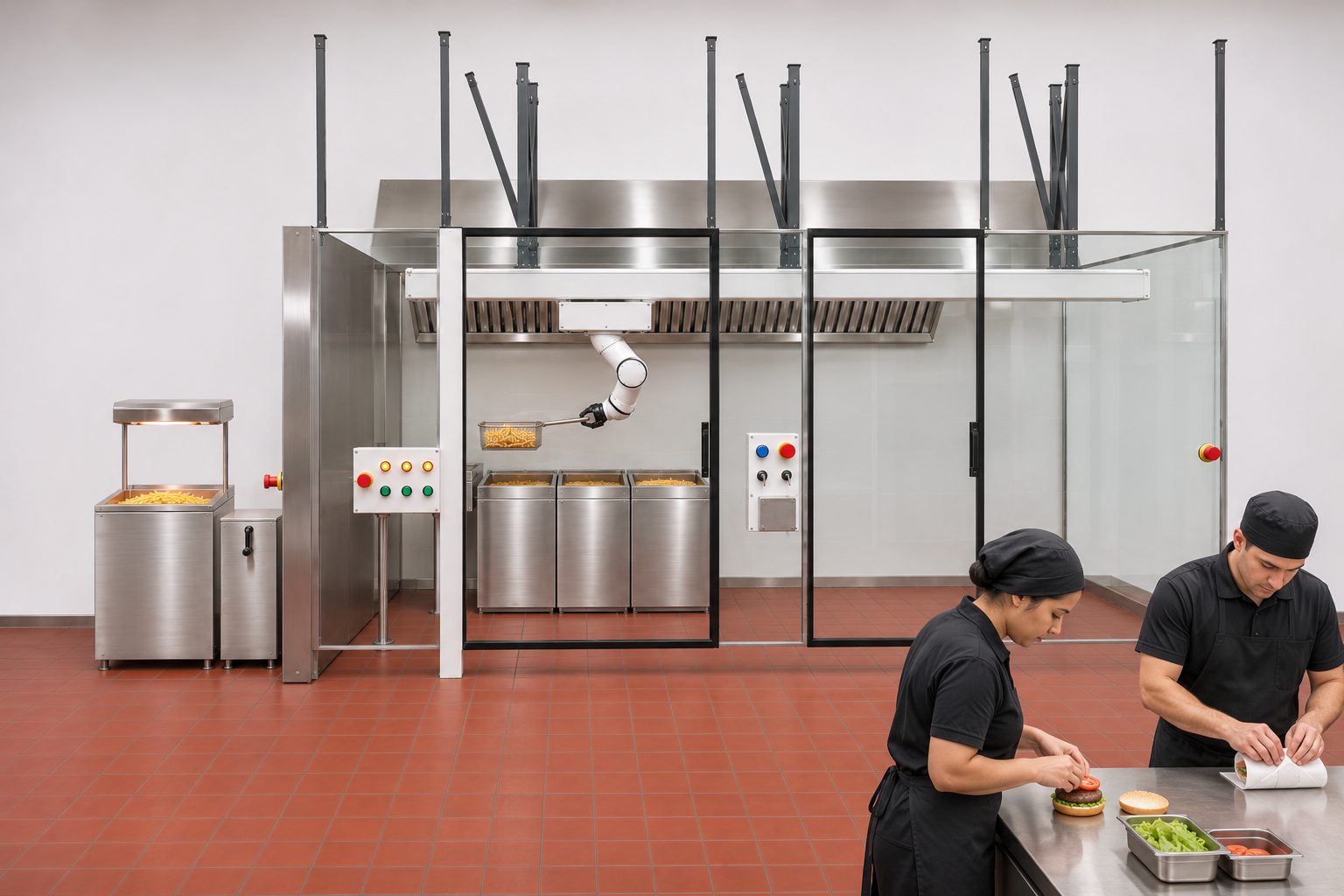
Watch Maddi work.
Maddi at the fry station, and the crew at the counter.
AI first, then the robot.
The order feed is designed to drive one queue for the whole store. Each stage hands more of that same queue to the robot, and each stage has to pay on its own.
AI only
Designed to read your POS order feed, where your vendor allows it, forecast the next few minutes of demand, and tell the crew what to drop and when. It is designed to time the hold bins and keep a record of hold times and of temperatures your crew or an approved probe has measured. No robot and no rail at this stage.
Fry station
Maddi is designed to work the fry station, starting with fries: one carrier with one arm at the existing fryers, taking its jobs from the same queue.
Drinks
Designed to extend the rail over the drinks tower, with separate clean tooling for cups.
Wider line
Grill and other stations are added only where the fry station and drinks have earned it in your store. Building the food and customer service stay with people.
The rail design starts from Shop Hand Rail.
The carrier is based on Shop Hand Rail and re-engineered to hang. The way it runs a machine on the machine's own controls is designed to come from Plant Hand.
- Carrier. Designed with a rack and pinion drive and positive capture on the rail.
- Power. Designed with wired power and safety signals through an enclosed cable run. No battery rides over the cook line.
- Guarding. The fry station is designed as a guarded cell. Open any guard door and the robot is designed to stop.
- Kitchen fit. Designed with sealed, wipe-clean covers and an enclosed rail, to keep anything above the oil from shedding into it.
- Where it runs. Designed to hang from verified building structure, or fix to a suitable wall, outside the hood and fire-suppression zone. Never on the hood. No floor track.
The crew stays in charge.
The STE rule holds in a kitchen as it does in a yard: AI plans, rules govern, humans authorize, safety has veto.
- The queue advises. A forecast can be wrong. The crew decides what to cook, and the robot is designed to work only the vats the crew has enabled. The queue is designed so it cannot move the robot or change a cook time.
- A stop is a stop. In the safety system, sensing is designed only to slow, hold or stop the robot, never to override a stop.
- Agreed before the rail goes up. The health authority, the fire authority for the hood and suppression, the building owner for the hanging loads, the franchisor where there is one, electrical and building permits, and an engineer's sign-off.
Every store is different, so every Kitchen Hand starts with a site survey: structure, rail height, power, line layout and the POS link. Rail length and height are set from that survey.