
The job is cleared before the machine is.
The Site Foreman is the job-preparation software every Steady Eddie job runs through. One job, one site, up to twelve Eddie units, each on its own machine. A supervisor defines the work, states the ground, clears the job, proves the plan and keeps the record, through six gates. Until every gate is closed, nobody can ask for Eddie.
Before Eddie, not beside it.
The Foreman is the console a supervisor works through in the hour before a machine is armed, and the one the foreman closes out at the end of the shift. It runs in a browser on an ordinary computer in the site office or the truck.
It never touches the machine, it holds no session with Eddie, and it cannot start anything. The furthest it can take a job is clear to request. From there a named person asks another person for the machine, and that request happens between people. Prepared, installed and authorized are three different states, and the Foreman keeps them apart.
- Twelve units
- On one job, one site, each Eddie on its own machine with its own skill set and its own pre-start.
- Five steps
- Define, ground, clearance, prove, record. In that order, every job.
- Six gates
- Each one closes on something a named person wrote down today.
- One record
- Every act, in order, chained to the one before it. Nothing is deleted.
Define. Ground. Clearance. Prove. Record.
The Foreman walks a job in the order a good supervisor already does, and it will not let a step be skipped.
Define
The scope of work, the units on the job, and the skill set each one is being hired for.
Ground
The site and its data, the map, the layout, and the haul route. The ground can only take permission away.
Clearance
The locate ticket before the ground is broken, and the pre-start on every machine and the whole job.
Prove
The plan drawn so a person can approve it, and the six gates that say where the job stands.
Record
The daily report and the records keeper. The account of the shift, and a record that cannot be quietly changed.
Twelve screens, one job.
Each screen has one job and says, in its own words, what it can and cannot do. Every one of them is in the demo.
Job
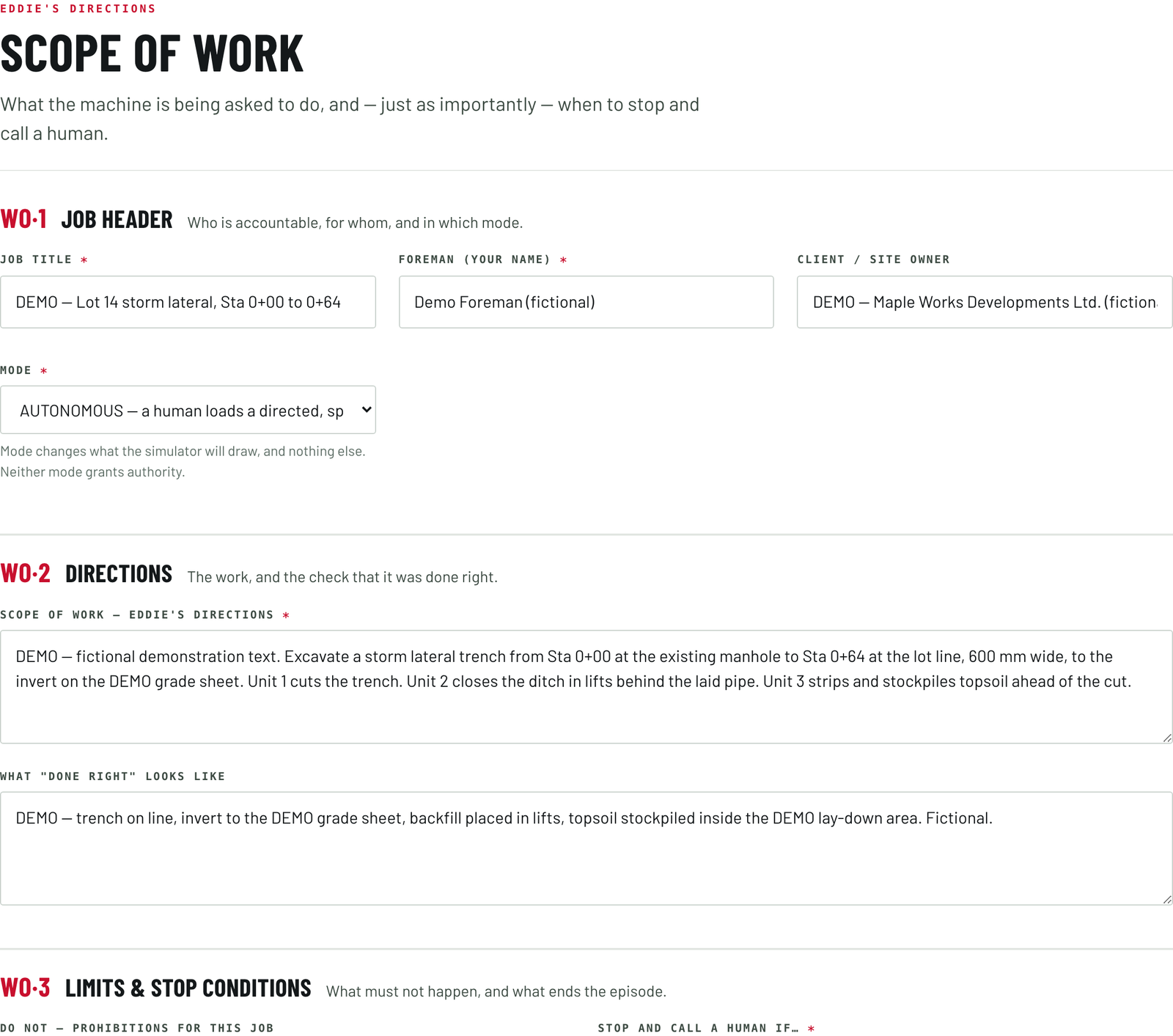
The scope of work: what the machine is being asked to do, and, just as importantly, when to stop and call a human.
Fleet
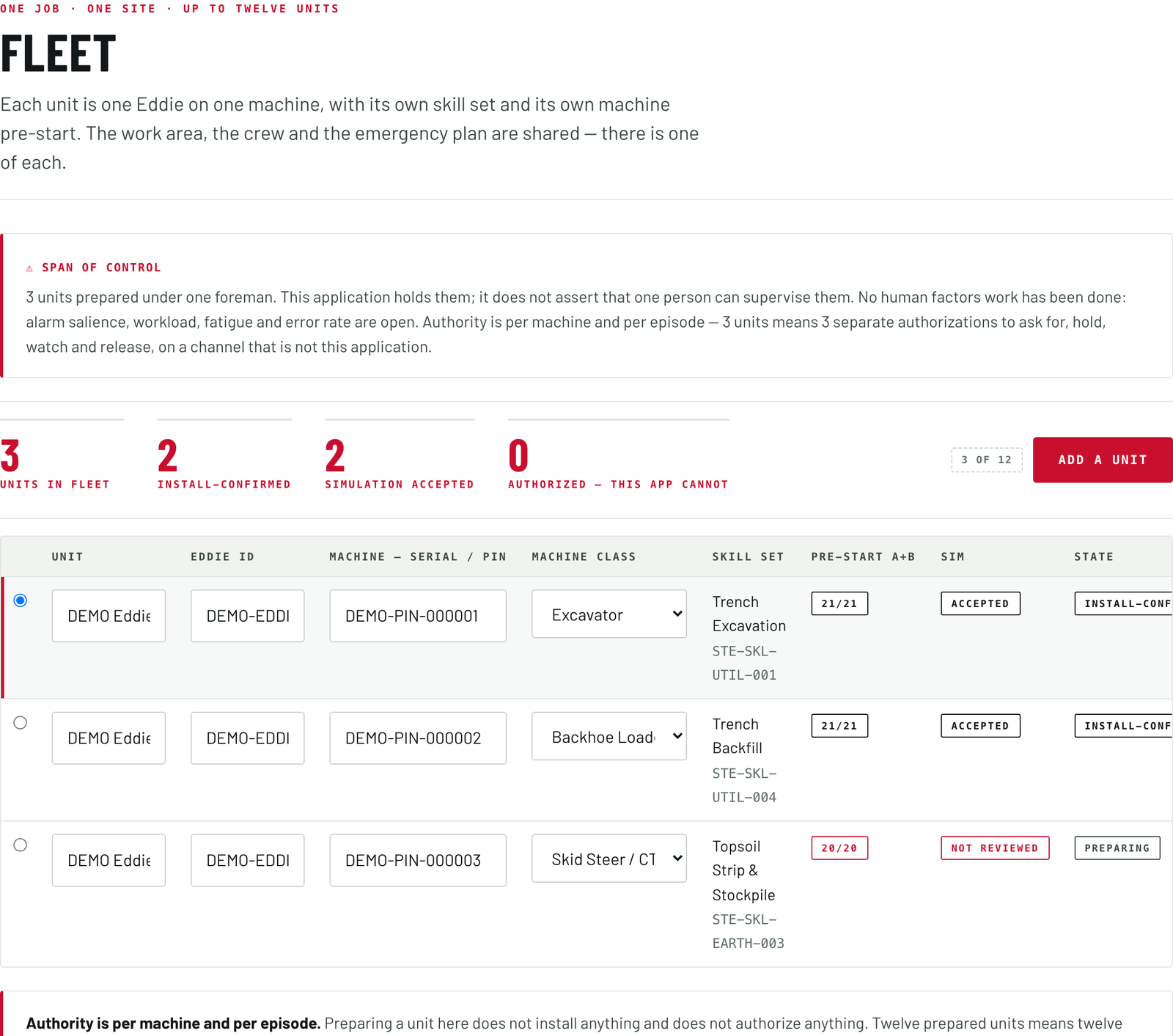
One job, one site, up to twelve units. Each unit is one Eddie on one machine, with its own skill set and its own pre-start. The work area, the crew and the emergency plan are shared.
Skill set
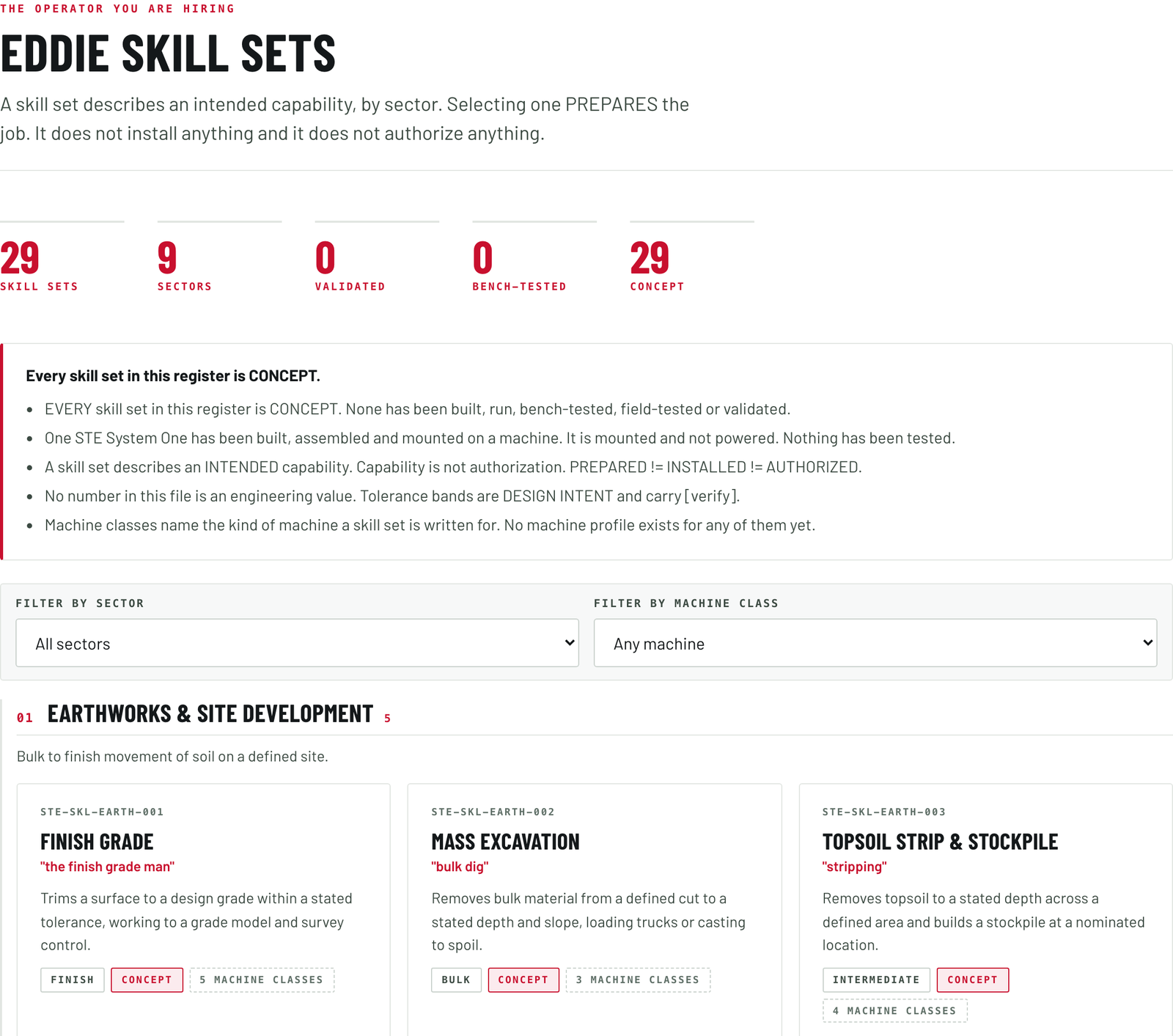
The operator you are hiring, by sector: earthworks, trenching and utilities, roads, aggregate and quarry, agriculture, forestry and land clearing, snow and grounds, waste and recycling, yard and material handling. Selecting one prepares the job. It installs nothing and authorizes nothing.
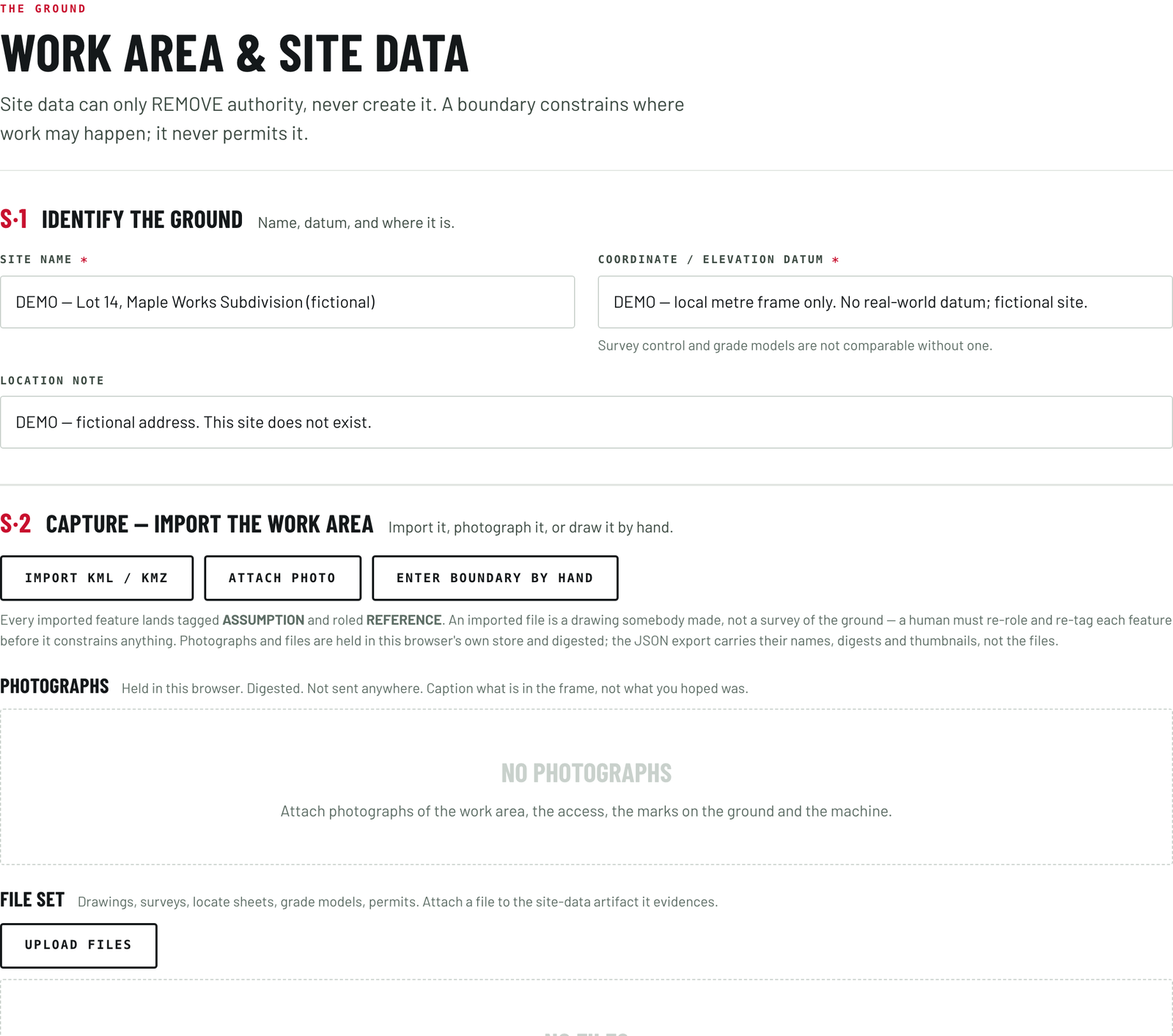
Site
Work area and site data. Site data can only remove authority, never create it. A boundary constrains where work may happen. It never permits it.
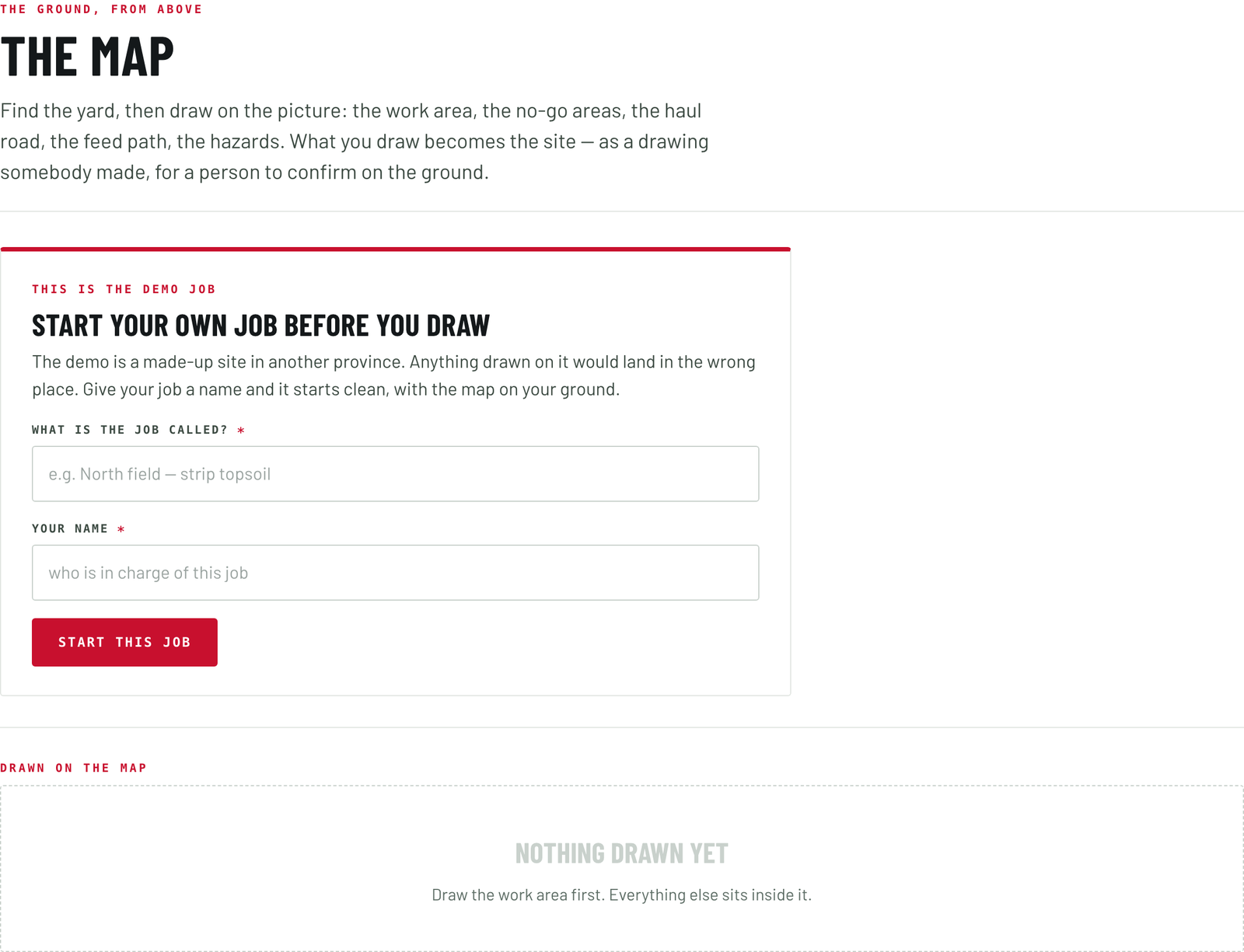
Map
The ground, from above. Find the yard, then draw on the picture: the work area, the no-go areas, the haul road, the feed path, the hazards. What you draw becomes the site, as a drawing somebody made, for a person to confirm on the ground.
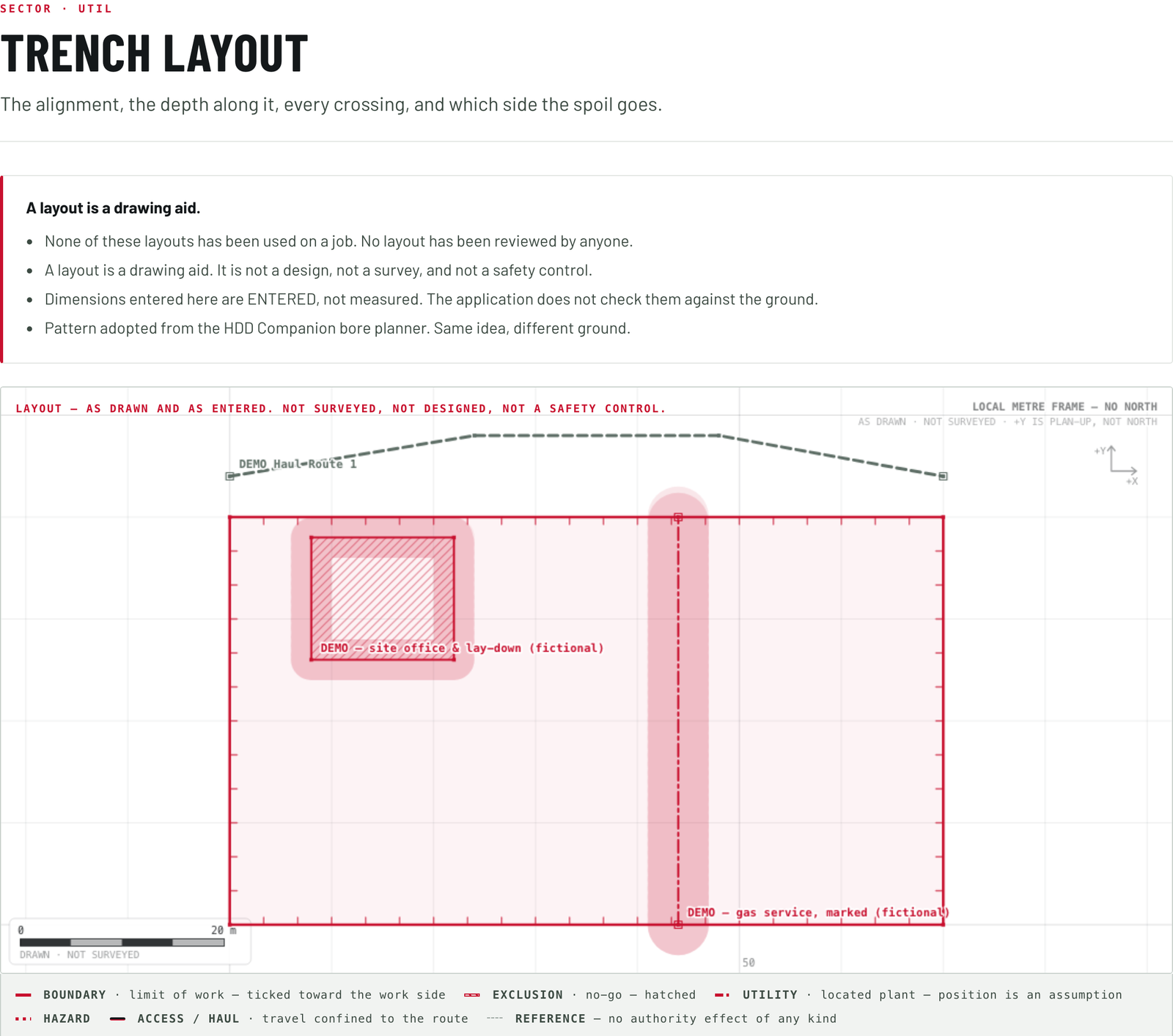
Layout
The layout the sector calls for. For utility work: the alignment, the depth along it, every crossing, and which side the spoil goes.
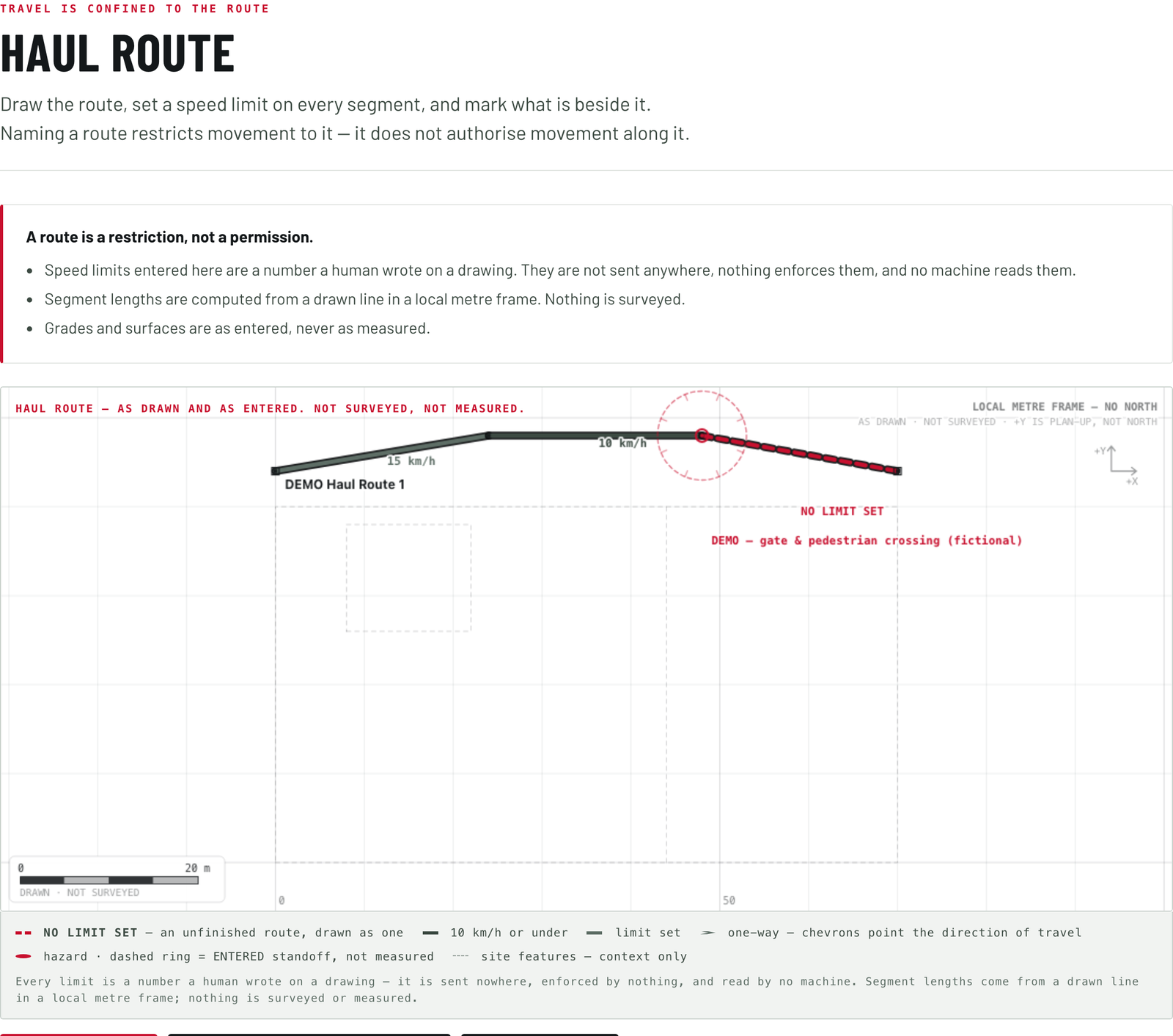
Haul route
Travel is confined to the route. Draw it, set a speed limit on every segment, and mark what is beside it. Naming a route restricts movement to it. It does not authorize movement along it.
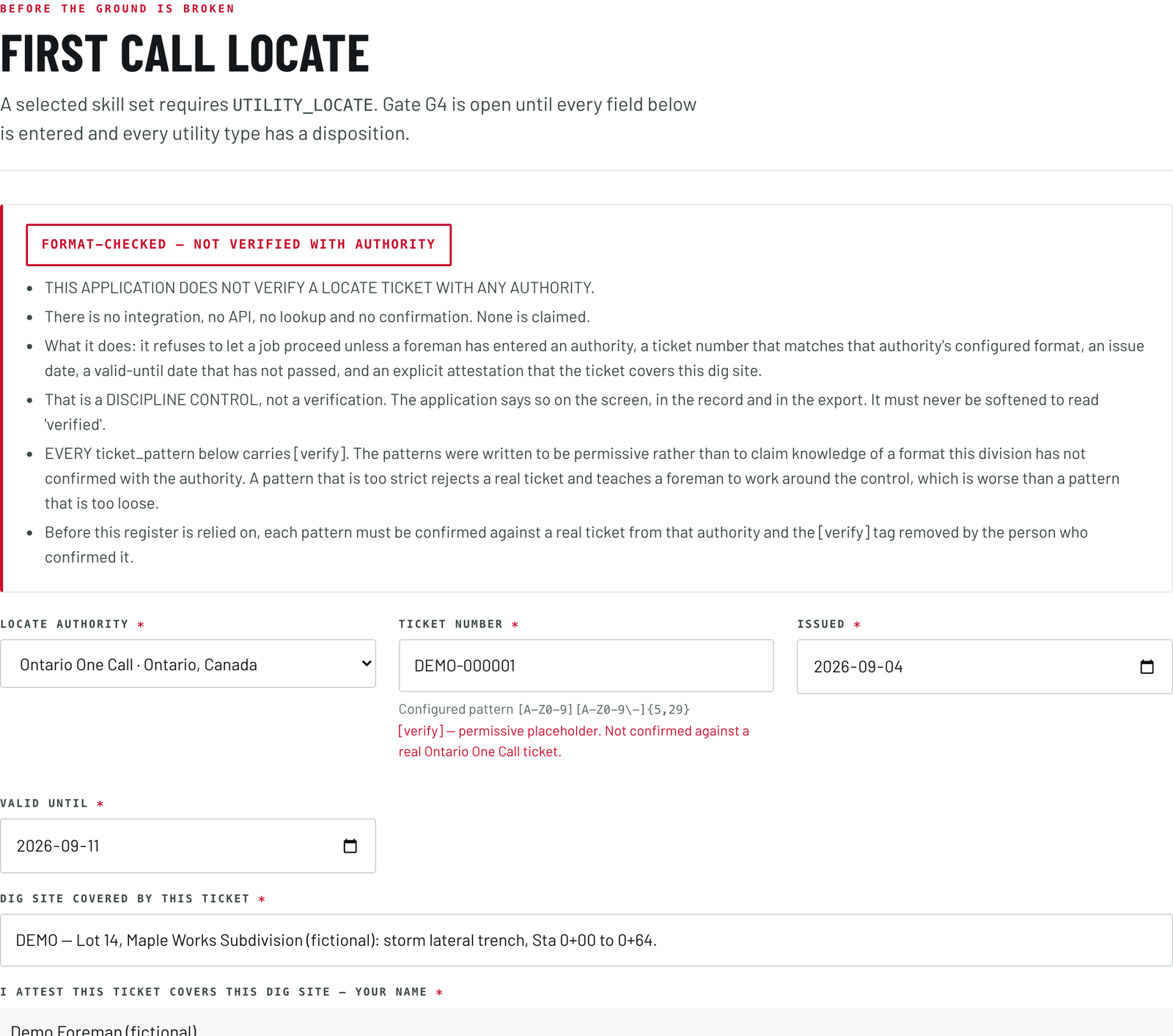
First call
Before the ground is broken. The locate ticket entered, in date, and a disposition for every utility type. The gate stays open until every field is filled.
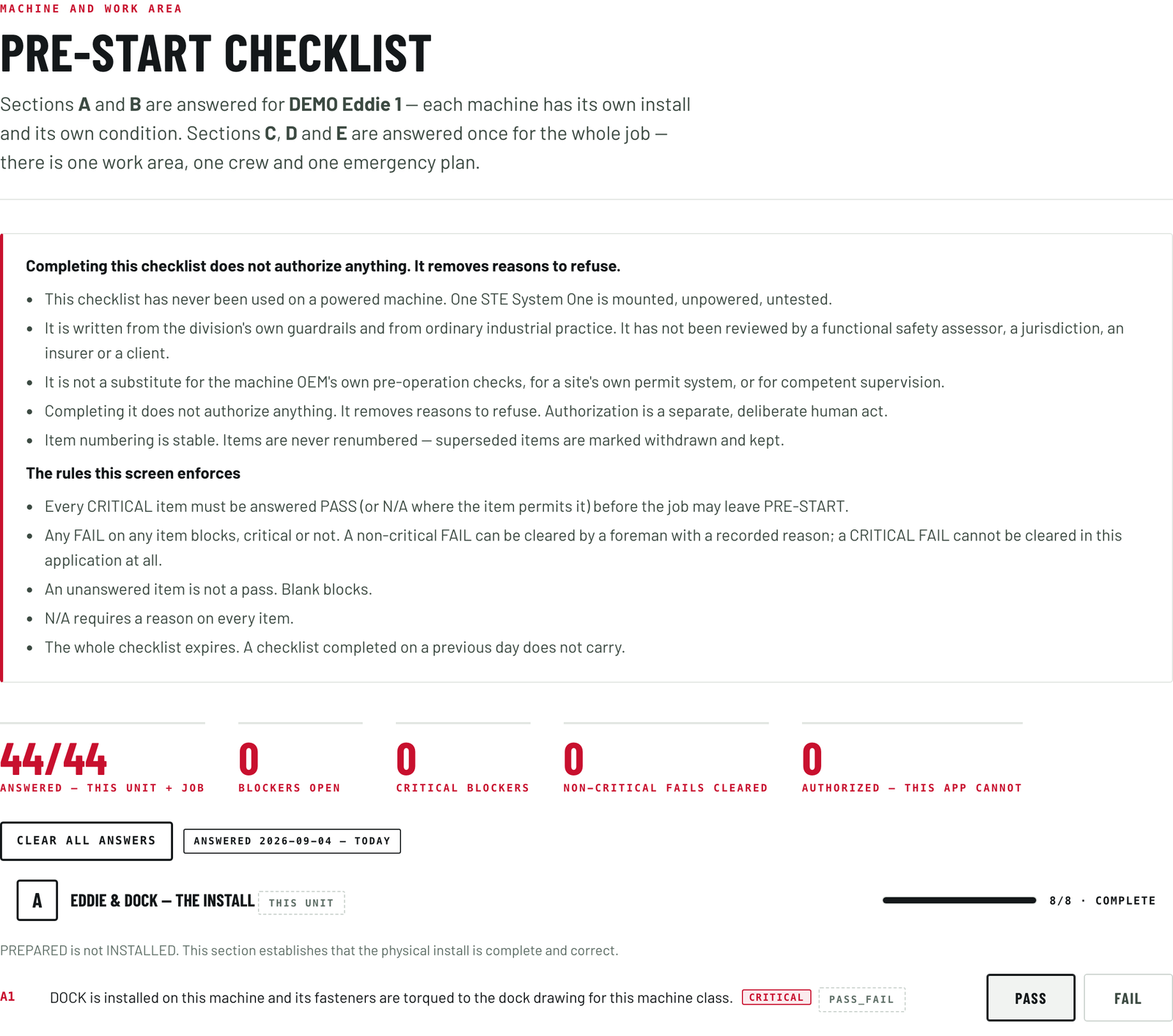
Pre-start
Machine and work area. The install and the host machine answered for each unit. The work area, the people and their authorization, and stop and recovery answered once for the whole job.
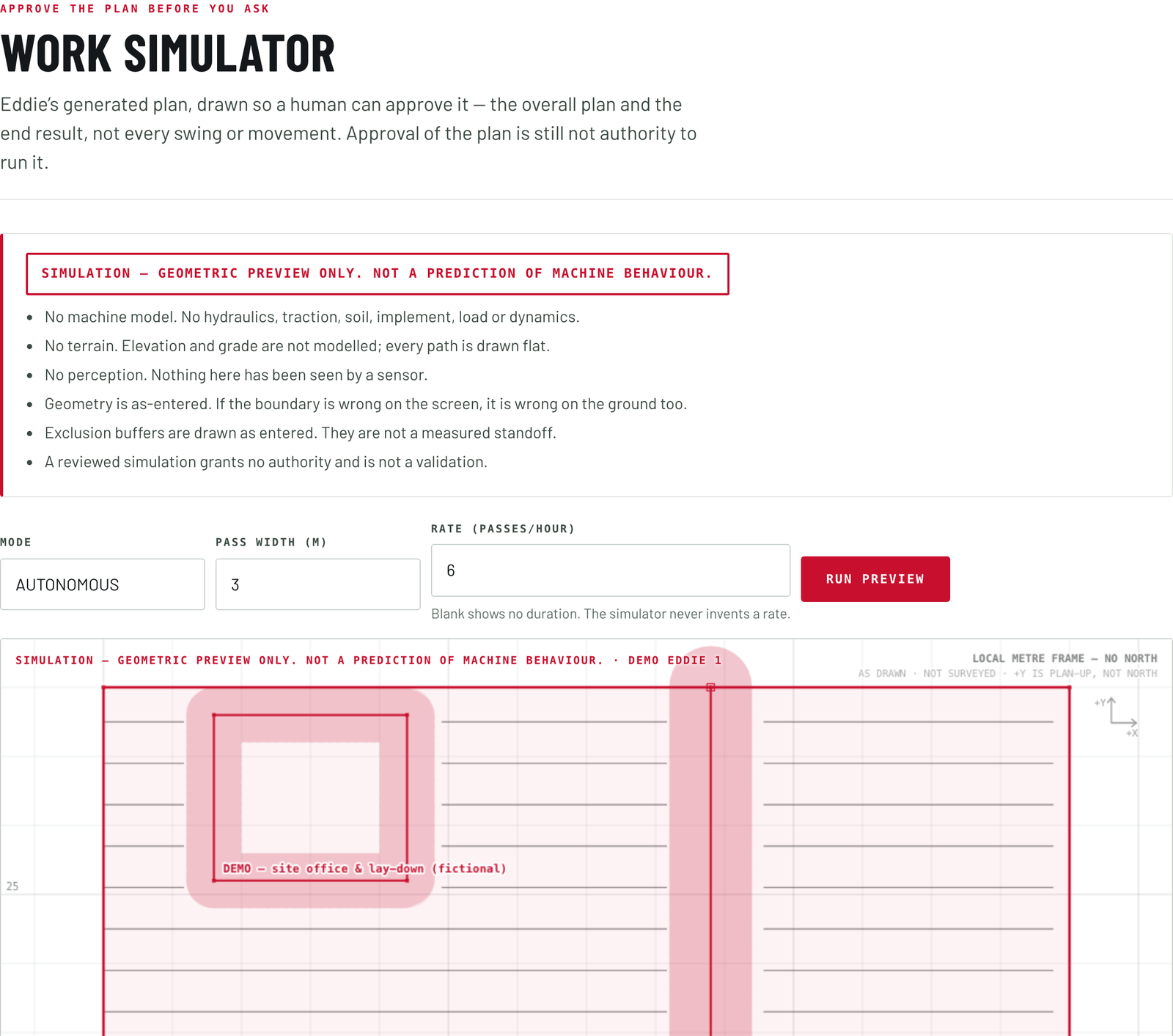
Simulator
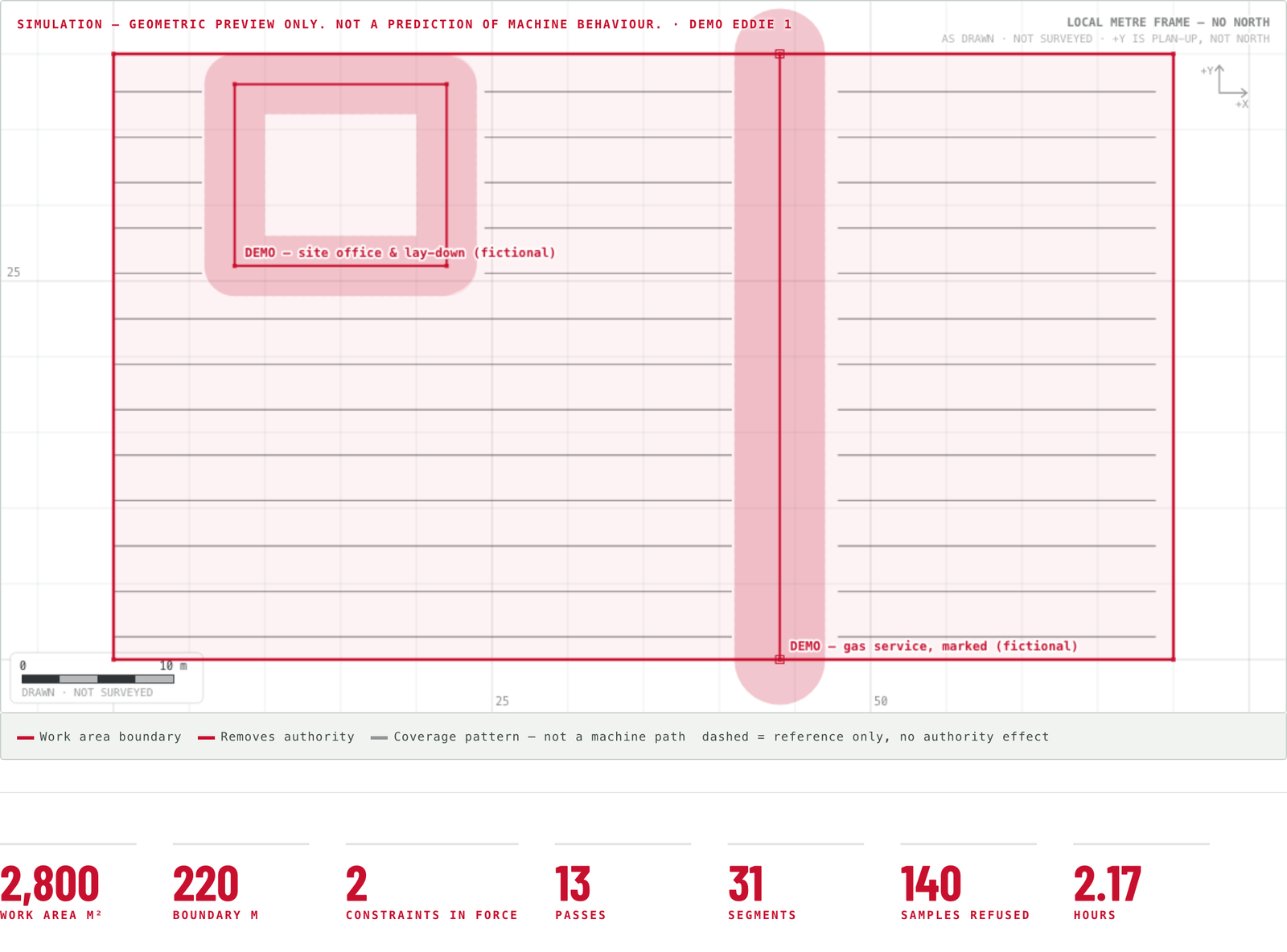
Approve the plan before you ask. Eddie's generated plan, drawn so a human can approve it: the overall plan and the end result, not every swing. Approval of the plan is still not authority to run it.
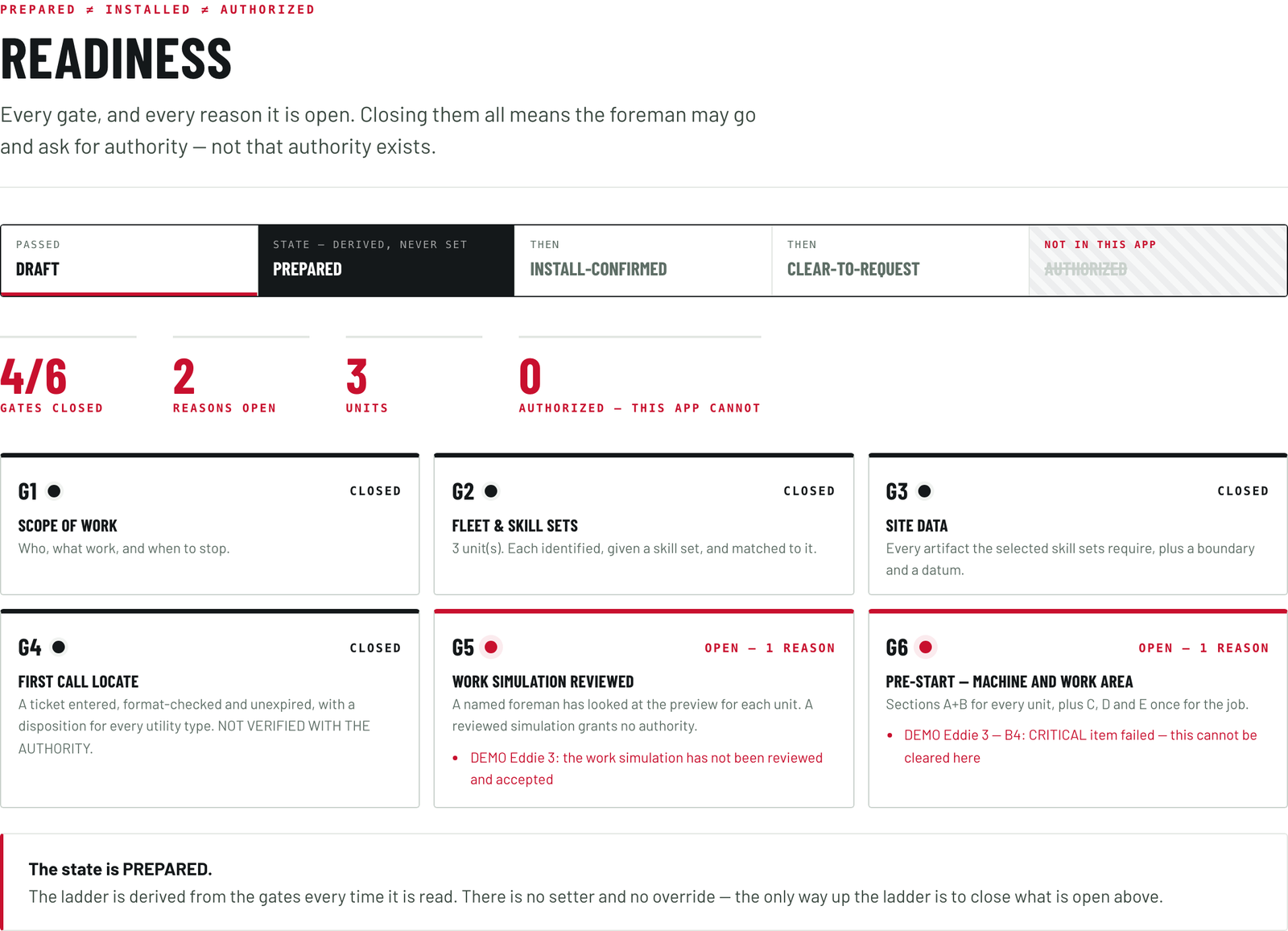
Gates
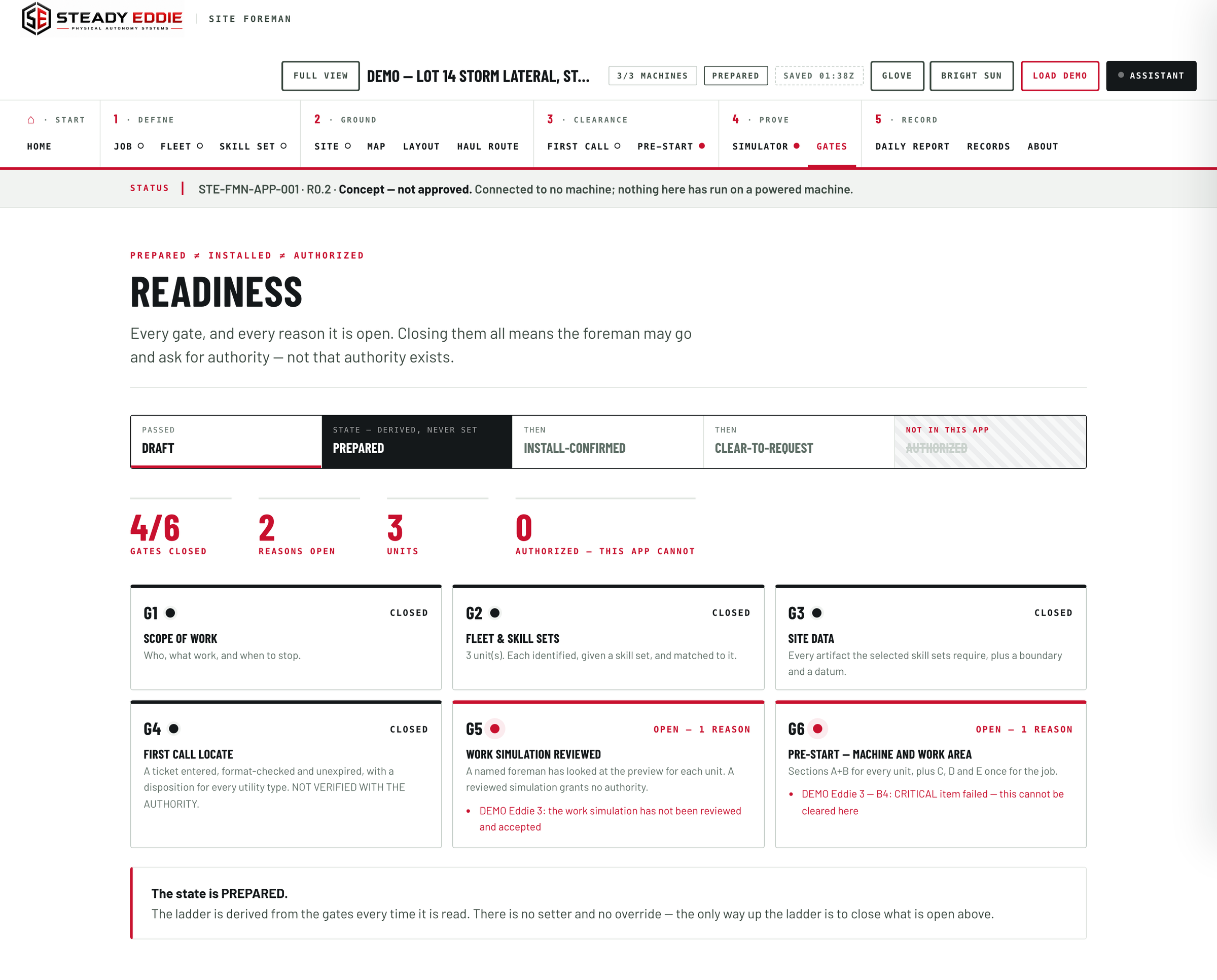
Readiness. Every gate, and every reason it is open. Closing them all means the foreman may go and ask for authority, not that authority exists.
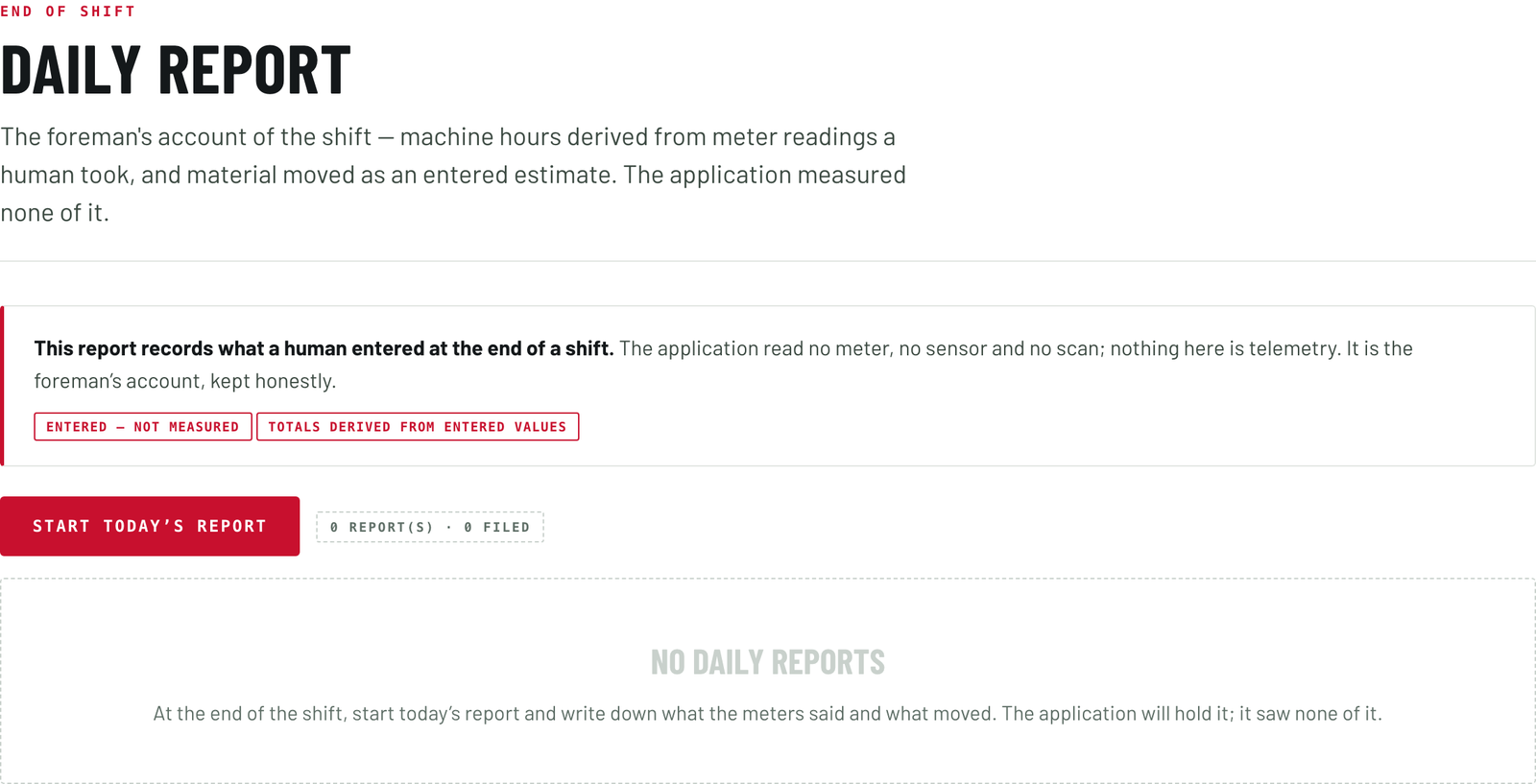
Daily report
End of shift. The foreman's account: machine hours from meter readings a person took, material moved as an entered estimate. The application measured none of it.
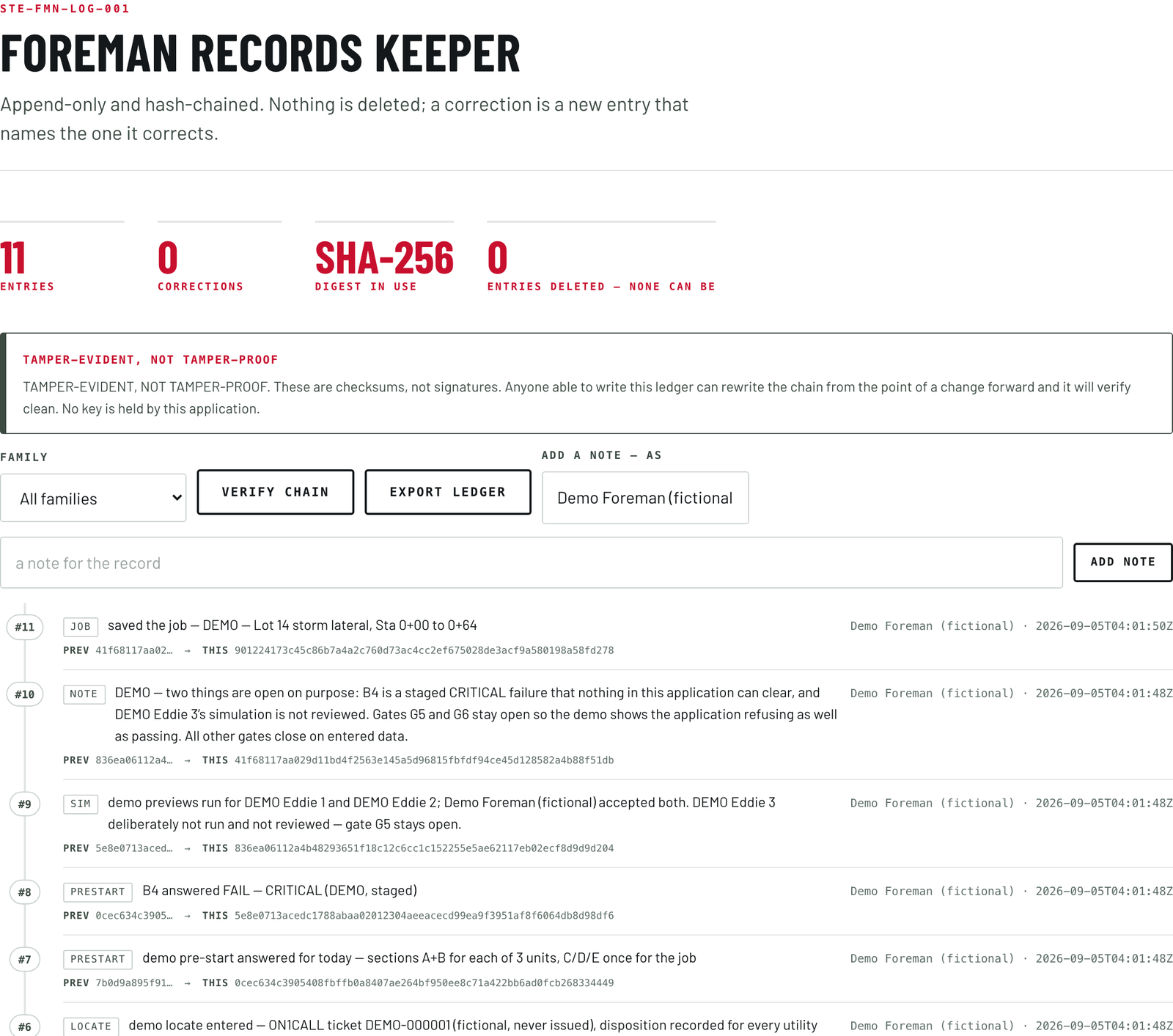
And one record of all of it.
Everything the twelve screens do lands in the records keeper: append-only and chained, so nothing is deleted and a correction is a new entry that names the one it corrects. The record of the shift exists whether or not anyone asks for it.
Every figure in it is marked as entered by a person, because the Foreman reads no meter and no sensor.
Six gates, in order.
A job moves forward only when the gate in front of it closes, and every gate closes on something a named person wrote down today.
- Scope of work.
The job, the foreman, the machine, the mode of work, the boundary of the task, and the stop-and-call-if conditions, all written before anything else.
- The units on the job.
Every unit identified and matched to the work it is set up to do.
- Site data.
A named site, a boundary and a datum, with the drawings and surveys the work calls for. Site data can only take permission away. It never grants any.
- Locates.
The utility locate ticket entered, in date, with a clear answer for every utility type. The Foreman checks the ticket. The clearance itself stays yours to hold.
- Work review.
A named reviewer accepts the work preview for each unit.
- Pre-start.
The walk-around and the checks on the machine and the job, answered by a named person, on the day. Preparing a job is not the same as fitting a machine, so the fit is confirmed here before the job moves on.
Humans authorize. The Foreman makes sure of it.
Humans authorize is the rule that runs through everything we build, and the Foreman is that line written into software. It clears away every reason the system has to refuse a job, and then it stops. It cannot say go. Only a person can.
What that means on your site.
- The rules your site has already written down are the rules the job is checked against.
- Your foreman opens the job and closes it out. Nobody outside the site does either.
- A machine with Eddie in the seat has a scope, a stop plan and a named person behind it before it is armed.
- The record of the shift exists whether or not anyone asks for it.
See it working.
The demo runs in your browser behind an access password. Load the demo job once you are in: three units, a site, a locate ticket and a pre-start with one failed item, so you can watch a gate refuse as well as pass. Nothing you do in it reaches a machine.