
The programs that can help pay for it.
Governments help pay for automation on a machine you already own. They lend against it, they let you write it off faster, they pay for the training, and in a few places they share the purchase. This page maps what exists, what each program covers, and where buyers lose the money. Every figure is from the program's own page, with the date we read it.
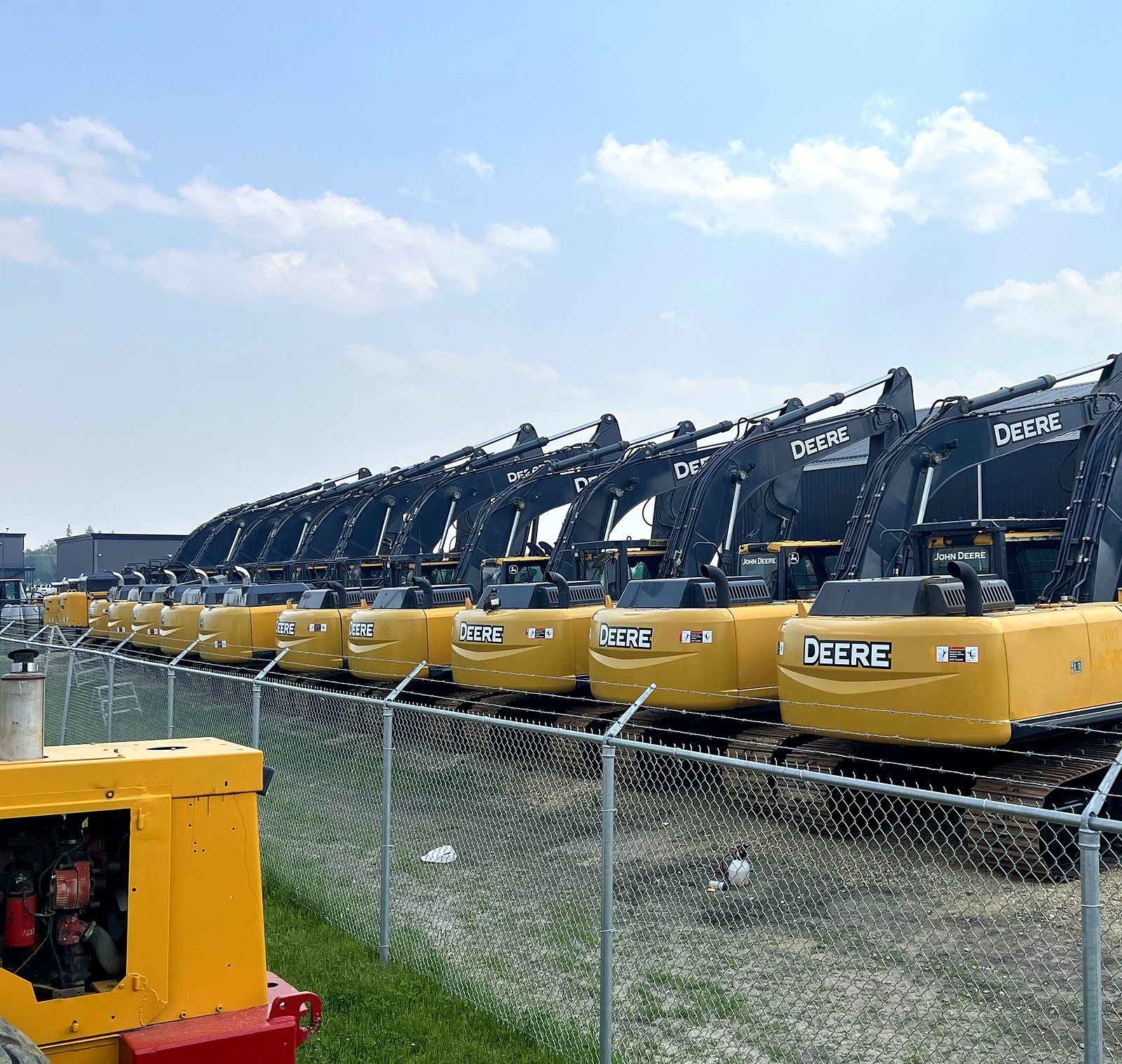
The group's own fleet, Alberta.
Nothing on this page is tax, legal or financial advice, and no program is open to you until the program says so in writing. We keep this map current, we point you at the right door, and we tell you when a program does not fit. We will not tell you money is coming before it is approved.
Read on the programs' own pages, 2026-09-04
Know which kind you are asking for.
Lend against it.
Government-backed loans and guarantees for equipment, new or used, through your bank, Farm Credit Canada, BDC, the provincial farm lenders and, in the United States, the SBA and the Farm Service Agency.
Depreciate it faster.
Canada's Accelerated Investment Incentive and the thirty-per-cent classes for construction iron. In the United States, section 179 expensing and bonus depreciation, both of which take used property.
Pay for the people.
Every western province funds employer training, half to four-fifths of the cost per trainee. Approval comes before the course starts, never after.
Share the purchase.
The rarest kind. British Columbia's on-farm technology program names autonomous equipment; Alberta's on-farm program is between intakes; the Prairie regional programs fund technology adoption for firms that clear their thresholds.
What exists, program by program.
Figures are the program's own maxima and rates on the day we read them. They change without notice, and we confirm every one against the program before it goes in a plan.
Federal, Canada
| Program | Who | What it covers | What it is worth | Status |
|---|---|---|---|---|
| Canadian Agricultural Loans Act | Farmers and farm co-operatives, through your lender | The purchase, major repair or overhaul of implements and machines, which is exactly what a unit on your machine is | A 95% guarantee to the lender; $500,000 in total, $350,000 for purposes other than land | Open, continuous |
| Farm Credit Canada equipment financing | Farm operations, through dealers | New or used farm equipment | Nothing down under $100,000, 10% down under $500,000, terms to ten years, no FCC fees | Open |
| BDC equipment purchase loan | Canadian businesses with a year of revenue | New or used equipment, and the page names automated equipment and robotics, with shipping, installation and training | Up to 125% of the purchase price, up to 24 months interest-only, terms to twelve years | Open |
| Canada Small Business Financing Program | Businesses under $10 million in revenue, through your lender. Farms are sent to the Agricultural Loans Act instead | The purchase or improvement of new or used equipment | Up to $500,000 for equipment, $1.15 million in all; rate capped at prime plus 3%, a 2% registration fee | Open, continuous |
| Accelerated Investment Incentive | Any business | A larger first-year capital cost allowance on eligible property | Double the normal first-year allowance for property under the half-year rule, through 2027. Budget 2025 announced an extension that is not yet on the CRA page; ask your accountant, not this page | In force |
| Capital cost allowance classes | Any business | Excavating, moving and compacting equipment sits in class 38 and contractor's movable equipment in class 10; an addition generally follows its host machine | 30% declining balance for those classes; 20% for class 8 | In force |
| PrairiesCan Regional Tariff Response Initiative | Prairie-incorporated firms of up to 499 people, two years old, hurt by tariffs | Capital investment, including adopting new technologies | Non-repayable, up to $3 million | Open to 2027-12-31 |
| PrairiesCan Business Scale-up and Productivity | High-growth incorporated firms in priority sectors | Acquiring and adopting new technologies, equipment and machinery | Up to 50%, from $200,000 to $5 million, interest-free and repayable | Continuous intake |
| Poultry and Egg On-Farm Investment | Supply-managed poultry and egg producers holding quota | On-farm automation and efficiency; costs back to 2019-03-19 qualify | Allocated by quota share; the page publishes no rate | Open to 2030-03-31 |
Alberta
| Program | Who | What it covers | What it is worth | Status |
|---|---|---|---|---|
| Canada-Alberta Productivity Grant | Any Alberta employer, any sector | Third-party training, including technical and digital skills. Not the equipment | 50% for existing staff and up to 75% for new hires from unemployment; $5,000 or $10,000 per trainee, $100,000 per employer per year | Open; approval before training starts |
| On-Farm Efficiency Program | Alberta producers with $25,000 of farm income and a current Environmental Farm Plan | The Smart Farm Technology stream. The funding list has no autonomy item and rules out GPS and auto-steer equipment, so a unit would need approval as a similar expense | 50%; $50,000 for the stream, $150,000 per applicant over the program | Between intakes; due to reopen from September 2026. We check it weekly |
| Emissions Reduction Alberta, energy management for industry | Farming, mining, construction, manufacturing and transport operators | Capital retrofits at a facility with fixed equipment. Whether a mobile machine fits is a question for the program | Up to 50%, up to $1 million per facility | Waitlists open; program runs to 2027-03-31 |
| AFSC lending | Alberta producers and agribusiness | Term lending. The pages do not say whether a retrofit on a used machine qualifies; we ask before you apply | Not published | Open |
Saskatchewan
| Program | Who | What it covers | What it is worth | Status |
|---|---|---|---|---|
| On-farm equipment or technology cost-share | Producers | There is none. The producer programs under the current agricultural partnership cover water, irrigation, land, weeds, livestock, biosecurity and safety | — | No program |
| Saskatchewan Lean Improvements in Manufacturing | Value-added agri-processors | Automation equipment, but it rules out tractors, trailers, forklifts and other mobile motorized equipment, and used or leased equipment | 50% to 60%, capped between $300,000 and $750,000 | Not for a machine seat |
| Canada-Saskatchewan Job Grant | Employers | Training | — | Eliminated in 2025, no successor |
Manitoba
| Program | Who | What it covers | What it is worth | Status |
|---|---|---|---|---|
| MASC direct loans | Manitoba farm operators | Equipment, new or used; ten-year terms for new, seven for used | Up to $6.25 million at 80% financing | Continuous |
| MASC loan guarantees | Manitoba producers diversifying | Credit backing for diversification and value-added projects | No principal cap; rate ceiling of prime plus 2% | Continuous |
| Building Up Manitoba | Any Manitoba employer under 500 people | Employee training | 50%; $10,000 per employee, $100,000 per program | Open, continuous |
British Columbia
| Program | Who | What it covers | What it is worth | Status |
|---|---|---|---|---|
| BC On-Farm Technology Adoption Program | BC producers two years in, with $50,000 of production revenue | The best fit in Canada. It names autonomous equipment, and it rules out used equipment. Whether a new unit on a machine you already own counts as new is the question we put to the program first | Up to 65%, to $100,000, with at least 35% in cash from you | Closed. The fourth intake ran February to April 2026; no fifth announced |
| BC Employer Training Grant | Any BC employer | Training | 80%; $10,000 per employee, $300,000 per employer per year | Open; approval before training |
United States
| Measure | Who | What it covers | What it is worth | Status |
|---|---|---|---|---|
| Section 179 expensing | Any trade or business, property bought and used more than half for business | Used property qualifies; the test is that you bought it, not that it is new | $2,560,000 for 2026, phasing out from $4,090,000; capped at the year's business income, with the rest carried forward | In force |
| Bonus depreciation | Any business | New or certain used property | 100% for property acquired and placed in service after 2025-01-19 | In force |
| Recovery period | Any business | The class follows your trade, not the device | Five years for new farm machinery and for construction; seven for used farm machinery and for quarrying and mining | In force |
| SBA 7(a) and SBA 504 | For-profit small businesses | Purchase and installation of machinery and equipment; 504 needs ten years of remaining life | $5 million under 7(a), $5.5 million under 504 | Open |
| USDA Farm Service Agency operating loans | Family farms that cannot get credit elsewhere | Equipment among the essentials | $400,000 direct; the guaranteed limit differs between two of the agency's own pages, so confirm it locally | Open |
| USDA Business and Industry guarantee | Rural businesses in towns under fifty thousand; plain farms go to the Farm Service Agency | Purchase and installation of machinery and equipment | An 85% guarantee under $5 million, 80% above, with a 3% fee | Open |
Read on each program's own page on 2026-09-04. Figures move; confirm before you plan on one.
Four mistakes that cost the money.
Buying first, then looking for the grant.
British Columbia's on-farm program rules out any purchase made before the application is approved. Saskatchewan's manufacturing program bars spending before project approval. Alberta's training grant wants approval before the first day of the course. Yet Alberta's on-farm program can reach back to spending made before the application, and the federal poultry program reaches back years. There is no general rule, so we read the pre-approval clause program by program before a quotation is signed.
Assuming a unit on your machine reads as new equipment.
Two of the best programs rule out used equipment, and neither says whether a new unit fitted to a machine you already own trips that clause. That one question decides whether the strongest cost-share in the country is usable at all, so we put it to the program before you apply. Saskatchewan is blunter: its manufacturing program rules out mobile motorized equipment outright.
Applying to the wrong family of program.
The research council's industrial assistance, the agricultural science programs, Alberta Innovates' vouchers and Saskatchewan's agtech funds pay the company that develops a technology, not the customer who buys it. Farms are barred from the small business financing program and sent to the Agricultural Loans Act; plain farms are sent off the rural business guarantee and onto the Farm Service Agency. Knowing which door is yours saves a season.
Old names, and stacking.
The Canada Job Grant no longer exists as such. Alberta renamed and re-cut its version, Manitoba's became Building Up Manitoba, and Saskatchewan's ended with no successor. On stacking, most programs bar the same dollar from two sources, and British Columbia will not let other government money sit inside your own share. Plan the split before the first application, not after the second.
Closed, or not for this.
- AgriInnovate and the Agricultural Clean Technology adoption stream: closed to applications.
- AgriScience: open, but for pre-commercial research, not adoption.
- NRC IRAP, Alberta Innovates vouchers and demonstration programs, Saskatchewan's agtech funds: for the firm developing the technology.
- Canada Digital Adoption Program: retired.
- Emissions Reduction Alberta challenge rounds: closed, and mature commercial technology is out of scope.
- Manitoba agri-processing productivity: closed; the capital investment program starts at $1 million projects.
- British Columbia's manufacturing tax credit: new processing equipment only. Its feeder and breeder guarantees fund livestock, not machines.
- USDA REAP: energy projects only, and its own rules exclude vehicles, tillage equipment and used equipment.
How we help you get it right.
Tell us where you are and what you run, and we tell you which of these doors is yours, in what order to knock, and what has to be true before you sign a quotation. We read the program pages, and we put the two questions that decide the most to the programs themselves: whether a new unit on a machine you already own counts as new equipment, and when Alberta's on-farm program reopens.
The tax lines are your accountant's call. Eligibility is the program's call, in writing. Our job is to make sure you are asking the right one, with the right paperwork, before the money is spent.