
An empty seat still needs a full tank.
The OILER is site infrastructure. It is designed to stand still, hold a fluid path from your tank to the machine's, and write down what went through. The machine comes to it. It never sends for the machine.
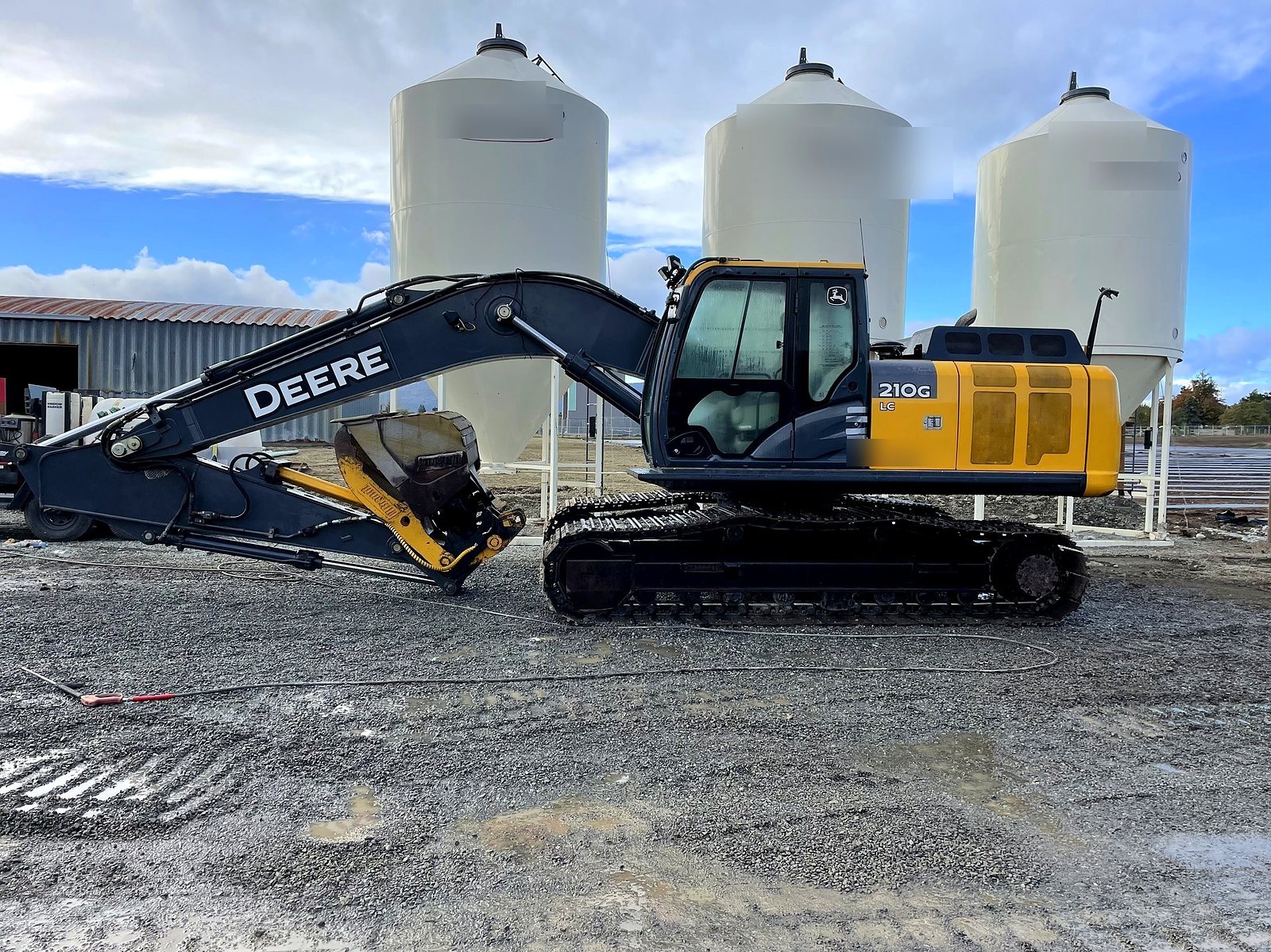
The group's John Deere 210G excavator at the tanks.
A bay the machine comes to, and a note of what went through.
A machine parks. A nozzle is designed to mate to a receiver fitted where its fuel cap used to be. The tank fills, and the volume is designed to reach the STE Site Foreman. The rest of this page is what the bay is never permitted to do.
The fuel stays yours. Our part of the path is designed to begin at your isolation valve and end at that receiver. We do not supply, own, permit, fill or close bulk storage.
One bay, or a yard of them.
A fixed bay the machine comes to, carrying a single fluid. Everything the family is made of is here: the receiver, the arm that mates to it, the fill, and the record.
The same bay, serving more than one fluid. Each receiver is designed to key against every other by its shape, so a fluid can only go where that fluid goes.
Several machines and several bays, queued against the work the STE Site Foreman has already prepared.
A mobile OILER, listed last on purpose. Taking the unit to the machine looks like it avoids the parking problem. It inverts it. A unit that has to find a machine has the harder job, with none of the bay's containment.
A destination, and never a dispatcher.
Sensing outside a machine may take authority away and can never create it. The OILER sits outside the machine, and every line below follows from that.
- It may refuse to dispense, for any reason or none. Refusing is always open to it.
- It may never start an engine. A person starts a machine, every session.
- It may never move, arm or release a machine, and it may never create an authority the machine did not already have.
- It may never ask for a machine to come to it. A machine arrives because a person authorized a job that ends at the bay. The OILER is told a machine is coming, and it never asks for one.
- It may break its own connection at any time.
A thing that summons machines is a thing that starts motion, and starting motion is the one act site infrastructure in this division is never allowed. It is the difference between a fuel bay and a dispatcher, and we do not build the second one. The safety page has the rest.
The fuel cap comes off. A receiver goes on its thread.
This is the first thing Steady Eddie has ever asked an owner to change on a machine, and it is designed to unscrew and leave the machine standard again.
Everywhere else we say your machine stays stock: nothing cut, nothing wired in, no controller flashed. That holds here. A cap is none of those things, and taking one off cuts, drills, welds or taps nothing.
The receiver is designed to occupy the cap's own thread or bayonet and nothing else. Nothing is welded, drilled or bonded to the filler neck, and the neck, the strainer and the vent path stay as the manufacturer built them.
If a machine family's filler neck will not take a receiver on the cap's own thread, that family is not supported rather than cut to fit.
The cap that comes off is designed to leave with the machine: bagged and fixed to it at the fit-up, against a signature. It is a delivered part, and it goes back in the buyer's hand when you sell.
A fuel cap is a vent, not a lid.
The cheapest part in this product decides whether there is a product.
Diesel filler caps are commonly not closures: many carry a valve that works both ways. As fuel is drawn the tank has to admit air or it starves the lift pump, and as fuel warms it has to relieve.
A part that seals well and vents wrongly damages the machine, and the damage does not appear at the fill point. It appears as a fuel-starvation fault days later, in your yard, with nothing pointing back at the cap.
So there is no universal receiver. There is a family of them, one member per cap standard, each designed to reproduce the venting of the cap it replaces, and each designed to be qualified against that cap at the bench before it is fitted.
The fill is designed to be stopped by the tank's own overfill float, never by our software. Every fill is designed to be read by one instrument and checked against another, and the fill that gets reported on its own is the one where the readings disagree.
A volume, reported to the STE Site Foreman, tagged as observed.
What went into a machine is designed to reach the STE Site Foreman as an observation and nothing more. The receiver is designed to carry a readable identity, so a fill is attributed to the right machine without going near its CAN bus, its ECU or its firmware.
An observation is not a permission. Nothing the OILER sees can grant a machine anything. It is designed to put what it observed in front of a person to accept.
Where this stands.
The first thing you are told, because everything after it depends on it.
The OILER is designed, specified and written down, and that design, in full, is what we will put in front of your safety people. The first work it asks for needs no robot and no customer: fitting receivers to our own machines at our Test Facility in Alberta, and mating one by hand at the bench. We would rather you read that here than find it out for yourself later. A person walks around the machine, completes the pre-start inspection, starts it and clears it for operation. Only then does Eddie engage the controls: every session, every machine, no exceptions. Eddie never starts, wakes or inspects a machine. We claim the design and nothing past it. Your machine's warranty, its conformity and your liability position are for your counsel. No assessment against ISO 13849 or ISO 17757, the standards we design against, has been performed.