
Put the machine on the ground. Leave the seat empty.
Steady Eddie is a removable operator that fits the excavator, dozer, loader or tractor a unit already operates, and works that machine's own controls. For defence customers the case is earthworks and field engineering on ground where a person should not be sitting, on a line configured for it: no radio, sealed rules, leased authorization. It is not a weapon, and it is never fitted to one. Enquiries in this area are screened before any discussion.
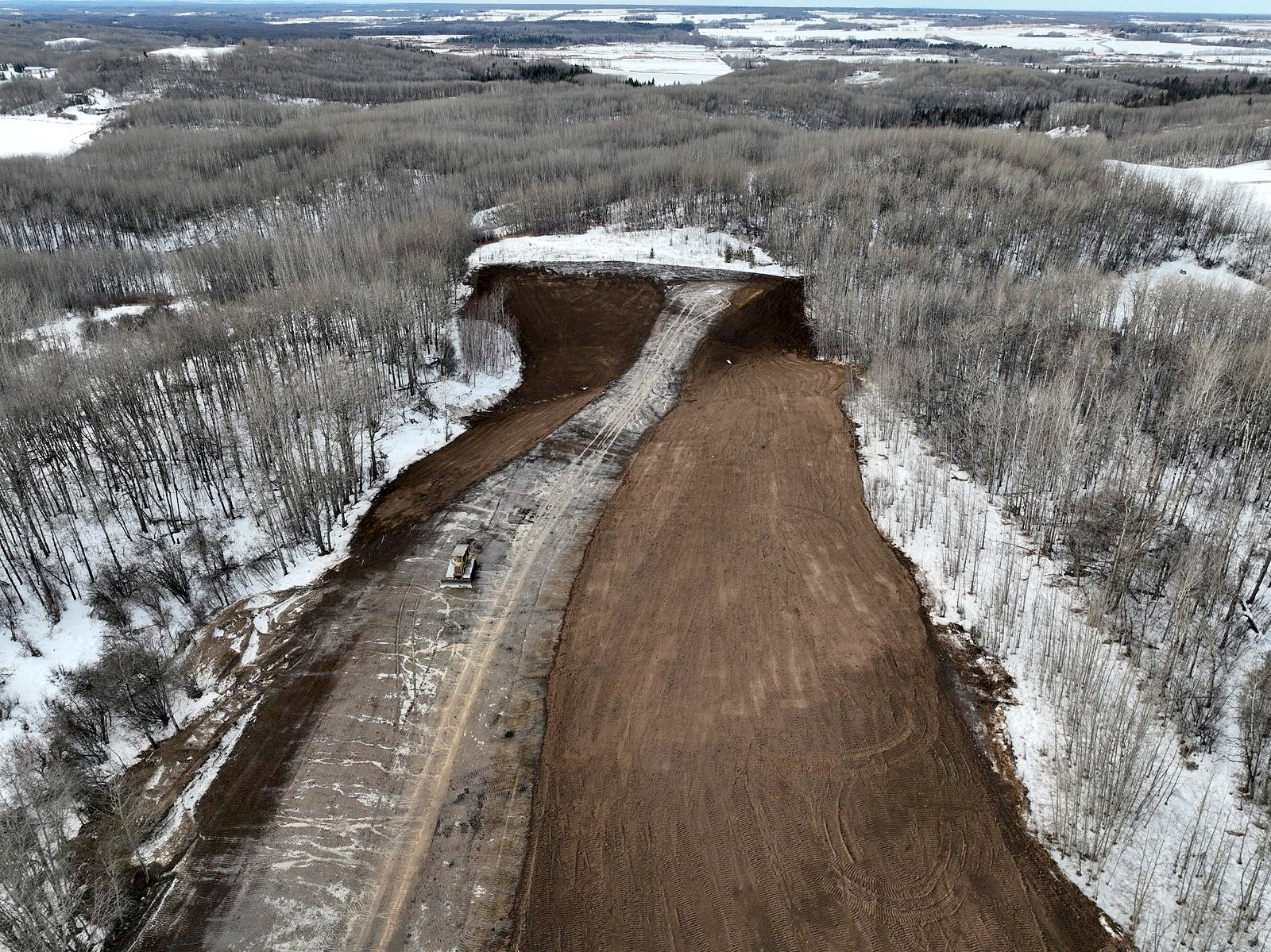
A dozer opening a winter corridor, from the air.
A removable operator, not a new machine.
Steady Eddie sits in the operator's seat of a machine a unit already owns — excavator, dozer, loader, grader, tractor — and works that machine's own joysticks, levers, pedals and switches with its own actuators, reading the dash with a camera of its own.
It never connects to the machine's CAN bus, ECU or firmware; the only wire between them is a fused feed from the accessory point.
The dock is the machine's own seat-belt anchors and pins and stays with the machine when the unit lifts back out, leaving the machine standard.
The seat is the exposure, not the machine.
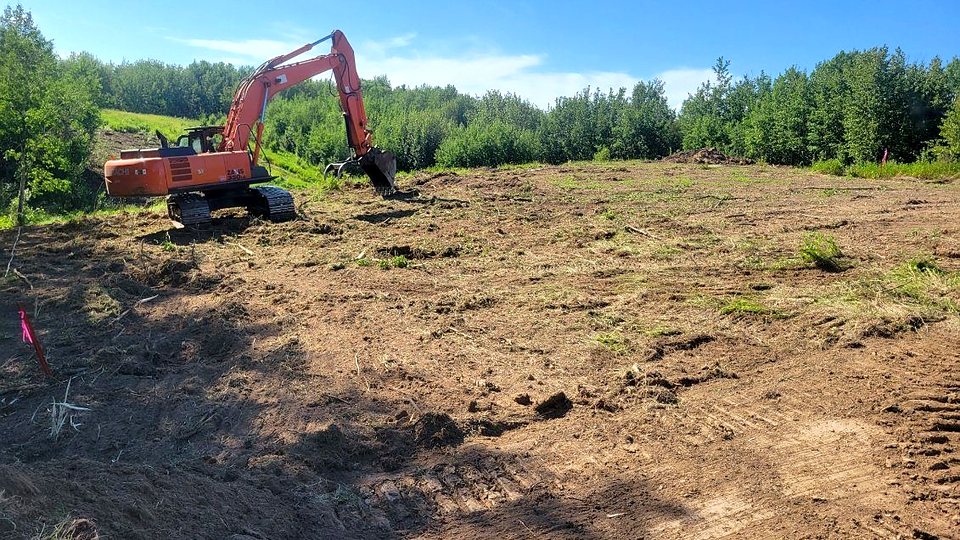
Earthworks and revetments, obstacle reduction, route and rubble clearance, remote handling: work that has to happen on ground where a person should not be sitting. The machine can be there. The operator does not have to be.
Nothing to procure, ship, park, fuel or train a crew on. The capability travels as a dock and a unit, fitted to plant that is already in theatre or already on the yard. Older machines count the same as new ones, because the interface is the human interface: if a person can work the controls, Eddie can.
Nothing on the host machine is modified. No harness tapped, no controller flashed, no manufacturer software touched. There is nothing to undo when the unit comes off, and no new fault codes in the shop.
The work.
Earthworks and revetments.
Berms, cuts and protective earthworks, shaped without a person on the ground doing it.
Obstacle reduction.
Reducing or clearing what blocks movement, on ground a machine is already built to work.
Route and rubble clearance.
Opening a route, or clearing what closed one, so what follows can move again.
Remote handling.
Positioning, moving and placing material or equipment from a machine's own seat, with nobody in it.
Recovery and route repair.
Recovering a stuck or damaged asset, and repairing the ground or the route around it.
The same machines, a different sector.
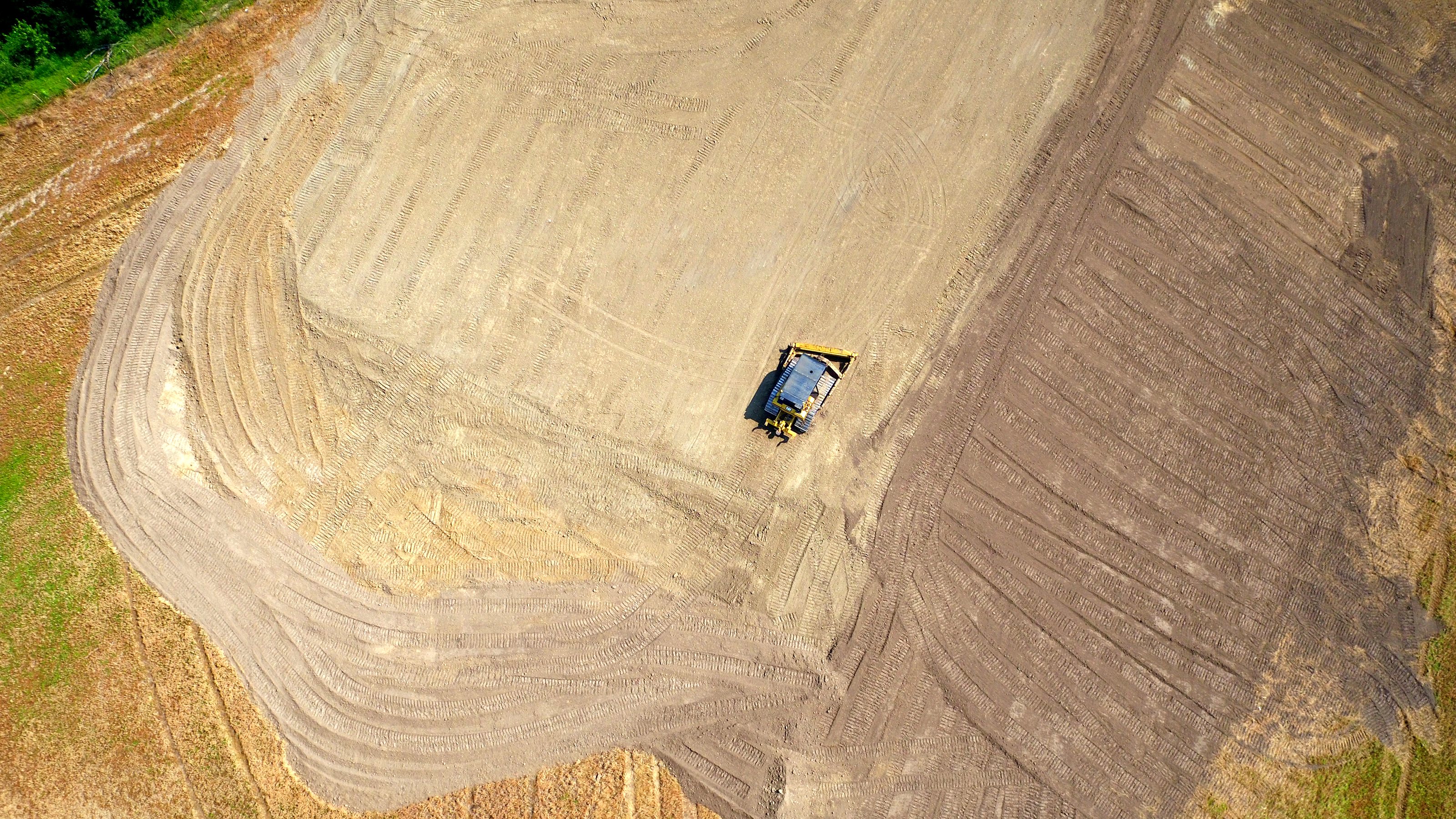
Grading a field, from the air.
What is different on this line.
The machine, the seat and the safety system are the same as on every Steady Eddie. What changes for defence is how the unit is guided, how it is locked, how it is authorized, and how each task stops. Each of these is stated here so it can be screened against what you actually need.
No radio on the line.
A defence unit is guided one of three ways: task programs loaded at the dock and run inside a sealed rule set; a fibre tether to a person at a stand-off station; or its own perception and planning, inside the same rules. Nothing on the unit transmits over the air. There is no radio link to jam, spoof or intercept, and no satellite positioning for anyone to deny.
The rules ship sealed.
Eddie does what its rule set allows and nothing else. The rules and the software that runs them are signed, the unit runs nothing unsigned, there is no service access on a shipped unit, and the keys stay with Steady Eddie in Canada. Tampering is designed to be slow, obvious and self-defeating: detected, it ends in a safe stop and a retained record.
Authorization is a lease.
A unit runs under a time-limited authorization that Steady Eddie issues and can withdraw. When it expires or is withdrawn, the unit comes to a safe stop at the next safe point and stays there. A unit outside its lease stays installed and will not run. On this line the lease travels by wire or is loaded at the dock, never over the air.
It runs only on the machine it was set up for.
Each unit is configured for one machine and checks that it is on it. Moved to any other machine, it has no authority to move anything until Steady Eddie sets it up again. The hardware is yours; the configuration and the application stay ours, licensed to that unit on that machine.
Programmed for the task, including how it stops.
On a civil site, a situation the rules do not cover means stop and wait for a person. On some ground, stopping where it stands is the harm. So each defence task carries its own safe response, decided with you in advance: withdraw to the dock line, hold with the implement grounded, or carry on to the end of the tether. It is decided before the job, never improvised during it.
Your operators teach it. The skill stays with your unit.
Every unit arrives knowing the common machines. Put STE Trainer in the cab with your own best operator in the seat and it learns your machine, your ground and your way of working, from a person, while that person drives. What it learns belongs to your unit and goes nowhere else.
What it asks of a unit, and what it does not.
It ships as a dock and a unit.
Flat, bolted together, one per machine, fitted to plant that is already on the ground. There is no vehicle to procure or move, and a mixed fleet of any make and age is one system, not one program per machine.
The machine goes back to a crew in minutes.
Unbuckle the unit, lift it out, and the machine is what it was: the dock is the machine's own seat-belt anchors and pins. The same fleet serves crewed and uncrewed work, and there is nothing to hand back at the end of a deployment except the unit.
Every act is on a record that cannot be quietly changed.
Who authorized the job, what the unit was set up to do, what it did and where it stopped, in order, each entry chained to the one before it. Nothing is deleted. The record stays with the unit and reads back by wire.
A person is in charge, in plain English.
- A person authorizes the work.
Nothing runs until a person clears it, machine by machine, job by job.
- Authority runs through named modes and states.
Seven authority modes — OFF, MANUAL, ASSIST, APPROACH, TELEOP, AUTONOMOUS, MAINTENANCE — and five mechanical states, from OEM standard through installed, armed and under autonomous control, to fault/safe. What Eddie may do is decided in advance, by the mode and state it is in, not improvised on the ground.
- Every control checks itself before it is trusted.
Eddie runs a self-calibration on every control each day. Key rotation stays outside this system, on purpose: a key is a human's authority token, not a machine's.
- The link is wired, not wireless.
CAN 2.0 and Ethernet carry every motion command and the safety loop, wired only. Wireless never carries either.
- A stop and a manual release are always there.
A stop wired directly into Eddie's own safety controller, with no software in the path, and a red manual release on every actuator, one hand, no tool.
Eddie's actuator family covers thirteen modules — SE-HAND, SE-TILLER, SE-WHEEL, SE-PEDAL, SE-PEDAL-HI, SE-GATE, SE-ROTARY, SE-SWITCH, SE-SWITCH-MATRIX, SE-AUX, SE-SENSE, SE-DOCK and SE-CORE.
Eddie's actuator family is designed to ISO 12100, 13849, 17757 and 19014. No conformity assessment has been performed against them.
Not a weapon. Never fitted to one.
Steady Eddie does not operate a weapon. It does not handle energetics. It is never fitted to a weapon platform. Its scope is mechanical and field-engineering work, on machines that already move earth.
- Operating a weapon, of any kind.
- Handling energetics.
- Fitting to a weapon platform.
Weaponization is not a product decision.
Who we can help, and who we cannot.
No defence customer has taken delivery of a unit. What we offer today is screening, then a fit assessed machine by machine, and a first job scored on your own ground before anything further is discussed.
- A defence engineering unit, a ministry or agency, or a prime contractor acting for one, with excavators, dozers, loaders, graders or tractors already on the ground and a task nobody should have to sit through.
- Earthworks, obstacle reduction, route and rubble clearance, remote handling and recovery, with a defined work area and a person present to authorize and watch the job.
- A customer that goes through screening first, and accepts that supply, if it comes, is under permit from the Government of Canada.
- Weapons, energetics and weapon platforms, without exception.
- Any enquiry the screening cannot clear, and any transfer or re-export that a permit does not cover.
- Work that needs a guaranteed production rate or a promised response time. We do not offer either.
- Leaving Eddie fitted permanently and unattended, starting the machine, or driving it on a road.
Screened before any discussion.
Defence enquiries are screened before any discussion, because export control requires it. What you send here is used only to work out what may lawfully be discussed and supplied. Nothing on this page is an offer or a commitment, and any supply would be subject to permits issued by the Government of Canada.