
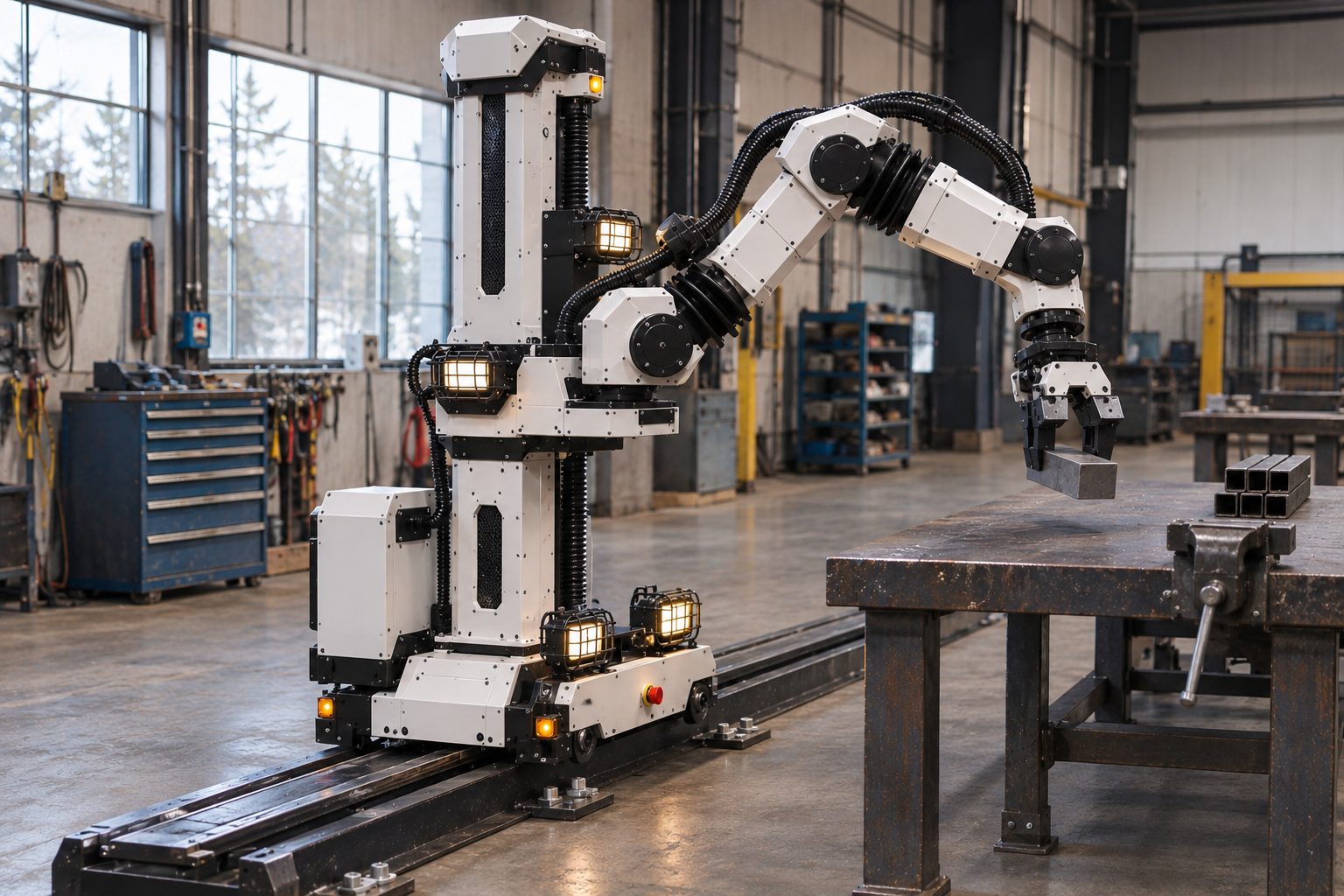
One rail through the shop. The arm goes to the work.
A shop has more stations than it has hands. STE Shop Hand Rail puts a robot arm on a carrier and the carrier on a floor rail, so one arm is designed to serve a row of stations in turn. It welds, tends machines and moves kits.
This is Riley.
Riley is our shop hand. Riley rides the rail. A shop has more stations than it has hands, so Riley is an arm on a carrier, and the carrier runs on a rail on your floor. Riley goes to the work: loads a machine, unloads it, brings a kit to the line. It stops when a person, a gate or a crane says stop.
A rail, a carrier and an arm.
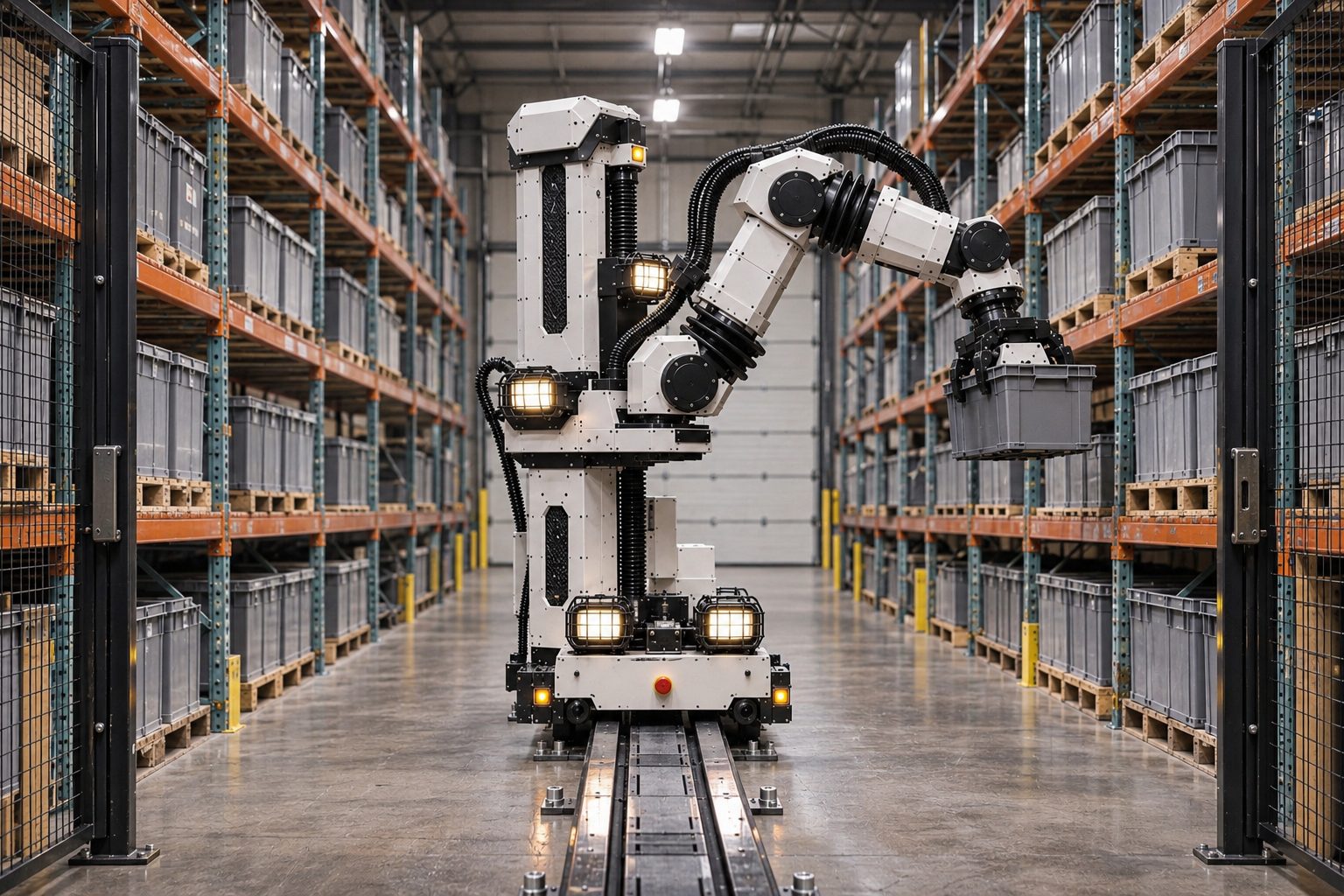
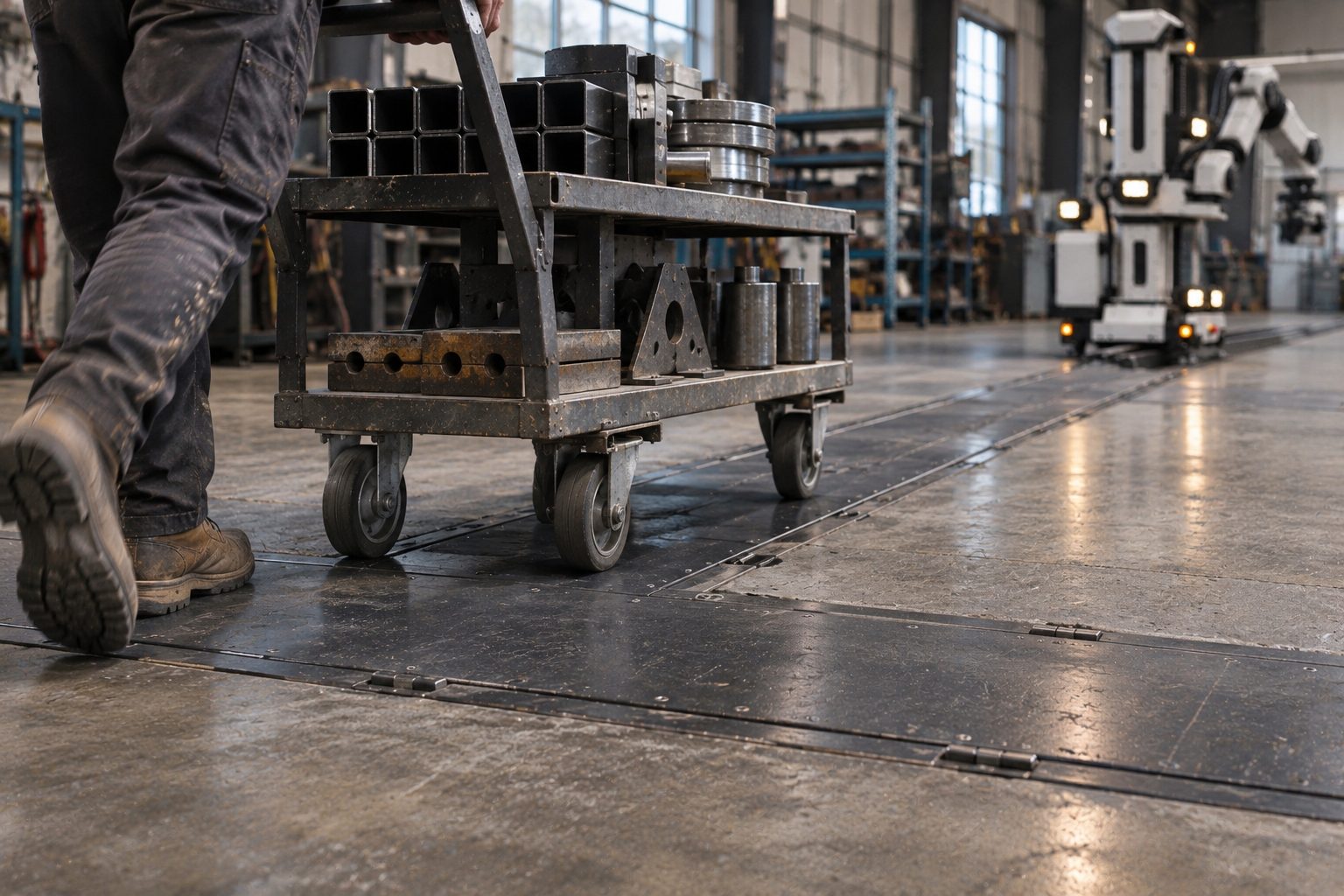
The rail sits on the surface of the floor, on plates anchored to the slab you already have. A rack runs along it and a pinion on the carrier drives against the rack. Turnouts let one carrier leave the main line for a spur and come back.
Each carrier has a swivel and a lift riser, and takes the arm the task calls for. The arm comes from its maker. The carrier, the riser and the rail are ours.
- Surface rail on anchored plates, on your existing slab
- Rack and pinion travel, with turnouts
- A swivel and a lift riser on every carrier
- A welding arm, a collaborative arm or a heavier arm, by task
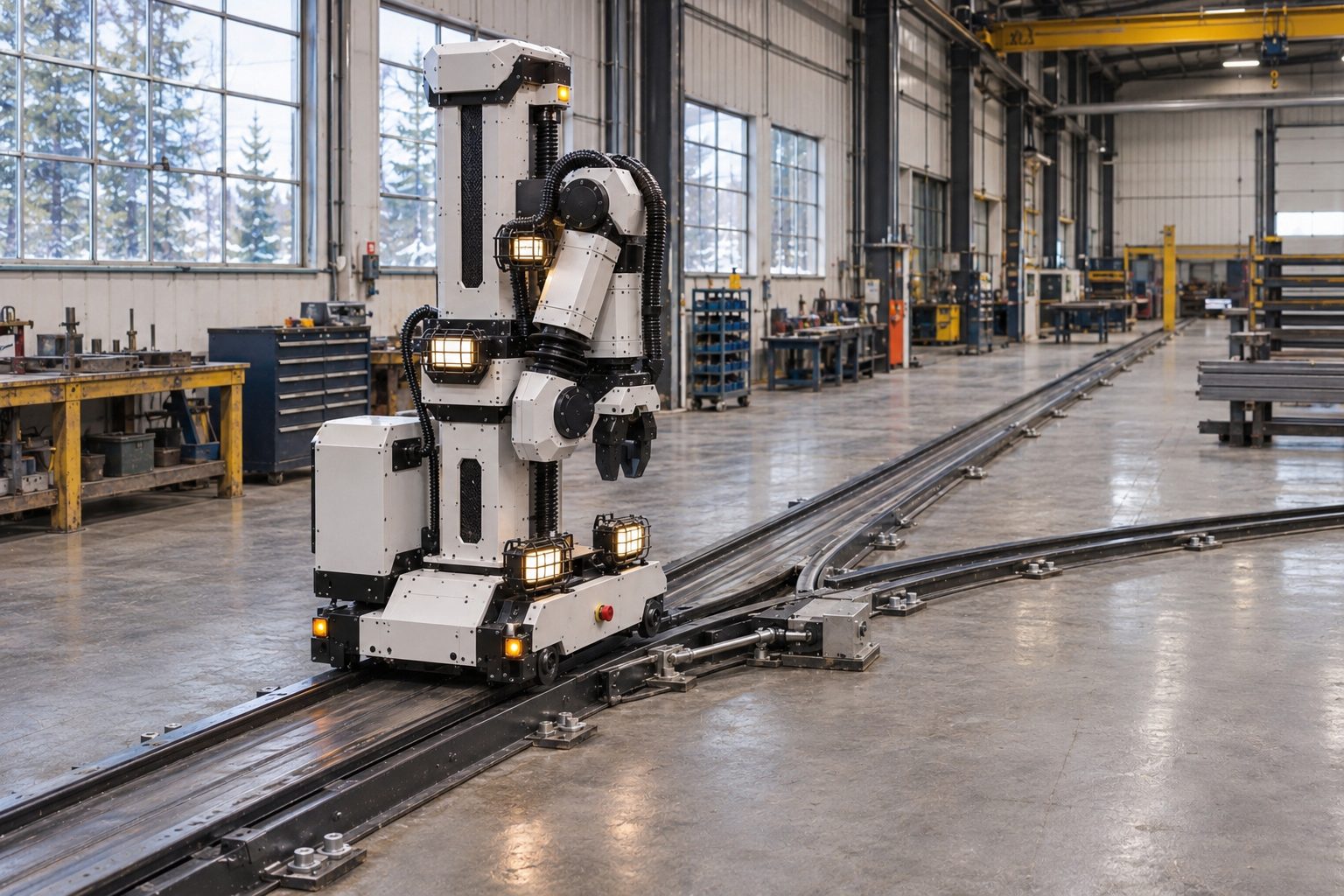
Three jobs, one rail.
Site Hand goes to the job. Shop Hand Rail stays in the shop and goes from station to station.
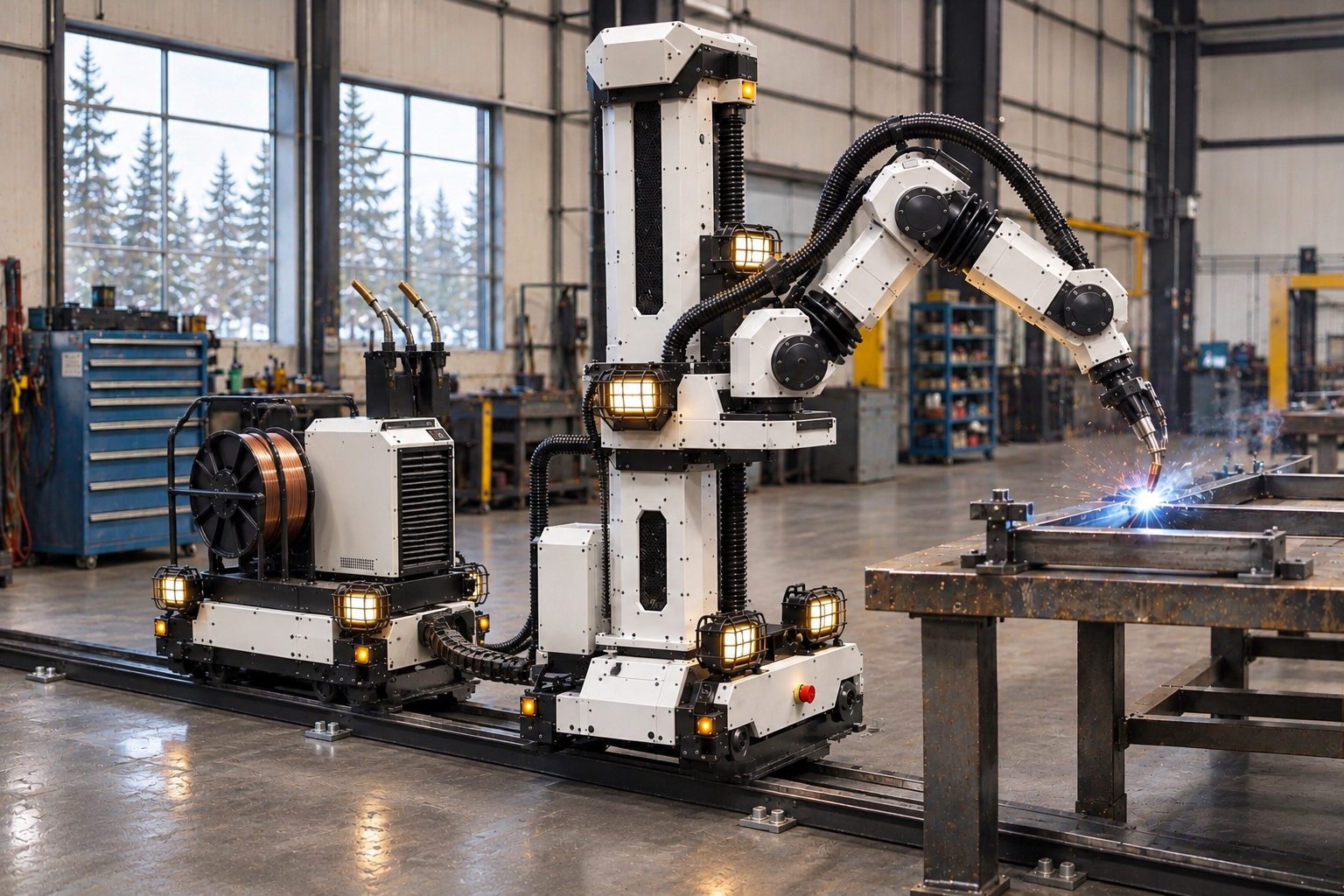
Weld at the table
The welding carrier takes a welding arm with a torch and a gripper on a tool changer. A weld cart trails behind it with a two-pocket head stand. One active cart works each fabrication line.
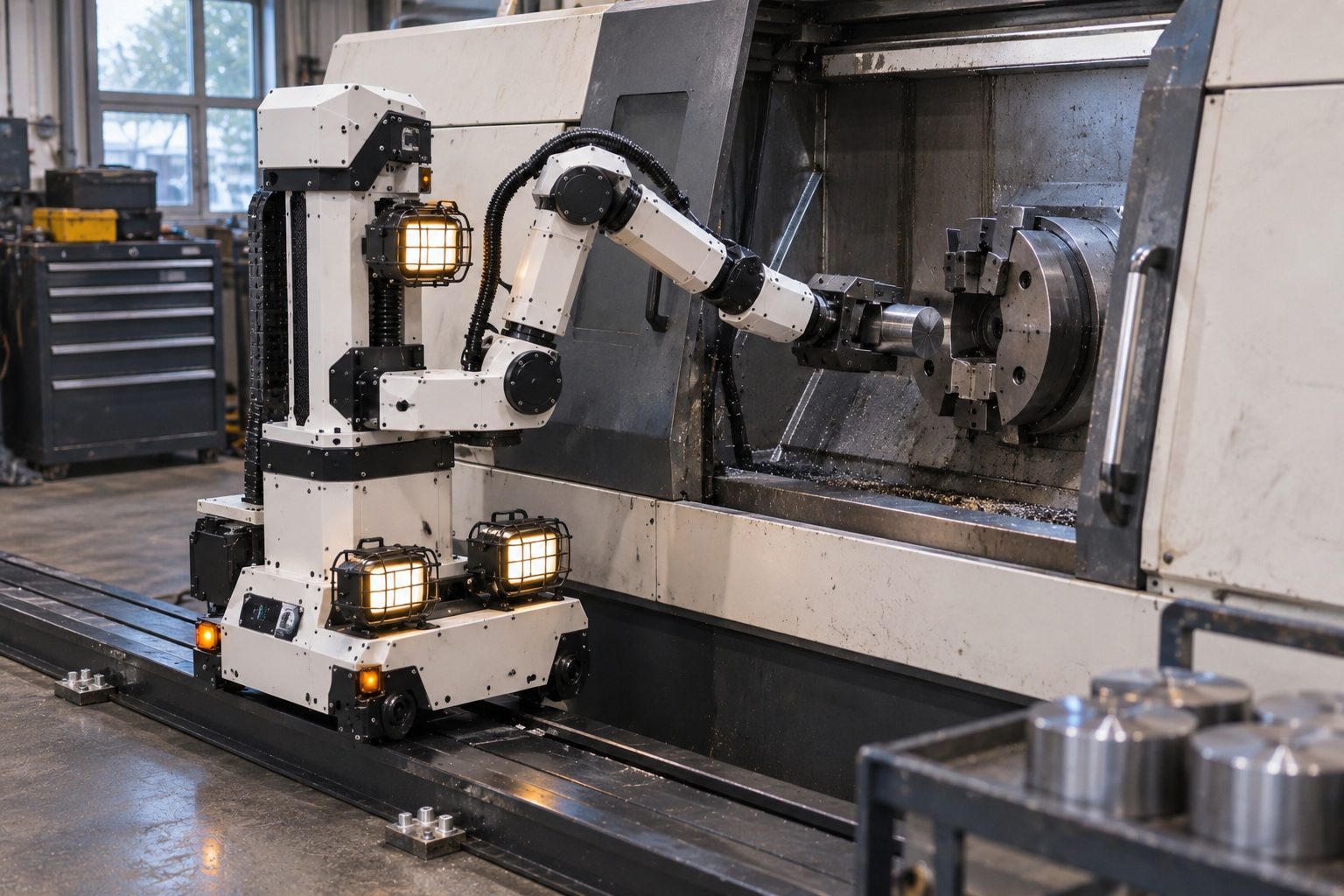
Load and unload
A carrier with a collaborative arm stops at a machine, opens it through an automatic door and the chuck signals, and loads the part. The machine keeps its manual mode, so a person can still run it.
Pick and put away
The heavy carrier works the racks from robot-only aisles and brings kits to the line. People pick in an aisle only when the arm is parked or locked out of it.
Watch Riley work.
Riley loading the lathe, then working the parts store from the same rail.
How it works through a shift.
The work is plain. The carrier travels, stops, scans and does the task.
- It travels with the arm stowed. On travel-only runs, on ramps and at crossings the swivel is locked with a brake and a pin, the arm is stowed and the lift is low.
- It scans the part, then makes the path. A part and seam scanner rides on the carrier, so the arm carries only its tool. The path comes from the part in front of it, not from a part that was there last week.
- It takes the turnout. Every carrier has a second pinion, so each turnout works for both hands.
- It crosses your aisles flush. At a crossing the rail drops down a ramp of 1 in 20 and runs under flaps set flush with the floor. A plough on the carrier opens them. Carts and people cross on the level.
- It charges at home. Battery carriers sit on contact-charging docks at their home positions and all charge at once. The welding carriers draw from a conductor bar along the fabrication rails.
- It comes off for service. A carrier leaves the rail on a cart and goes to the bench. The rail stays clear for the others.
The numbers.
The arm figures are the arm maker's published figures for the arm on the light carrier. The welding and heavy carriers take other arms.
| Item | Shop Hand Rail, light carrier |
|---|---|
| Rail | Surface rail on anchored plates, rack and pinion, turnouts |
| Carrier | Swivel and lift riser, one arm per carrier |
| Arm payload | 10 kg |
| Arm reach | 1418 mm |
| Arm repeatability | 0.05 mm |
| Arm mass | 39 kg |
| Power | Battery with contact charging at the home dock |
| Tooling | One fixed gripper, jaws to suit the part family |
One network, laid out for our own plant.
This is the layout we drew for our own shop floor. Yours will be shorter or longer. The parts are the same.
| What | How many |
|---|---|
| Carriers | 7: two welding, four light, one heavy |
| Rail runs | 24, about 1,208 ft in all |
| Turnouts | 9 |
| Bends | 4 |
| Traversers | 2 |
| Flush crossings on ramps | 6 ramp zones at 1 in 20 |
| Contact-charging docks | 8, all charging at once |
| Interlocked aisle gates | 4, on the robot-only aisles |
How it stays safe.
AI plans. Rules govern. Humans authorize. Safety has veto. Any stop stops motion, and sensing can only take authority away.
- Fields ahead of the carrier. Area scanners are designed to hold a protective field around a standing carrier and a longer one ahead of a moving carrier. Someone steps in, the carrier stops.
- Gates on the robot-only aisles. The side aisles the heavy arm works are closed by interlocked gates.
- No motion under a crane load. The rail is designed so a loaded crane over a rail zone stops robot motion in that zone, and a robot moving in a zone holds the loaded crane out of it.
- Off the contacts before it moves. An interlock proves the carrier is clear of its charging dock before travel is allowed.
- The heavy arm has limits. It has fixed travel limits and does not work on a grade.
- An engineer signs the building work. Anchors, slab, electrical and robot-safety work go to a licensed engineer for your site. We do not ask you to take our word for your floor.
What comes with it, and what we need from you.
Shop Hand Rail is fitted to a building, so the first step is a walk through yours.
- What comes with it. The rail, plates and anchors, the turnouts, the carriers with swivel and lift riser, the arms and their tooling, the part and seam scanners, the safety scanners, the charging docks and their panel.
- What we need. Your floor plan, the stations and the work at each one, your crane coverage, and what you know about the slab.
- What we will tell you. Where a rail and an arm would earn their place in your shop, and where they would not.
- Have manual machines you want to keep? Plant Hand rides the same rail and runs them through their own controls.
One rail on your floor, one arm at many stations. It welds, tends machines and moves kits, and it stops when a person, a gate or a crane says stop.