
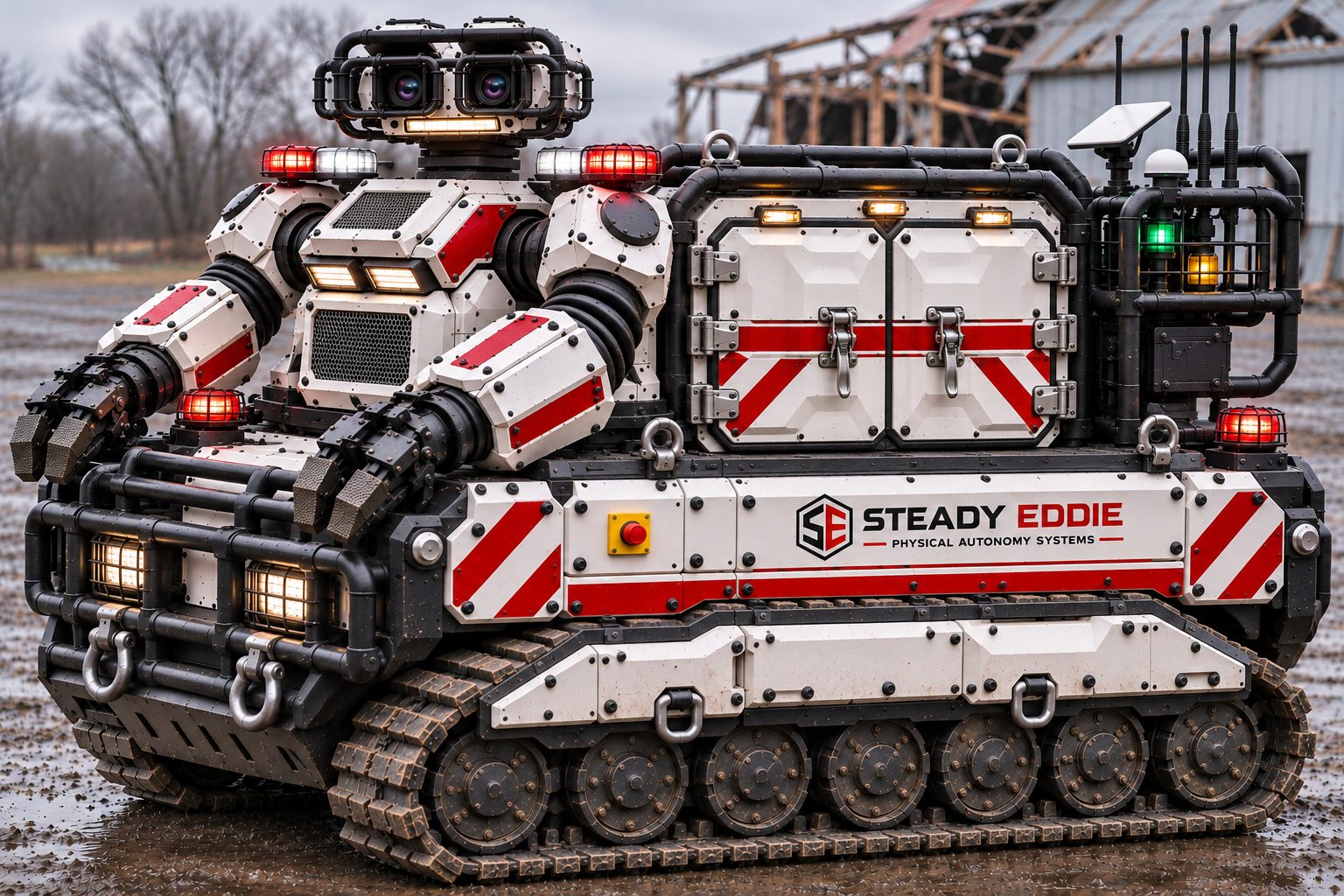
Twelve drones. One hub. Your people in command.
Alexander is a fully autonomous communication hub, and it carries twelve drones. Driven to site and engaged by the person in charge, it offloads itself, drives itself to the incident area and sends up its drones, mission ready to survey, assess, report and direct. Alexander assists and coordinates. Your people stay in command.
This is Alexander.
Alexander is our first responder. After a storm, a washout or a collapse, somebody has to look before anyone knows whether the ground is safe to stand on. Alexander gives your people eyes from above and on the ground, light, a voice and a shared record they can replay. What it and its drones gather goes to your responders' phones as it is gathered. Your people keep the command, the triage, the care and the rescue.
How a call runs.
Alexander does the driving. The person in charge decides where it may go.
- To the scene. Alexander rides on a truck or trailer, tied down, bay closed. It never drives itself on a public road.
- Engaged. The person in charge engages it and sets the area it may go to and its stand-off. A supervisor confirms.
- In on its own. It offloads itself and drives itself to the stand-off on open ground, on its own sensing.
- Drones up. It opens the bay and sends up its twelve drones, and relays what they gather to your responders' phones.
The bay opens. The drones go up.
Alexander carries twelve drones in an armoured bay behind the torso. Stopped at its stand-off, Alexander opens the bay and the door folds out flat into a landing platform where six drones land and charge at a time, so half the team can charge while the rest fly. The drones wear the same red and white.
- Survey. The drones fly the area and map it, each view marked with place and time.
- Assess. They look for heat, movement, people, damage and routes, and flag each find for a qualified person, who judges it.
- Report. Views and finds go live, through Alexander, to the responders the person in charge names.
- Direct. They show your people where to look and the way in, as seen from above. The person in charge commands.
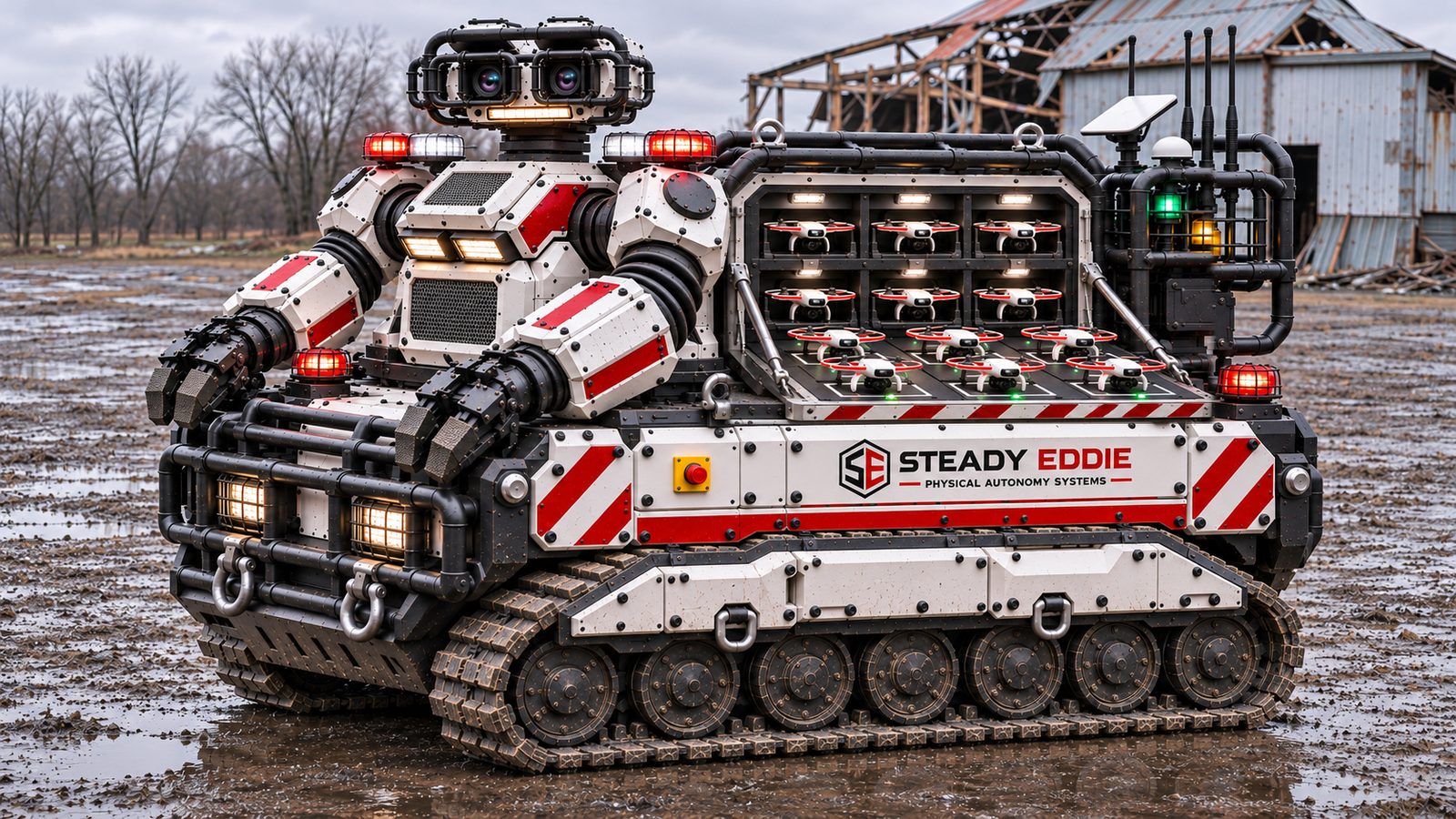
Watch the bay open.
Alexander on standby, the bay opening, and one drone going up and coming back to land and charge.
Assists and coordinates.
Alexander is the communication hub at the scene. Radio, mesh, cellular and satellite links tie its drones, an app on every responder's phone and incident command into one shared picture.
- The flight picture. Which drone is where, what has been looked at, battery and link. A qualified drone operator approves each flight and can take over or bring the drones down at any time.
- The shared picture. Zones, crew check-in and notes, entered by your people, each showing who entered it and when.
- Your radios first. The hub adds to your agency's radios and never replaces them. If it fails, the incident runs on without it.
On every responder's phone.
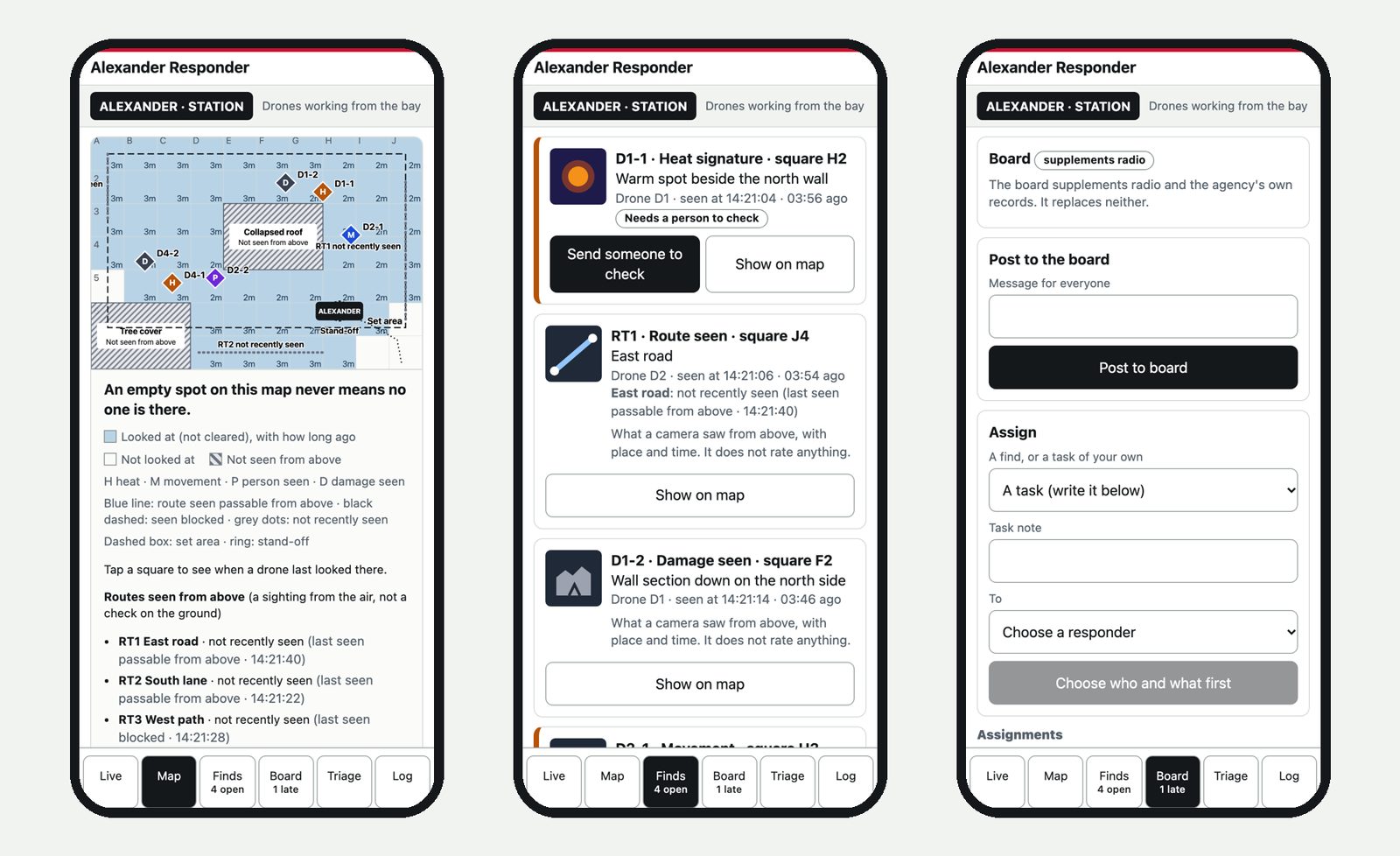
The Alexander Responder app puts what Alexander and its drones see in your people's hands, from the moment Alexander is engaged. Everyone sees the same picture, and every entry shows who made it and when.
- Live. Alexander's state, its cameras and all twelve drones: in the rack, on a pad or in the air.
- Map. The set area, the stand-off, what has been looked at and how long ago, and routes seen from above. An empty spot never means no one is there.
- Finds. Heat, movement, people and damage, each with place and time, for a person to check.
- Board. The person in charge assigns finds and tasks. The board adds to your radios and never replaces them.
- Log. Every message and entry in order, with a replay that is always marked as a replay. The record belongs to your agency.
Support, from outside the danger.
Triage support means support to a qualified person. The drones help that person find people and look at them, and that person makes every triage decision. Alexander never assigns, suggests or ranks a category, and nobody is ruled out from the air.
At a fire, Alexander works from outside: at the command post, staging or the casualty collection area, where the person in charge places it. It brings light, camera views, a voice and the shared picture. It does not enter fire or smoke.
How it stays safe.
AI plans, rules govern, humans authorize, safety has veto.
- Engaged by a person. The person in charge engages Alexander and sets where it may go. A supervisor confirms. Nothing moves until then.
- Emergency stops. On the robot, and the supervisor's stop. Either halts Alexander in every mode.
- It holds. For any person it senses, a lost supervisor link, a position fault or the edge of the set area, Alexander holds and a person decides. Wireless never carries the safety loop.
- Never on a public road. It rides to the scene on a truck or trailer and drives itself only inside the set area.
- Sensing only holds it back. Sensors can slow, hold or stop Alexander. They never give it permission to go into danger, and never call a place safe.
- Bay closed to drive. The bay is closed and latched for travel, and opens only with Alexander stopped.
- No find is final. A drone that sees no one never shows that an area is empty, searched or safe.
- Outside the rules. A situation the rules do not cover is a stop. Alexander waits for a person to decide.
Alexander is not a firefighter, a paramedic or a rescue team, and it replaces none of them. Your crew tests the air and deals with power lines and gas first. Keep Alexander out of fire, smoke, explosive or untested air, flood water, downed lines, hazardous materials, unstable structure and public traffic, and off debris or deep snow where a person could be lying unseen. The drones fly only where the airspace is clear to fly. We promise no response time. For the machines your agency already owns, see Steady Eddie for first responders.
It records. The record is yours.
Alexander records what its cameras and its drones see, with place and time, and can replay it. A replay is always marked as a replay. Nobody at the scene can edit or erase the record. It belongs to your agency, we have no access unless you ask in writing, and it is never used to train a model or for publicity.
What to tell us
Tell us the work and we will tell you plainly whether Alexander fits.
- Your crew. Who you are, who would be in charge of Alexander on scene, and who would fly the drones.
- The calls. What your people are sent to look at.
- The ground. Yard, trail, slope, debris or snow.
- The air. Where you would fly, and who controls the airspace above you.
- The radio picture. How your crew talks where it works.