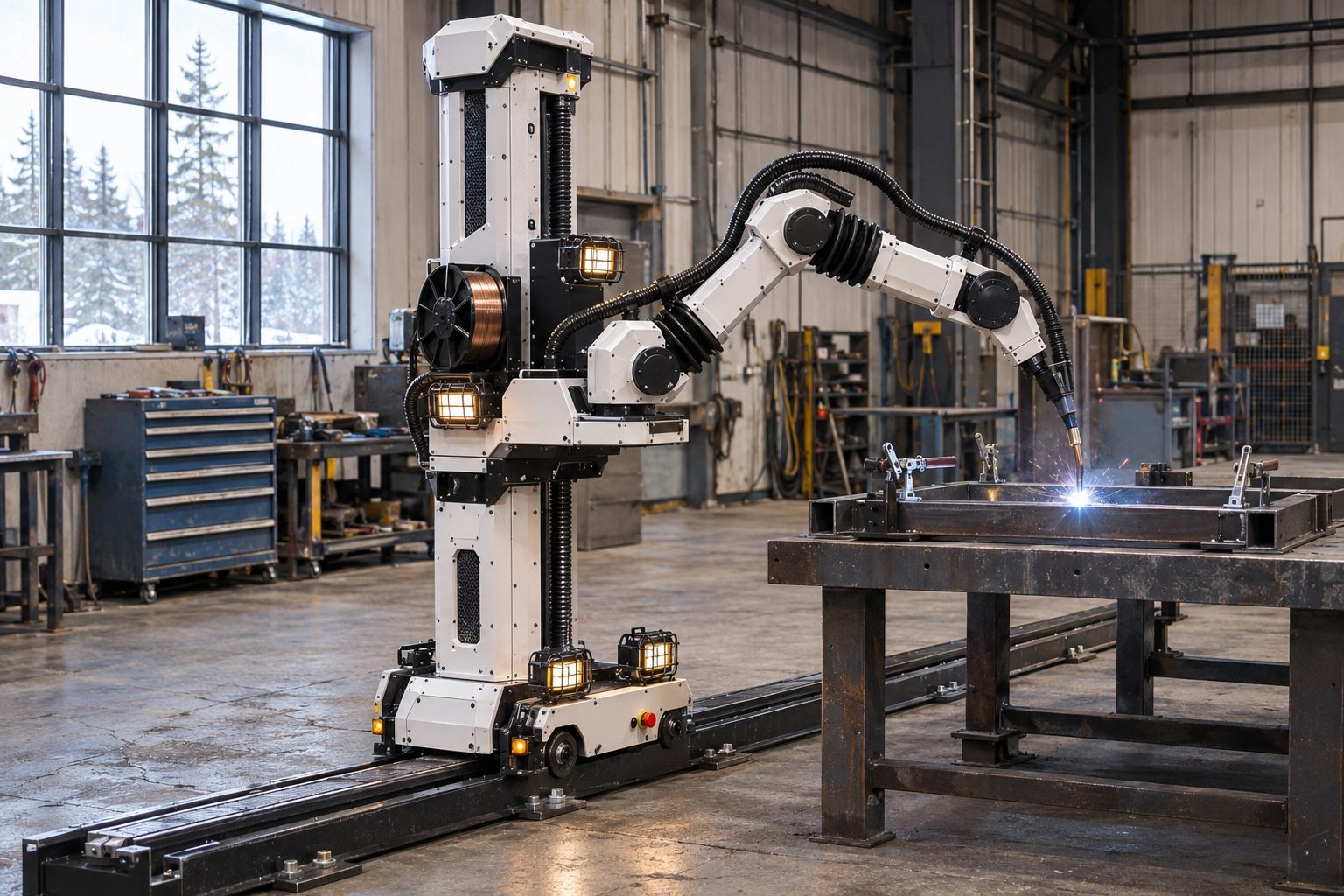
It drives to the part, stops, and welds.
STE Weld Hand is a welding arm on a travelling column. It rides the Shop Hand Rail along your floor to a station where a part sits in its fixture, stops, finds the seam, welds, and moves on to the next one. One arm covers a row of stations, so the big parts stay where they are.
This is Archie.
Archie is our welder. Most welding robots sit in a cell and the work comes to them. Archie goes the other way. It rides the shop rail to a part that takes a crane to move, stops, finds the seam and welds it. Archie takes the long, repeated seams. Your welders keep the fit-up, the tacking, the hard positions and the judgement calls.
A column, a lift and an arm, on a rail.
Most welding robots sit in a cell and the work comes to them. That suits small parts. It does not suit a frame that takes a crane to move.
Weld Hand goes the other way. The column travels the rail, the carriage climbs the column, and the arm reaches out from the carriage with a MIG torch. The fixture holds the part. The robot does the walking.
- Travelling column. Runs on the Shop Hand Rail, driven by rack and pinion as a servo axis.
- Lift carriage. Climbs the column on its own rack and pinion, so the arm reaches high seams on tall frames.
- Six-axis arm. A collaborative arm from an established robot maker, carrying the MIG torch.
- Sized to the job. The rail and carriage are sized to the arm the work needs.
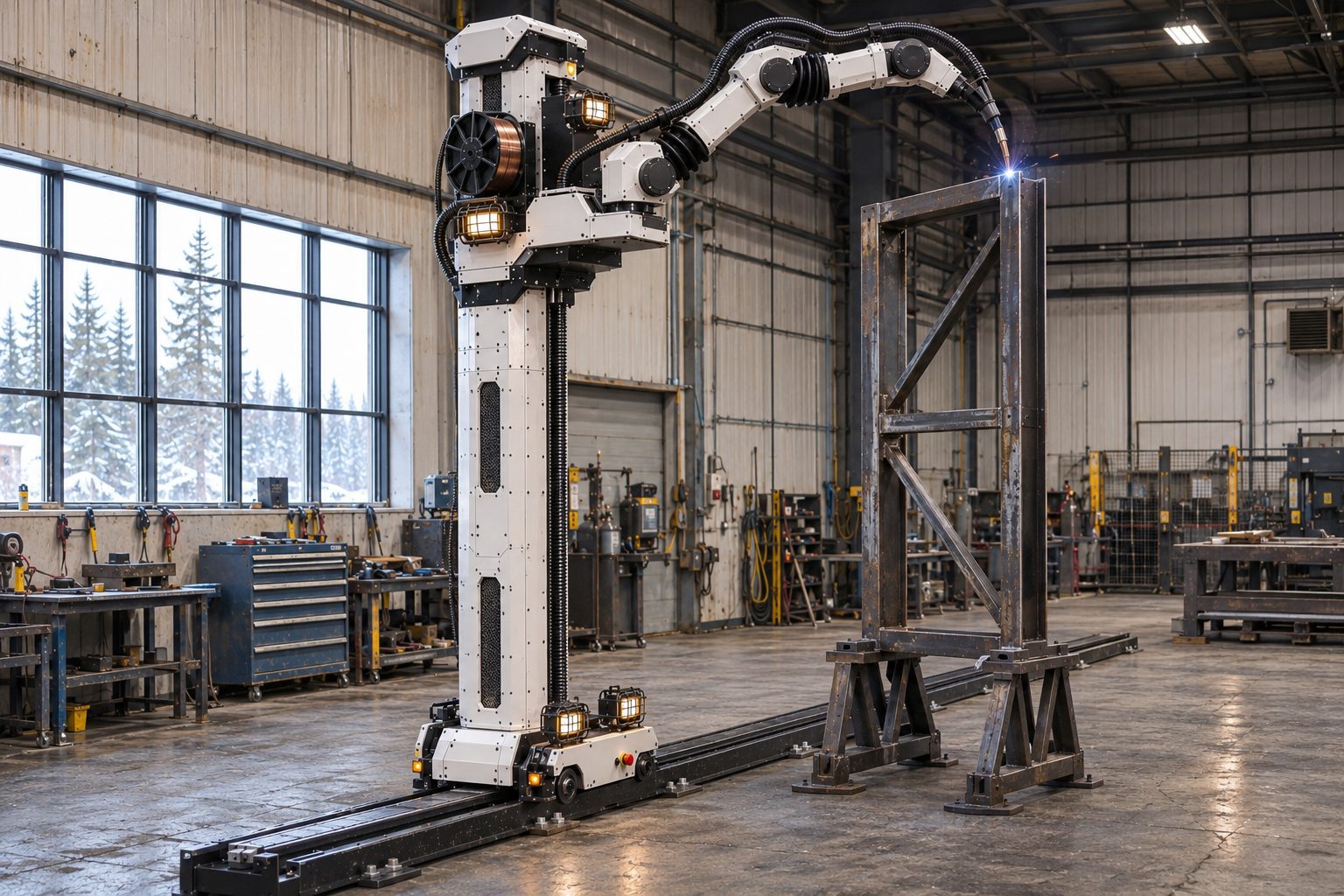
Watch Archie work.
Archie on a corner joint, then the top seam of a tall frame.
Who it is for.
Fabrication shops and plants that weld the same joints on parts too big or too awkward to carry to a cell.
- Long frames and repeat sub-assemblies. Parts held in fixtures on a grid table or on stands, welded where they sit.
- A row of stations, one arm. The rail links the stations. Weld Hand works one while your crew fits up the next.
- Shops short of welders. The robot takes the long, repeated seams. Your welders keep the fit-up, the tacking, the hard positions and the judgement calls.
How it finds the seam.
No fixture puts a part in exactly the same place twice, and steel moves when it gets hot. Weld Hand is designed to close the gap in steps, coarse to fine.
- The rail stop. The carriage drives to the taught station position and stops.
- The station datum. The arm touches two or three datum points on the fixture and shifts the whole station program to match.
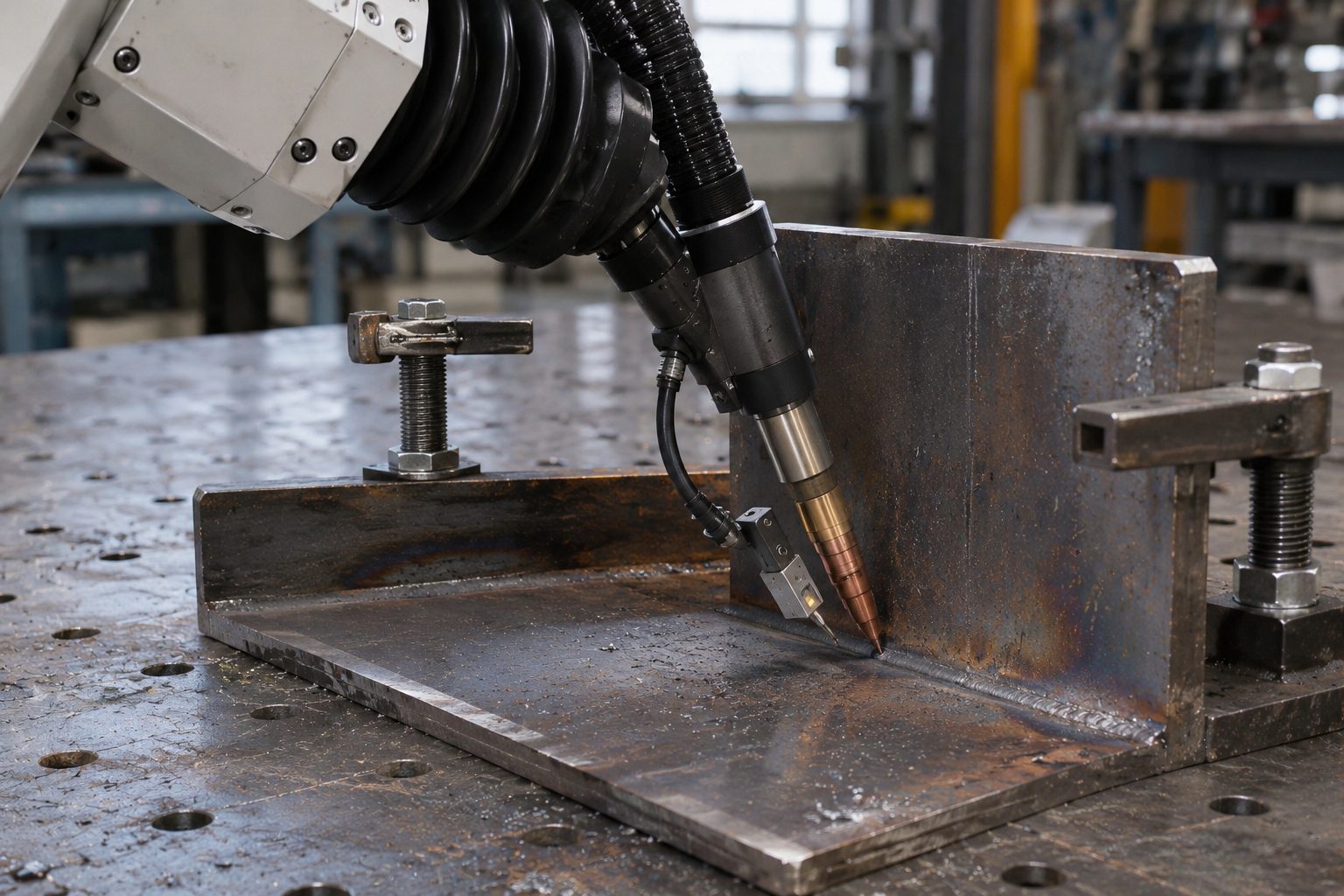
- Touch sensing. Before a weld, the wire touches the plates to find the joint and shift the path. It needs clean reference edges and it adds a little time to each weld.
- Through-arc tracking. While it welds, the arm weaves and reads the arc current to stay centred in the joint and follow the warp.
- Programs. Taught at the station, then corrected by the steps above on every part.
The numbers.
The arm figures are the arm maker's published figures. Rail length, station count and lift height are set by your floor and your parts.
| Item | Weld Hand |
|---|---|
| Process | MIG (GMAW), robotic power source and wire drive |
| Arm | Six-axis collaborative arm |
| Arm reach | 1,418 mm |
| Arm payload | 10 kg |
| Rail drive | Rack and pinion, servo controlled |
| Lift | Rack and pinion on the column |
| Rides on | Shop Hand Rail |
| Work holding | Fixtures on a 28 mm grid welding table, or on stands |
How it stays safe.
The Steady Eddie rules carry over unchanged: AI plans, rules govern, humans authorize, safety has veto. Welding adds arc, fume, spatter, hot work and UV, and those are dealt with at each station.
- Any stop stops motion. Weld Hand is designed so that a stop from any source stops the rail, the lift and the arm, and cuts the arc.
- A hard-wired safety loop. The stop circuit is wired, not left to software.
- A manual release on every actuator. The rail drive and the lift included.
- Sensing can only remove authority. A sensor can slow or stop the robot. It can never give it permission to move.
- A collaborative arm does not make welding safe. A live arc, a hot torch tip, spatter and fume are hazards whatever the arm's force limits. The risk assessment is done for each application and each station.
- Screens and fume capture are part of the station. Arc screening and fume extraction are set out station by station with your shop, to suit your floor and your ventilation.
What stays with your shop.
Weld Hand puts the torch where the program says. It does not decide what a good weld is.
- The weld procedure. Your procedures, the code they are written to and your inspection stay yours. Weld Hand runs the procedure you qualify for it.
- Fit-up. Seam finding corrects small differences. It does not fix a poor fit or a dirty joint.
- The floor. People, carts and forklifts cross the rail, and cranes work overhead. How Weld Hand shares that floor is set out with you before it runs.
One welding arm, one rail, a row of stations. It drives to the part, stops, finds the seam and welds. Your welders keep the work that needs a welder.