
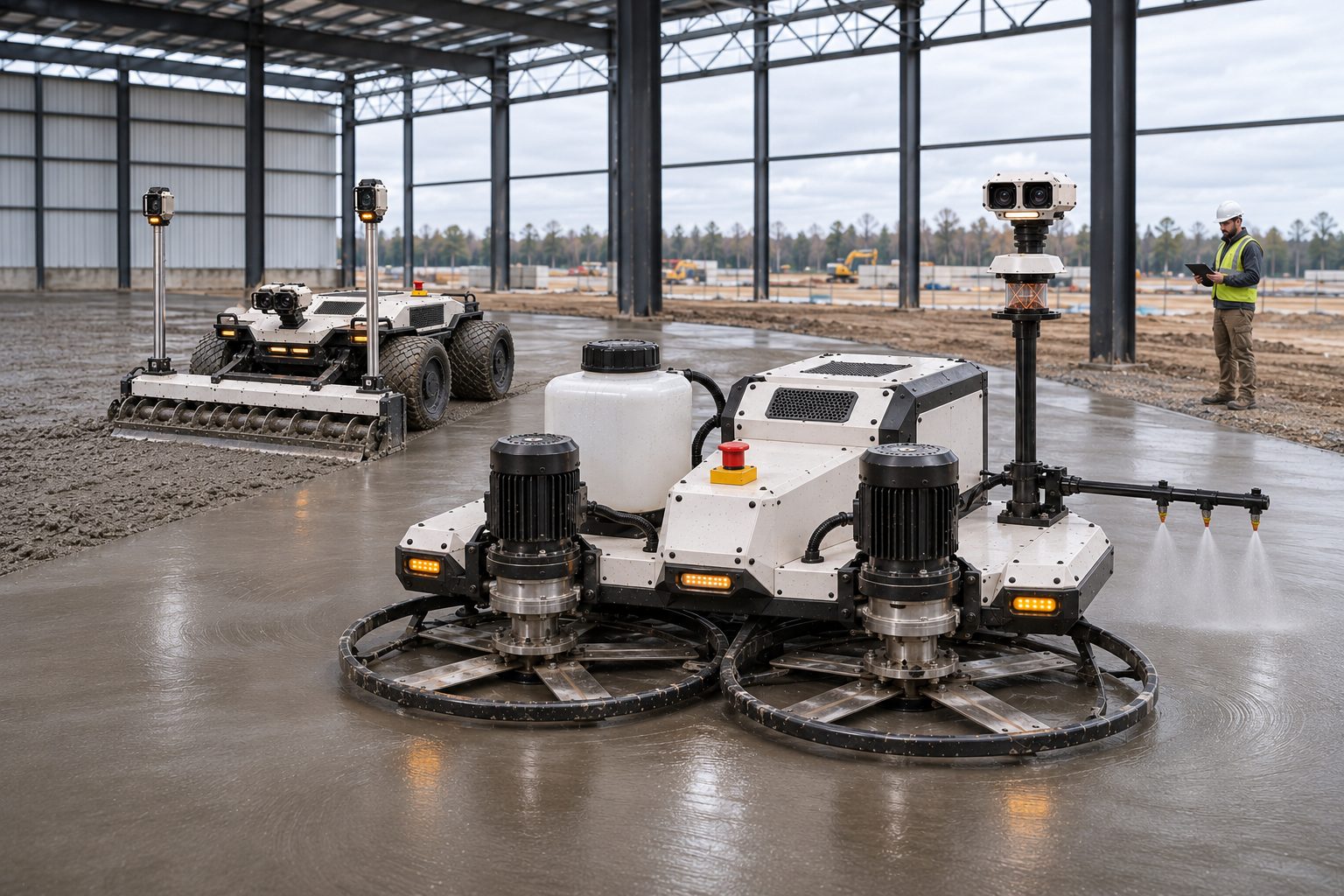
The slab sets the clock. Two robots screed, finish and seal it.
A slab does not wait. Once the concrete is placed, the mix and the temperature set the finishing window, not the crew. This kit works beside STE Site Hand off a truck hub: a screed robot strikes the slab off to laser grade, and a finish-and-seal robot floats it, trowels it and sprays the sealer. One operator supervises both from the slab edge.
Meet Levi and Flo.
Levi is our screed hand, and Flo is our finisher. Levi strikes the slab off. A slab does not wait. Once the concrete is placed, the mix and the temperature set the clock, not the crew. So Levi rides in the wet concrete and screeds it to laser grade, then hands the slab to Flo.
Flo finishes what Levi starts. Flo is a twin-rotor trowel with nobody on it. It floats the slab, trowels it and sprays the sealer. The concrete decides when, and the kit reads it. Levi and Flo come as one kit and work beside Eddie, off the same truck. One operator supervises both from the slab edge.
Four steps, in the order the concrete asks for.
The sequence is the one a finishing crew runs today. The robots take the passes. The operator makes the calls.
- Set the grade. A rotating laser and a robotic total station on tripods give both robots their reference.
- Screed. The screed robot strikes off and consolidates to grade, riding in the fresh concrete on four wide low-pressure wheels.
- Float and trowel. When the slab is ready, the finish robot makes one float pass on pans, then three trowel passes on blades.
- Seal. On the last pass the spray bar lays a water-based cure-and-seal coat.
Watch Levi and Flo work.
Levi screeding the pour, then Flo trowelling and sealing.
The screed robot rides in the wet concrete.
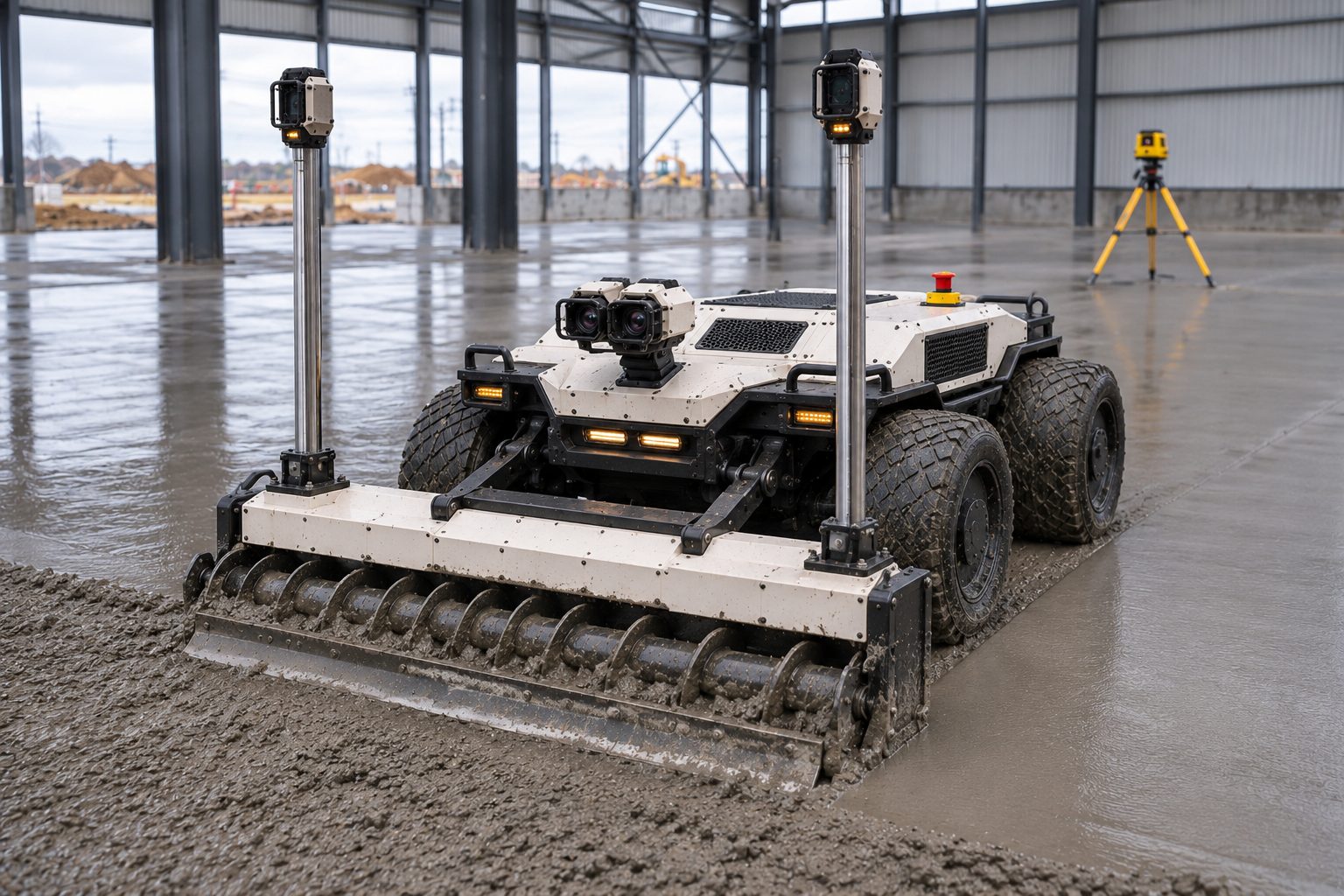
The head is 2,400 mm wide and carries the strike-off, an auger and a vibrator. A laser receiver on a mast at each end of the head holds its height to the laser, closed loop.
Four wheels, each 450 mm wide, spread the load so the machine can work in plastic concrete. It runs on one swappable battery pack, so no cable drags across the slab.
- Rate. Designed to screed 150 m² an hour.
- Ground pressure. 15.2 kPa in fresh concrete, by calculation.
- Run time. Designed to run about 138 minutes on a pack. One swap covers a 400 m² pour.
The finish robot is a twin-rotor trowel with nobody on it.
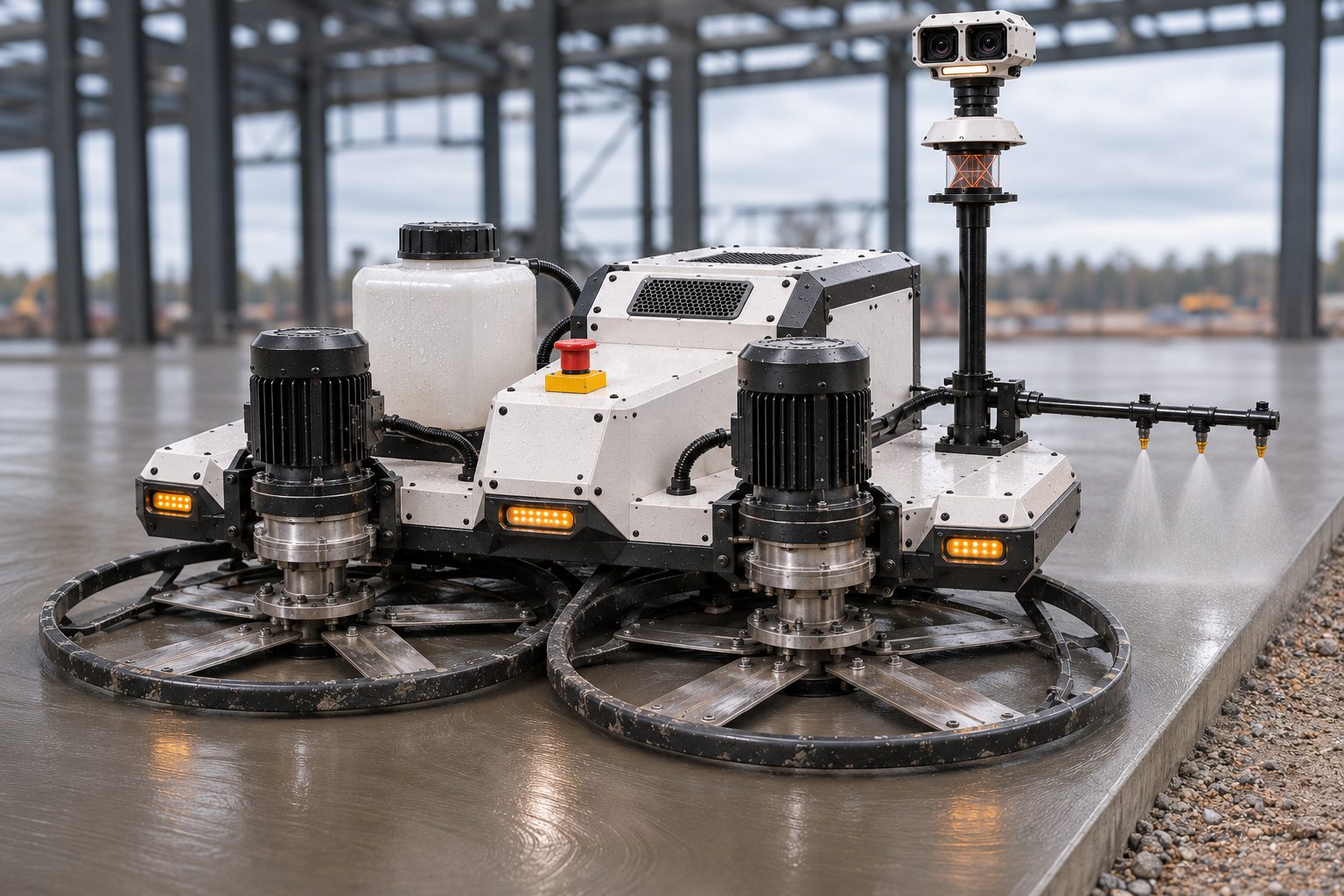
Two counter-rotating 915 mm rotors sit inside a guard ring. Pans go on for the float pass and come off for the trowel passes on blades. Its own weight does the trowelling, and it steers by tilting the rotors, the way a ride-on trowel does. An electric actuator on each rotor sets the blade pitch.
It carries a 40 L sealer tank and a 1,800 mm spray bar in four sections, with a metered pump and a flow sensor on each section. The tank is topped up from the truck at each pack swap.
- Rate. Designed to finish 300 m² an hour on each pass.
- Pour size. From 50 m² up to 400 m² for one finish robot at a concrete temperature of 20 °C.
- Sealer. Water-based cure-and-seal products only.
The kit, the numbers.
From the two data sheets. Rates and run times are what the machines are designed to do.
| Item | Screed robot | Finish-and-seal robot |
|---|---|---|
| Working tool | 2,400 mm head with auger and vibrator | Two counter-rotating 915 mm rotors, pans and blades |
| Size | Body 1,900 × 1,350 mm, 800 mm high | 1,990 × 1,175 × 900 mm |
| Running gear | 4 wheels, 500 mm diameter × 450 mm wide | Rides on its rotors. Steers by rotor tilt. |
| Mass | 353.9 kg, inside a 450 kg limit | 434.9 kg, inside a 450 kg limit |
| Rate | Designed to screed 150 m²/h | Designed to finish 300 m²/h per pass |
| Passes | One, to laser grade | 1 float and 3 trowel, then the seal coat |
| Grade control | Laser receivers at both ends of the head, closed-loop head height | Works the surface the screed robot leaves |
| Sealer | None | 40 L tank, 1,800 mm spray bar in 4 sections |
| Battery | One 10 kWh swappable lithium iron phosphate pack | The same pack. One in the robot, three at the truck. |
| Run time per pack | Designed for about 138 minutes | Designed for about 50 minutes |
| Pack | 9 kWh usable, 90.9 kg | 9 kWh usable, 90.9 kg |
| Slab | Interior slab on grade | Interior slab on grade, steel-trowel finish |
| Operators | One, for both robots | One, for both robots |
The truck is the hub.
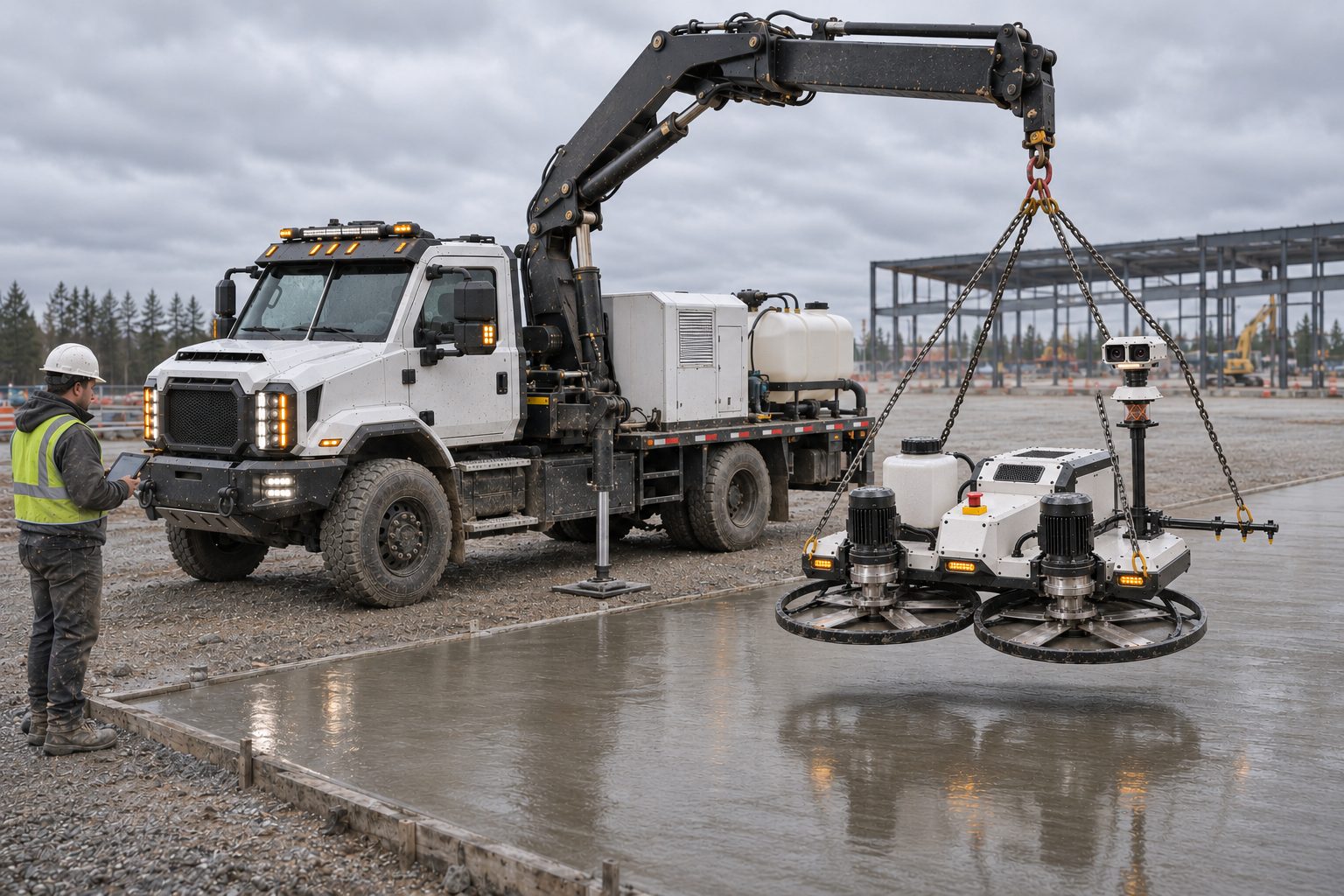
The kit works off a Class 6 or Class 7 truck. The truck carries the two robots, charges the packs, refills the sealer and holds the wash water. A knuckle-boom crane of the 3.1 t·m class swings the robots onto the slab and swings the packs.
Where the pour is inside a building and the crane cannot reach, a pack swap cart serves the robots, and the finish robot rolls in on its own retractable dolly wheels over an edge ramp.
- Five packs, one type. Both robots use the same pack. Two charge at a time, at 10 kW each.
- Charging. Packs charge while the genset or shore power runs. The genset runs parked only.
- Sealer and water. A 200 L bulk sealer tank and 300 L of wash water on the truck.
- Lifted, not carried. A pack weighs 90.9 kg. The crane or the cart moves it, not a person.
The concrete decides when. The kit reads it.
The kit is sized on one finish robot, a 400 m² pour and concrete at 20 °C. Warmer concrete sets sooner.
- Readiness station. It reads slab temperature, air temperature, humidity and wind. A footprint probe on the finish robot checks the surface.
- Hot day. The readiness model on the truck caps the area one finish robot takes, or calls for a second finish robot.
- Flatness. The kit is designed for the FF25/FL20 class, a moderately flat floor. The numbers that count are the ones measured on your slab.
- What it is for. Interior slabs on grade with a steel-trowel finish.
- What it is not for. Elevated decks, exterior broom finishes, stamped, coloured or polished work, and hard trowelling of air-entrained mixes.
One operator. Any stop stops motion.
The same rules as the rest of the line: AI plans, rules govern, humans authorize, safety has veto. Sensing can only remove authority.
- Stops. E-stops on each robot, on the tablet and on the truck, and a wireless stop the operator carries that is designed to reach each robot directly.
- People. A safety scanner on each robot. A person in the warning field is designed to slow it, and a person in the protective field to stop it.
- Edges. A slab-map boundary and edge sensors are designed to stop a robot before a form, an edge or a drop.
- Rotors. Contact on the guard-ring bumper is designed to stop the rotors at once.
- Link loss. Loss of the link to the truck is designed to bring both robots to a controlled stop.
- Packs and sealer. A pack bay is designed to unlock only with the robot powered down. The sealer pump is designed to stop when the robot stops or leaves the spray zone.
- By hand. Manual moves need an enabling switch held on the tablet. The screed head is designed to lower only with the head zone clear.
- Safety, in full. How Site Hand stops, and who is in charge.
Two robots, one pack type, one truck, one operator. The crew still reads the slab and makes the call. The robots take the passes against the clock.