
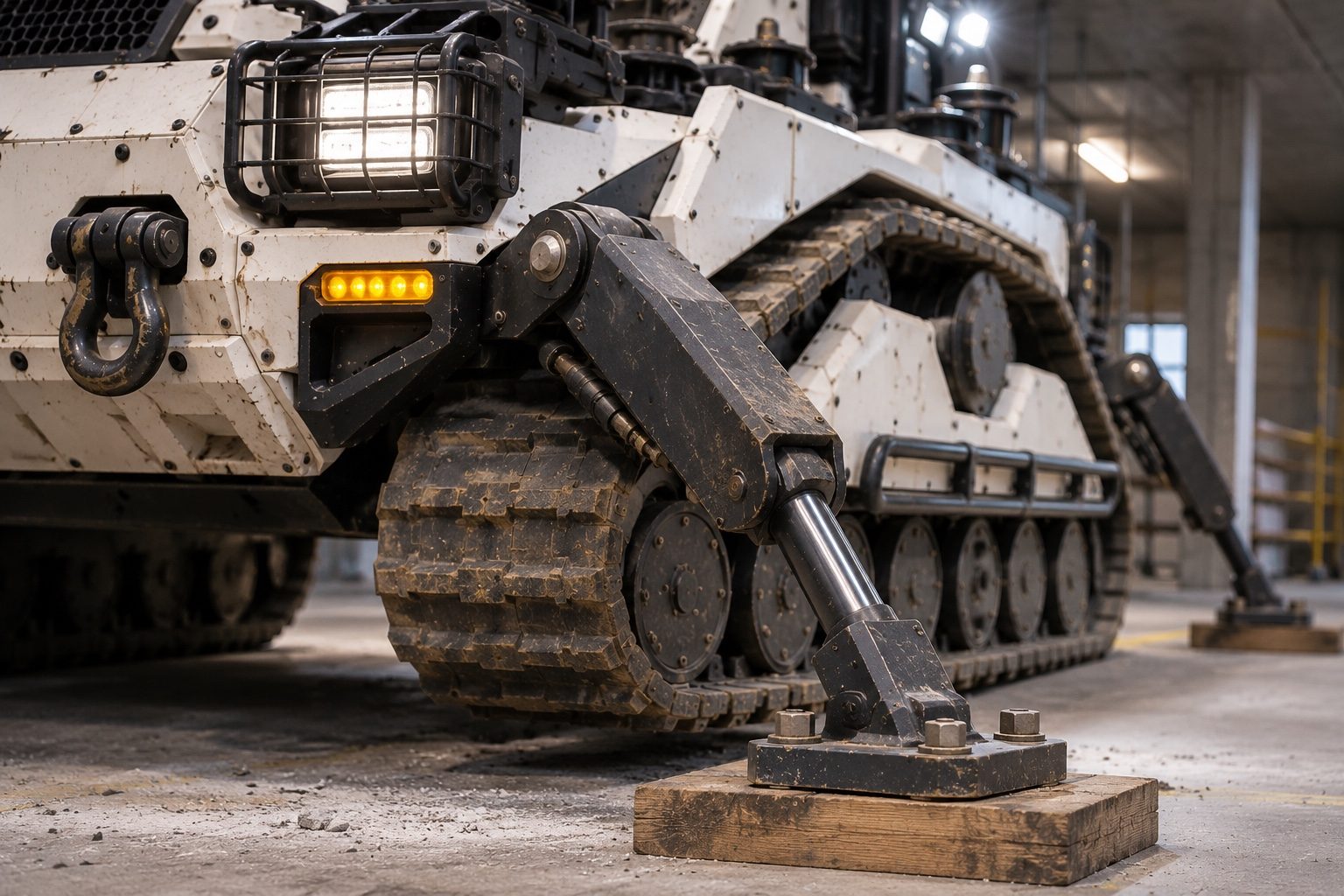
How Site Hand stays safe beside a crew.
STE Site Hand is a machine with arms and a mast, working where people work. This page says plainly how it is designed to behave around them, and what it is not for. AI plans, rules govern, humans authorize, safety has veto.
Four lines we hold to.
The same four lines sit under each Steady Eddie machine.
- AI plans. The computer works out how to do the job.
- Rules govern. A separate safety controller decides whether the machine may move. No data message from the computer counts as permission.
- Humans authorize. A person sets the working mode with a key and holds the stop.
- Safety has veto. Any stop stops motion. Sensing can only take authority away, never add it.
Three keyed working modes.
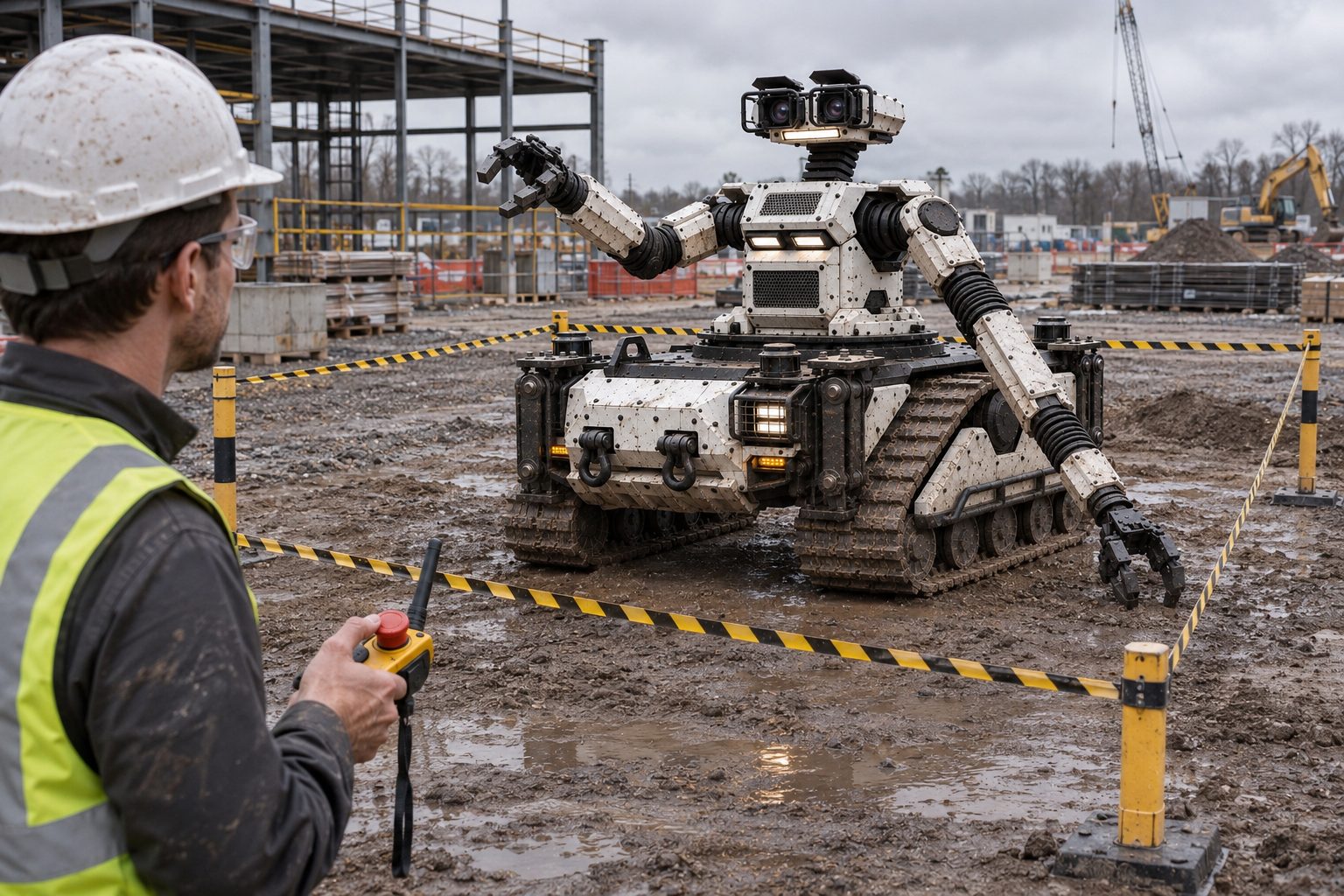
The mode is chosen by a person, with a key. Each one sets how close people may be and how fast the machine may move.
| Mode | Where people are | What the machine is held to |
|---|---|---|
| M1 Collaborative | A person may stand within reach. | Arms held to power and force limits, tool speed to 250 mm/s, base to 0.3 m/s (0.7 mph). |
| M2 Separation | People are kept outside the protective field by the scanners. | Full arm speed is allowed. Designed to slow to M1 speeds or stop as a person approaches. |
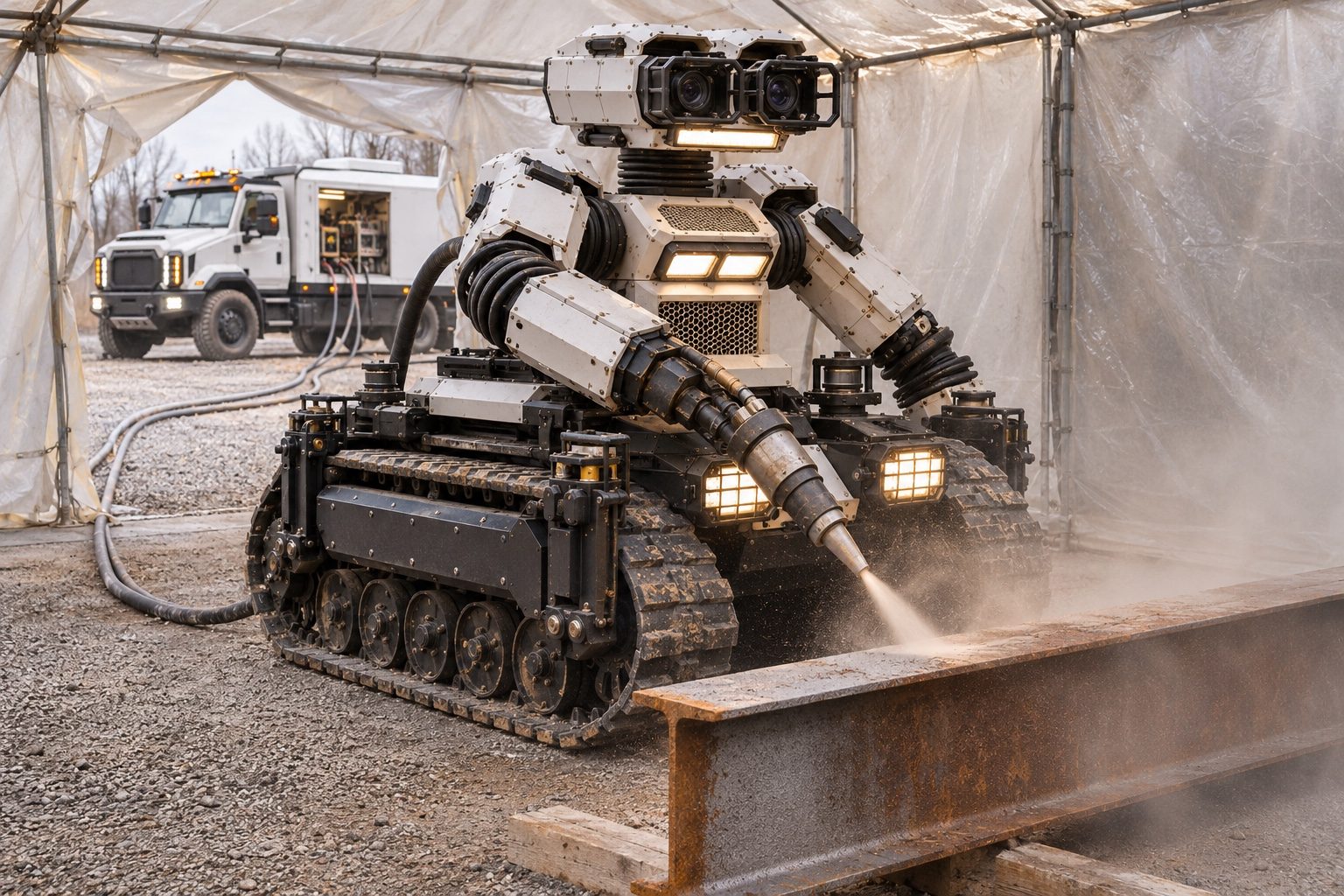
| M3 Bounded zone | A bounded area with nobody inside, and a supervisor holding the stop. | For work with nobody inside the area. The Heavy's wheel high range of 3 m/s (6.7 mph) applies here only. |
The Heavy is different, on purpose.
The Heavy has no hand-guided contact work. On the Heavy, people stay outside the separation distance while the arms or the mast move.
Abrasive blasting runs in the bounded zone only.
- Home. Two corner scanners. Works inside its track footprint.
- Tradesman. Two scanners and four outrigger pads.
- Heavy. Four scanners and four outrigger pads.
Protective fields and stop distance.
Safety scanners watch the ground around the machine. These are the values the two larger sizes are designed to.
| Size | Scanners | Field radius, tracks / wheels | Designed to stop within, on tracks |
|---|---|---|---|
| Home | Two corner scanners | Ask us | Ask us |
| Tradesman | 2 | 3.19 m (10.5 ft) / 3.03 m (9.9 ft) | 0.84 m (2.8 ft) in 1.2 s |
| Heavy | 4 | 3.15 m (10.4 ft) / 3.84 m (12.6 ft) | 0.72 m (2.4 ft) in 1.25 s |
Outrigger pads, with a load cell in each one.
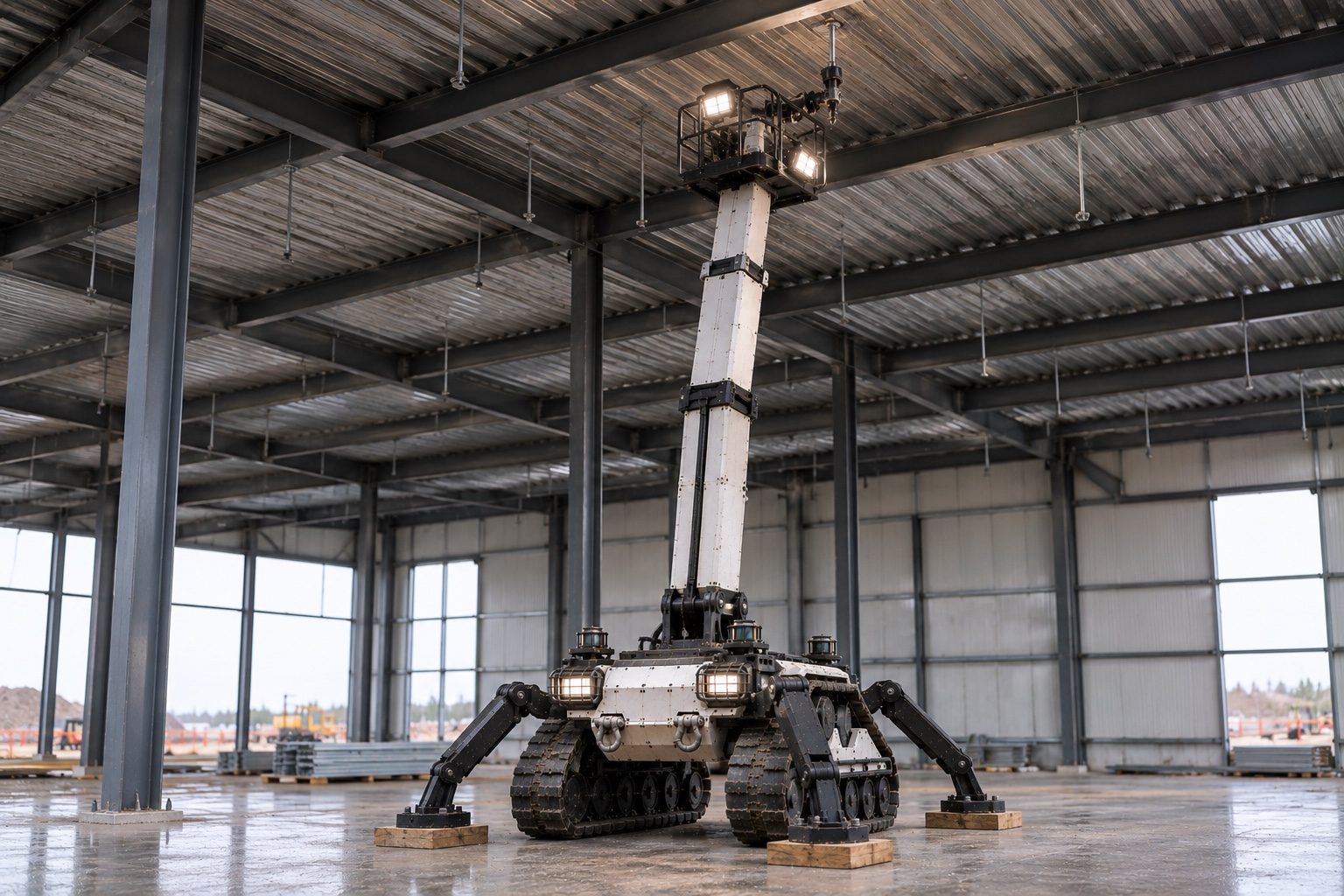
The Tradesman and the Heavy have swing-out outrigger legs. Each pad has a load cell, so the machine knows each pad is carrying before it does anything tall. The legs are designed to level the base on a slope of up to 10 %, and the base is designed to keep a running stability margin from the pad loads and the battery slots.
The pads are designed to load before an arm works at full reach or the mast rises.
- Mast. Designed to rise only on loaded pads with the base level.
- Driving. The base is designed not to drive with the mast up.
- Wheels. On wheel pods, arm work is designed to happen only on loaded pads.
- Span. 2,400 by 1,800 mm on the Tradesman, 2,800 by 2,800 mm on the Heavy.
- Feet. 340 mm square on the Tradesman and 400 mm on the Heavy. Soft feet indoors, cribbing outdoors.
Three things take control away.
None of them asks the planning computer first.
- A stop. E-stops on the body, on the tablet and on the truck loop, and a wireless safety stop.
- A lost link. Loss of the safety link is designed to stop the machine.
- A person in the field. In M2 the scanners are designed to slow the machine to M1 speeds or stop it as a person approaches.
- Then it holds. Spring-applied brakes and holds on each axis: tracks, pods, waist, mast and arms.
- Behind all of it. The safety controller is designed to apply 19 safety functions, plus 9 more added by the risk assessment.
What it is not for.
Plain limits, so nobody has to guess.
- Not for these. Site Hand is not designed for work in live traffic, work over people, lifting people, classified gas areas or stairs.
- Keep-outs. Rebar mats and fresh concrete are keep-outs on the site map.
- Ground. Soft, wet or steep ground stays on tracks. Steeper or wet truck loading uses the liftgate.
- Weather. Designed to operate from -20 to +40 °C.
- Your site rules still rule. The robot works inside your safety plan and your supervisor's call. It does not replace either.
A person picks the mode with a key. Scanners, pads and a separate safety controller can only say no. Any stop stops motion.