
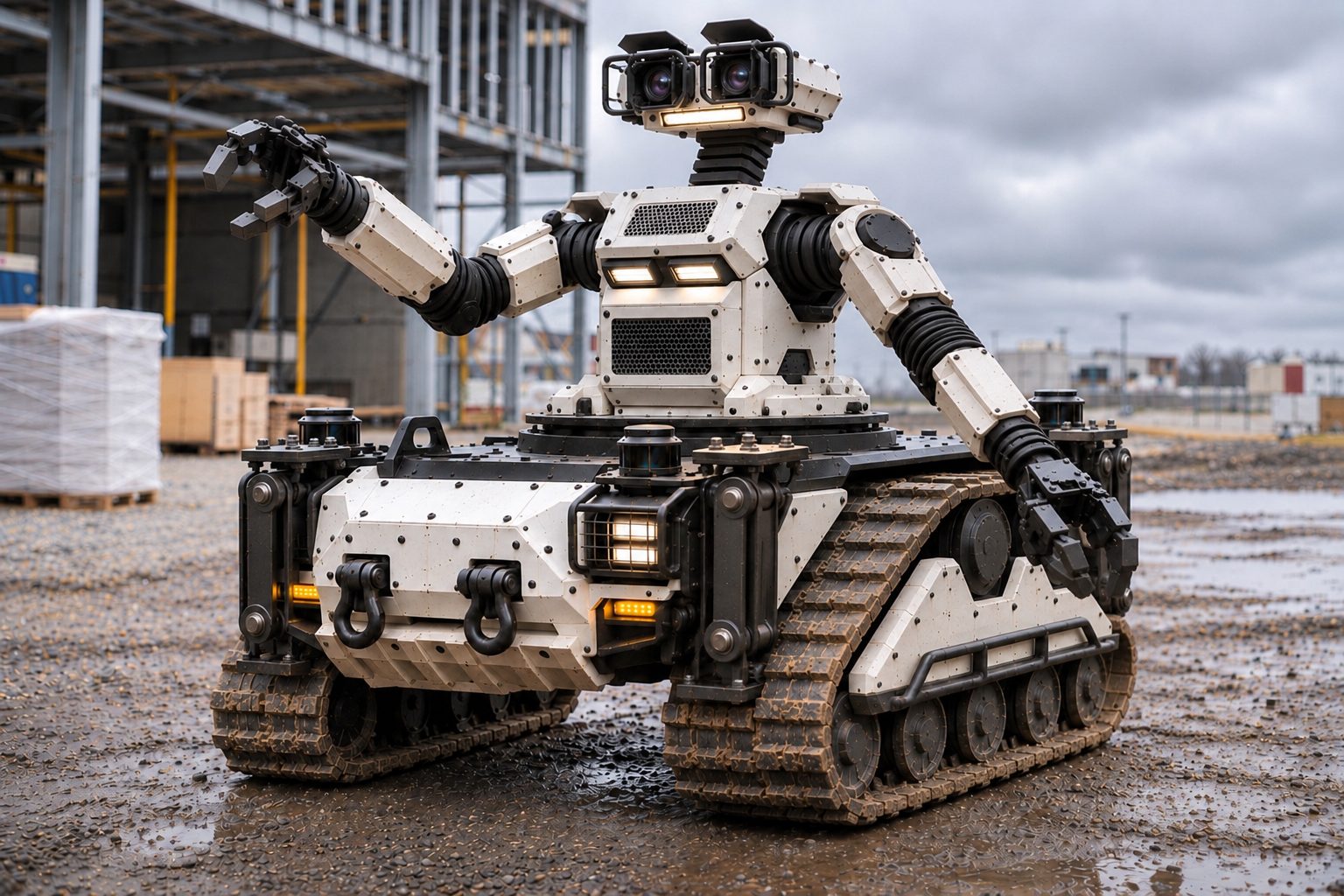
Pallet size. Built for the ground outside.
STE Site Hand Heavy is about the size of a pallet, 1,200 mm by 1,200 mm. It is for outdoor, site and tank work from the truck: mast work at a tank shell, abrasive blasting, hauling and hitch tools. On the Heavy, people stay clear while the arms or the mast move.
Two tops. One of them reaches 7.5 metres.
The Standard top is a two-arm torso on a lift mast. The lift is 2,000 mm, taking the shoulders from 1,100 mm up to 3,100 mm.
The Reach top is a telescoping mast designed to reach a tool height of 7,500 mm (295 in). Its head sits 1,400 mm off the mast, so from planted pads it is designed to reach past a tank shell and over the roof edge.
- Pads first. The mast is designed to rise only on loaded outrigger pads with the base level.
- No driving with the mast up. The base is designed to stay put until the mast is down.
- Eleven configurations. Bare, Standard or Reach, on tracks or wheels, with an optional rear mount and turret pack. Each stays inside the 1,370 kg mass limit.
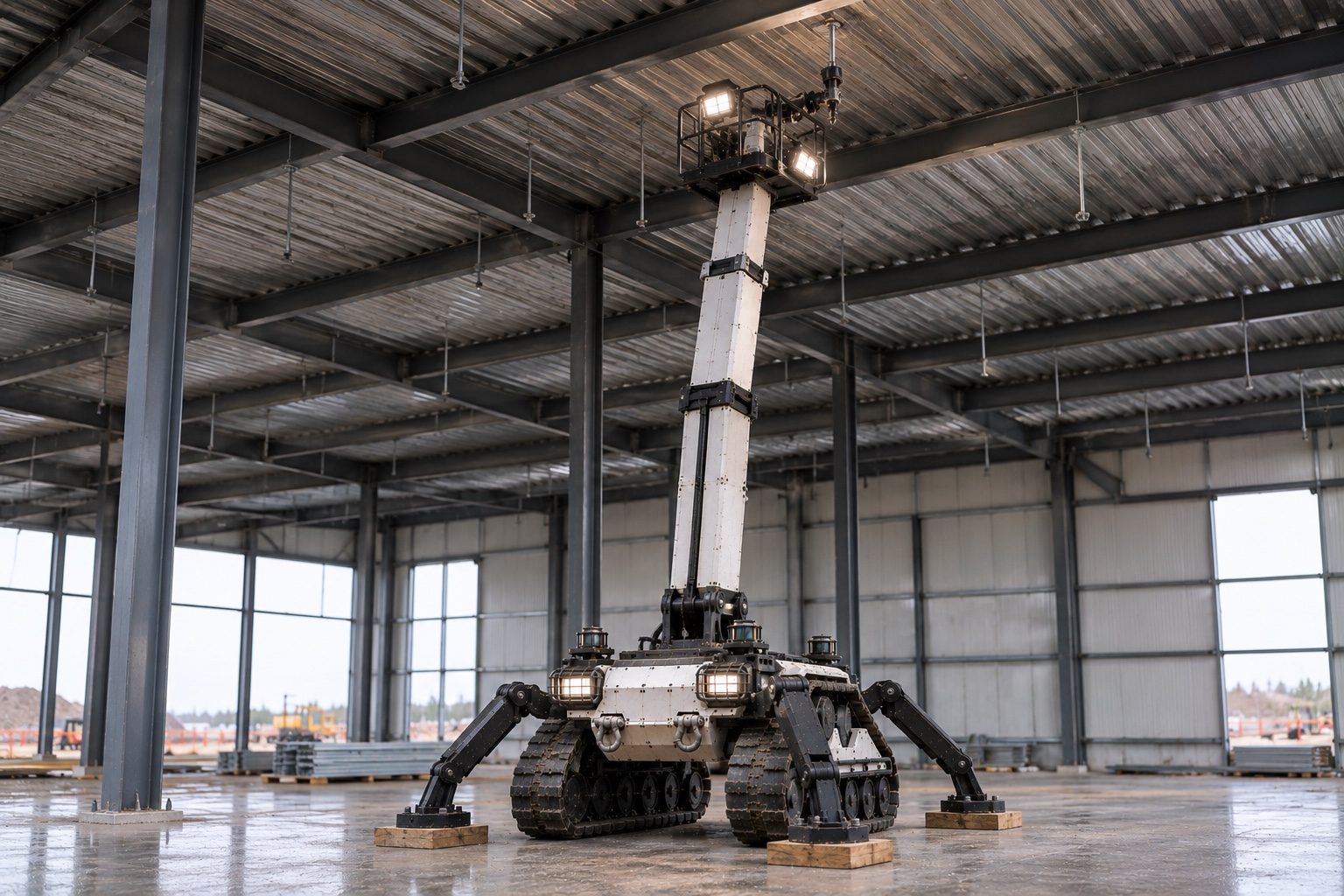
Heavy, the numbers.
From the Heavy data sheet. Speeds, grades and stop distance are what the machine is designed to do.
| Item | Value |
|---|---|
| Stowed size, L × W × H | 1,200 × 1,200 × 1,750 mm (47 × 47 × 69 in) |
| Mass limit, any configuration | 1,370 kg (3,020 lb) |
| Lift stroke, Standard top | 2,000 mm (78.7 in) |
| Shoulder height, mast down to up | 1,100 mm (43.3 in) to 3,100 mm (122.0 in) |
| Reach top | Tool height 7,500 mm (295.3 in), head offset 1,400 mm (55.1 in) |
| Running gear | Track pods. Wheel pods optional. |
| Curb climb, on tracks | 250 mm (9.8 in) |
| Grade on tracks, soft ground | 30 % |
| Travel speed on tracks, M2 and M3 | 1 m/s (2.2 mph) |
| Base speed in M1 | Held to 0.3 m/s (0.7 mph) |
| Wheel pods, M2 | Capped at 2.6 m/s (5.8 mph) |
| Wheel pods, high range | 3 m/s (6.7 mph), inside a bounded M3 zone only |
| Truck ramp, dry and firm | 17° (30 %) |
| Scanners and protective field | 4 scanners. Field radius 3.15 m (10.4 ft) on tracks, 3.84 m (12.6 ft) on wheels. |
| Stop distance, on tracks | Designed to stop within 0.72 m (2.4 ft) |
| Outrigger legs | Span 2,800 × 2,800 mm. Feet 400 mm square. Pad pressure 32.4 kPa (4.7 psi). |
| Side mounts, left and right | 80 kg (176 lb) and 400 N·m each, projecting 300 mm |
| Power | 400 V bus, 6 kW continuous working power |
| Battery | Two swappable lithium iron phosphate packs in the base. The Reach top carries a third on the turret. |
| Corded mode | Tether of 30 m (98 ft) |
| Colour | White body with black trim |
Tracks for the soft ground. Wheels for the firm.
Track pods are the base fit, for soft, wet or steep ground. Wheel pods are the firm-ground option, for yards, slabs and lanes.
On wheels the Heavy is capped at 2.6 m/s where people are about. Its high range of 3 m/s applies only inside a bounded zone with nobody in it. Arm work on wheels is designed to happen only on loaded pads.
- Side mounts. A mount on each side for carried tools, the Heavy only.
- Front hitch. A front hitch rated 230 kg and 1,600 N·m for hitch tools.
- Third pack. The Reach top carries a third pack on the turret. On the Standard top it is an option.
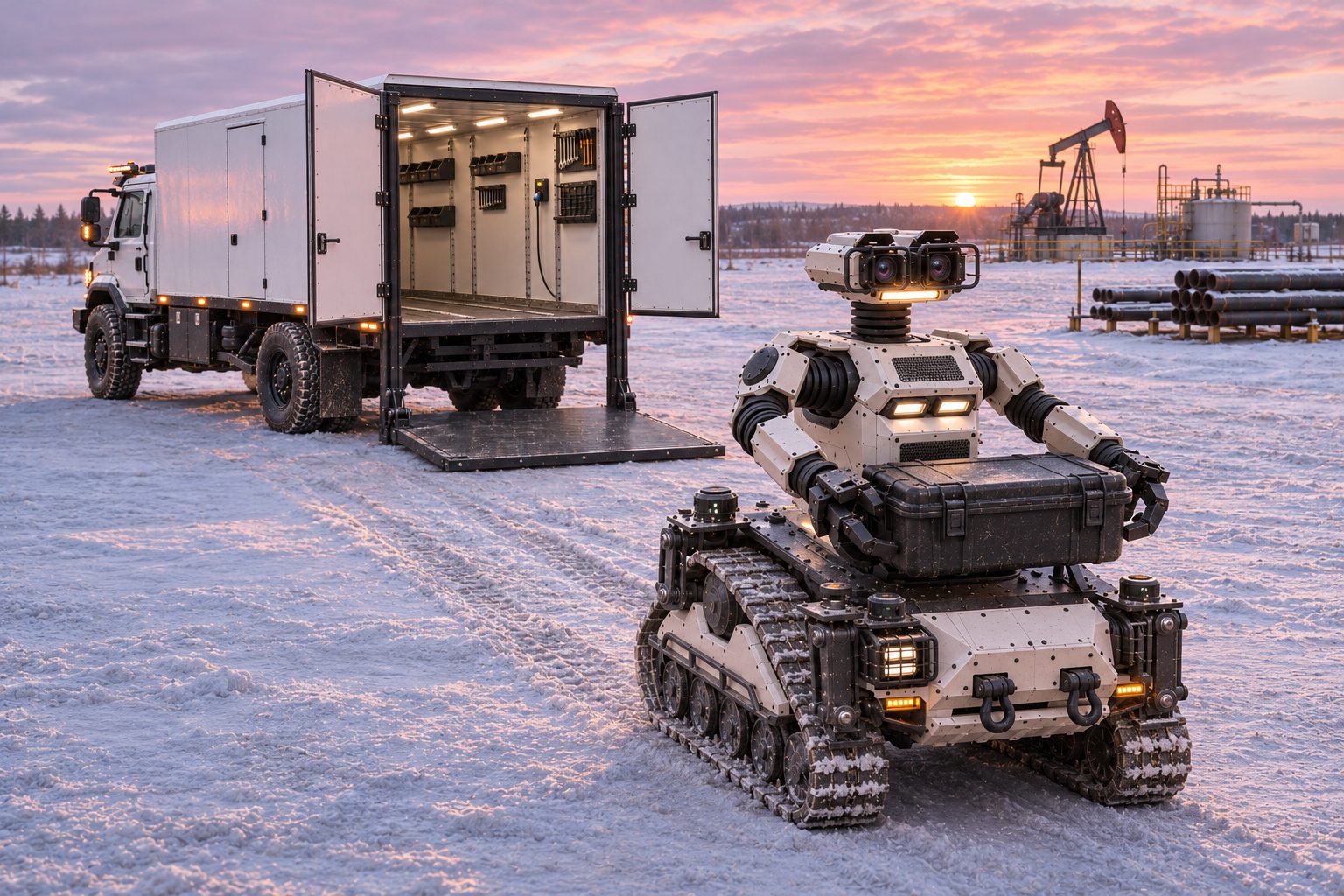
Blasting belongs on the Heavy.
The abrasive blast head rides the Heavy, and it works in the bounded zone only: a sheeted area with nobody inside and a supervisor holding the stop. The pot, the air and the media stay with the truck, and the hose runs to the robot.
The crew stays outside the containment.
- Working height. The blast set is designed to work to 6 m.
- Steel and concrete. Recycled steel grit on steel, garnet on concrete.
- More tools. See everything Site Hand carries.
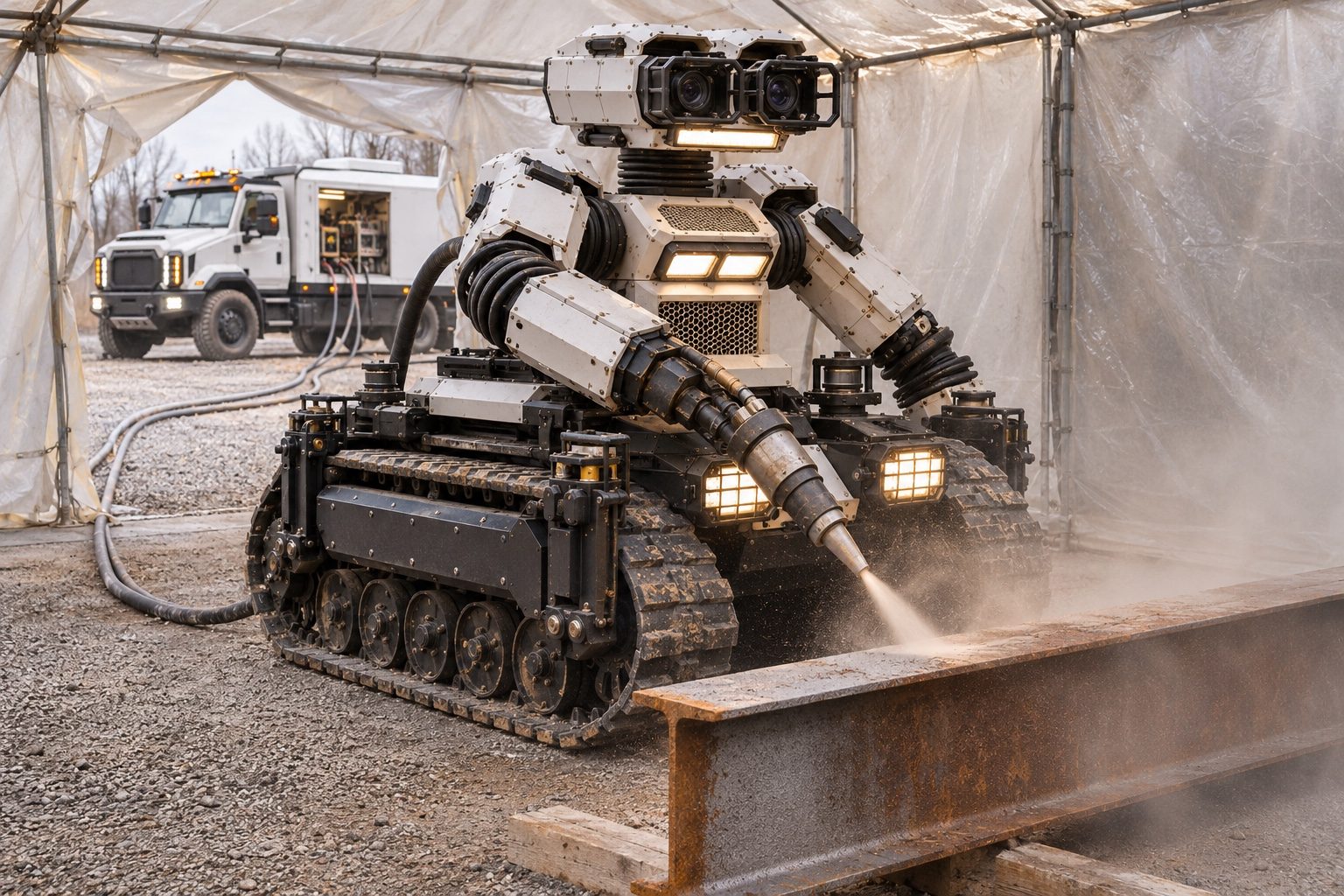
People stay clear of the Heavy.
The Heavy works in the same three keyed modes, with one firm difference.
- No hand-guided work. On the Heavy, people stay outside the separation distance while the arms or the mast move.
- Four scanners. The protective field is 3.15 m on tracks and 3.84 m on wheels, and the machine is designed to stop within 0.72 m on tracks.
- Stops. E-stops on the body, on the tablet and on the truck, and a wireless safety stop. Loss of the safety link is designed to stop the machine.
- More. How Site Hand stays safe.
The Heavy is the outdoor one. If the work is inside a building, behind a door and an elevator, look at the Tradesman.