

From the drawing to the dirt.
Mark is our surveyor, in two sizes. It is designed to measure against site control and put design layout on the ground. Mark Tradesman is also designed to paint cut and fill marks while earthwork goes on.
This is Mark.
Mark is our surveyor. A mark in the wrong place costs far more than the mark. So Mark is designed to check site control before the job starts, and to stop the job if the check is out. Your people set the work area and give the go.
You know Mark by the guards: a black cage with mesh panels, a guarded sensor head on a mast, a guarded survey prism, guarded scanners and stop buttons, and bumper frames. White and black. Red is the emergency stop and nothing else.
Two sizes.
Tell us the ground and we will tell you which one fits.
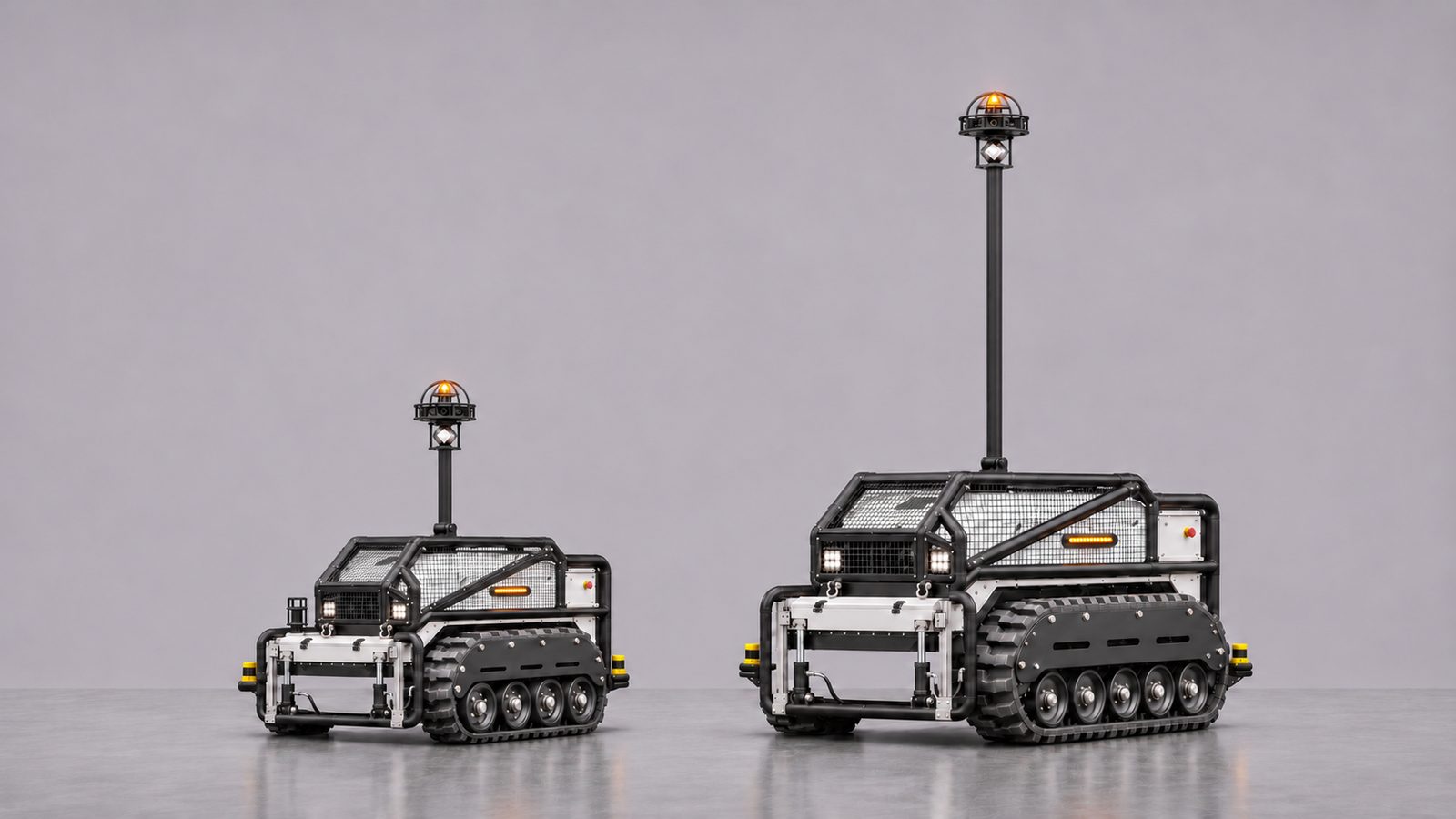
Mark Compact
The small size, for slab layout and tight access. It is not for active earthwork areas.
Mark Tradesman
The mid size. Designed to put design layout on the ground, and to paint cut and fill marks, stopping for each row while it prints.
Watch Mark work.
Mark beside the layout it has printed on gravel, then at a grade mark on the dirt.
Raised to travel, lowered to paint.
Mark is designed with one paint nozzle, inside a closed, skirted head. Mark Compact is designed to carry one marking head at a time: an ink head for slab layout, or the paint head with one nozzle. The head is designed to raise on hydraulics for travel and to lower to paint.
Paint is designed to come in cartridges that ride inside the body, supplied by Steady Eddie.
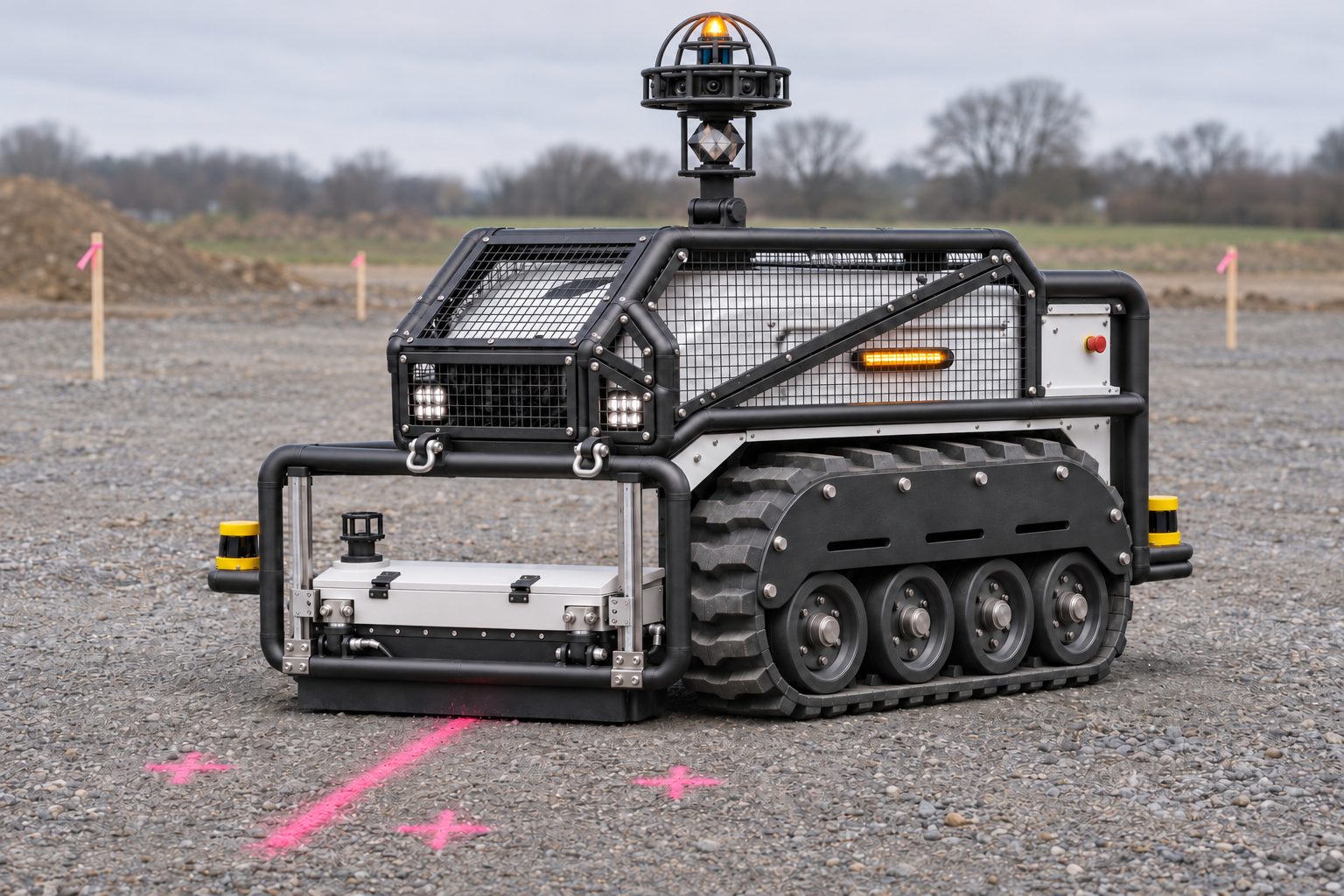
Grade marks while the work goes on.
Cut or fill, and by how much, painted on the ground where the operator can see it. This is Mark Tradesman's job.
- Accept the drawing. Mark is designed to paint only from a design revision a named person has accepted.
- Release the area. Your supervisor splits the site into work areas. A local person releases one, and confirms that no machine without the data link is working in or near it.
- Measure, paint, step back. At each point Mark Tradesman is designed to stop and measure, then print the call a row at a time, stopping for each row and stepping back between rows.
- Come back after the pass. After a machine has worked an area and a local person releases it again, Mark Tradesman is designed to measure it again and repaint.
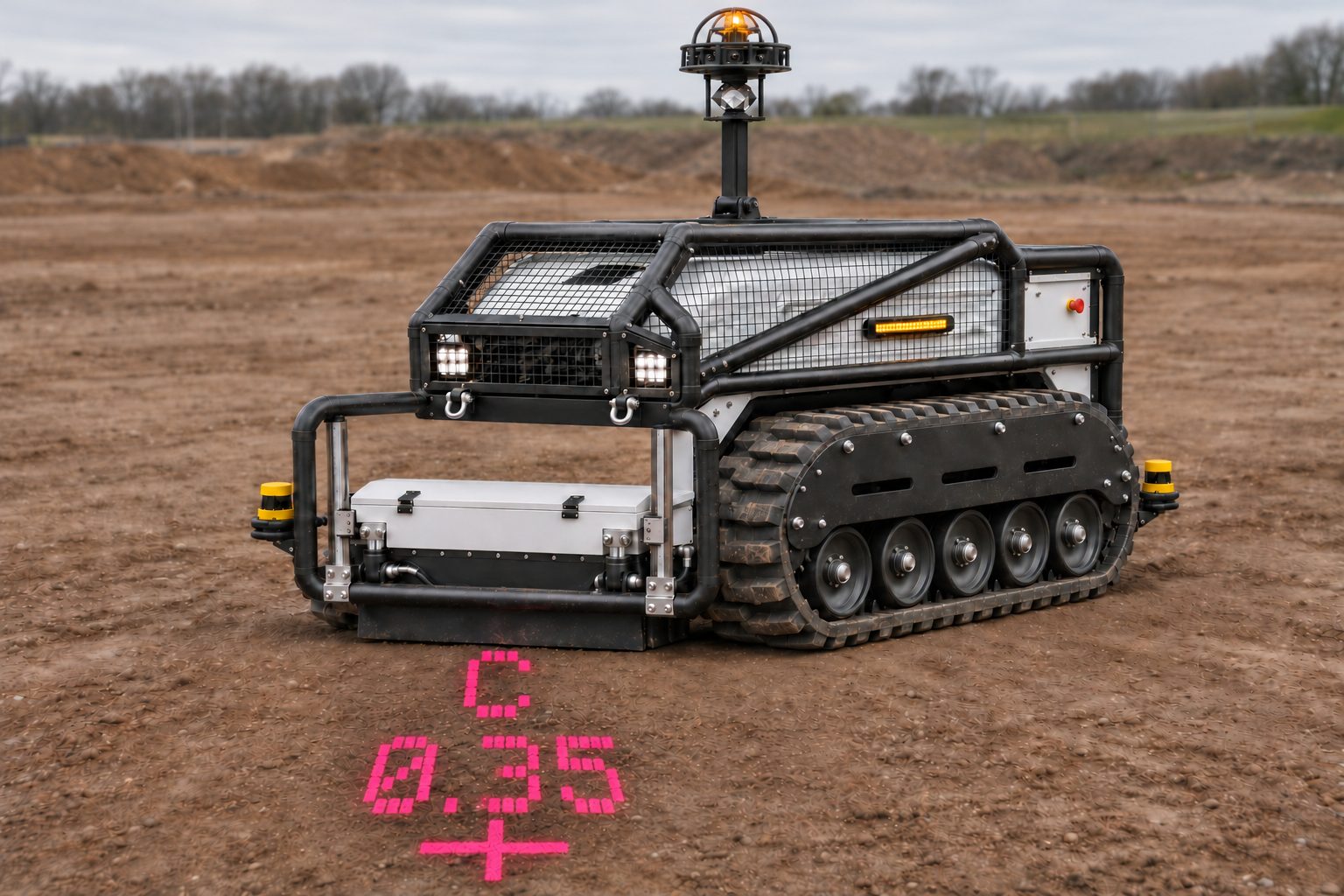
Layout, from the file.
Someone walks the site with a rod or a tape and marks where the anchor bolts, pile caps, pads and lines go. It is careful, slow work. Give Mark the design file and the control points, and it is designed to drive to each point and put it down.
- Industrial site layout
- Slab and foundation layout
- Pad, subdivision and yard layout
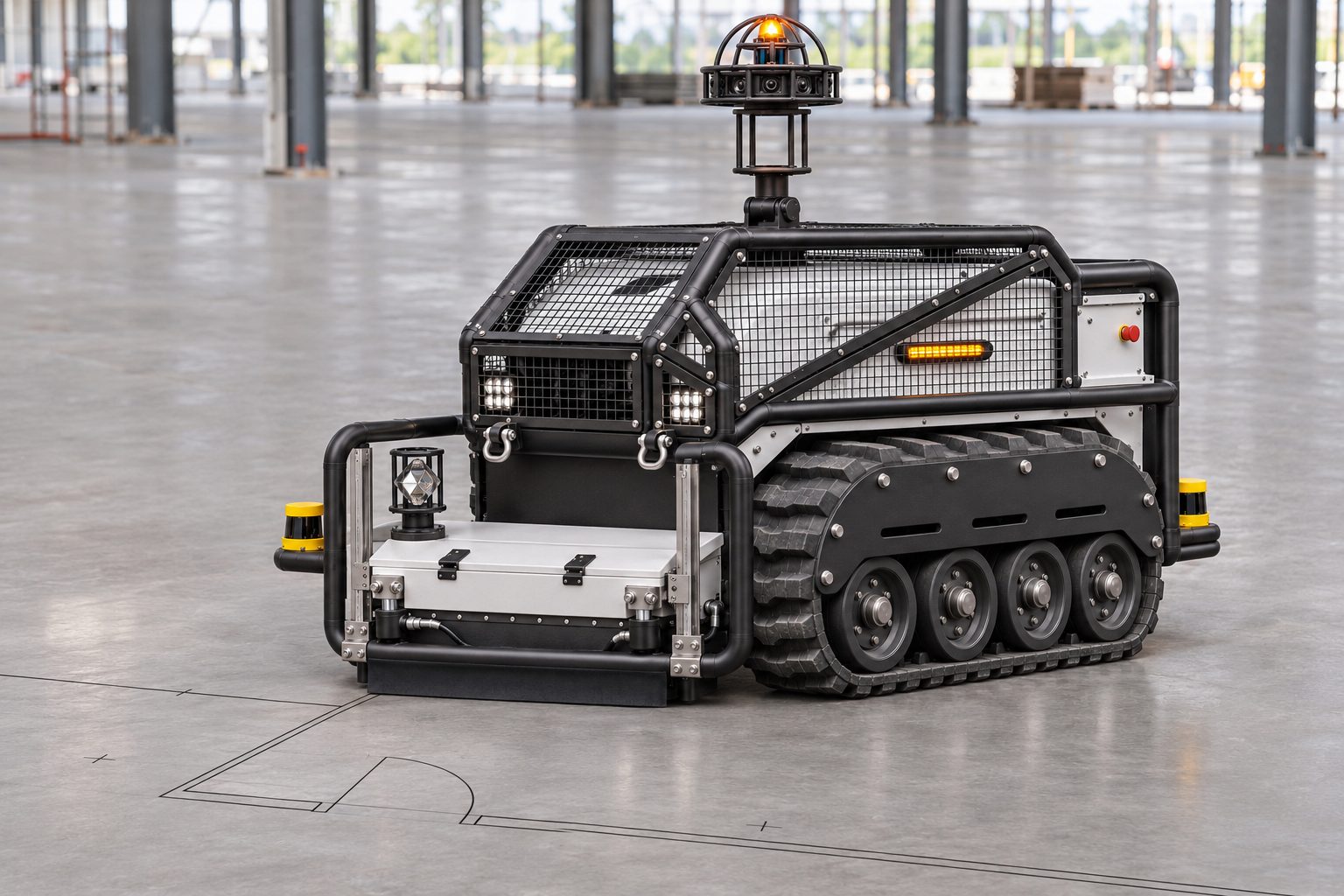
The same grade on the ground and in the cab.
Mark is designed to share survey and grade data with Steady Eddie machines, AGGA machines, Anvil trucks and group crews. Other machine-control systems take it by file.
The paint stays where everyone on the ground can see it.
How it stops.
AI plans, rules govern, humans authorize, safety has veto. In the safety system, sensing is designed only to slow, hold or stop Mark, never to override a stop.
- Your people give the go. A local person releases the work area. After a hold, Mark is designed to wait for a deliberate local reset and resume.
- Emergency stops. Designed with stop buttons on the robot and a stop on the operator's safety link. Paint is designed to shut off on any stop.
- Lost link. If the operator's safety link is lost, Mark is designed to stop.
- People. Two scanners at opposite corners are designed to watch for people. They do not see all the way round.
- Poor position, no paint. When the position fix is not good enough, Mark is designed to hold the paint.
- New drawing, new go. A new design revision is designed to hold painting until a person loads and accepts it.
- Other machines can only hold it. Data from another machine is designed so it can put Mark on hold, never start, release or resume it. It is not a safety stop.
Mark is not a land surveyor and does no legal or boundary survey. Painted marks are not a utility locate and do not clear anyone to dig: a qualified locator still does the locates. Your project's surveyor still accepts the final grade.
What to tell us
Tell us the work and we will tell you plainly whether Mark suits it.
- The marks. Bolts, pads, lines or grade.
- The tolerance. What the drawings call for.
- The ground. Slab, rough ground or active earthwork, and the slope.
- The file. The design file format and the site control.
- The machines. What is working on the site while Mark is.
- The season. When the work runs.