
It runs the machines you already own.
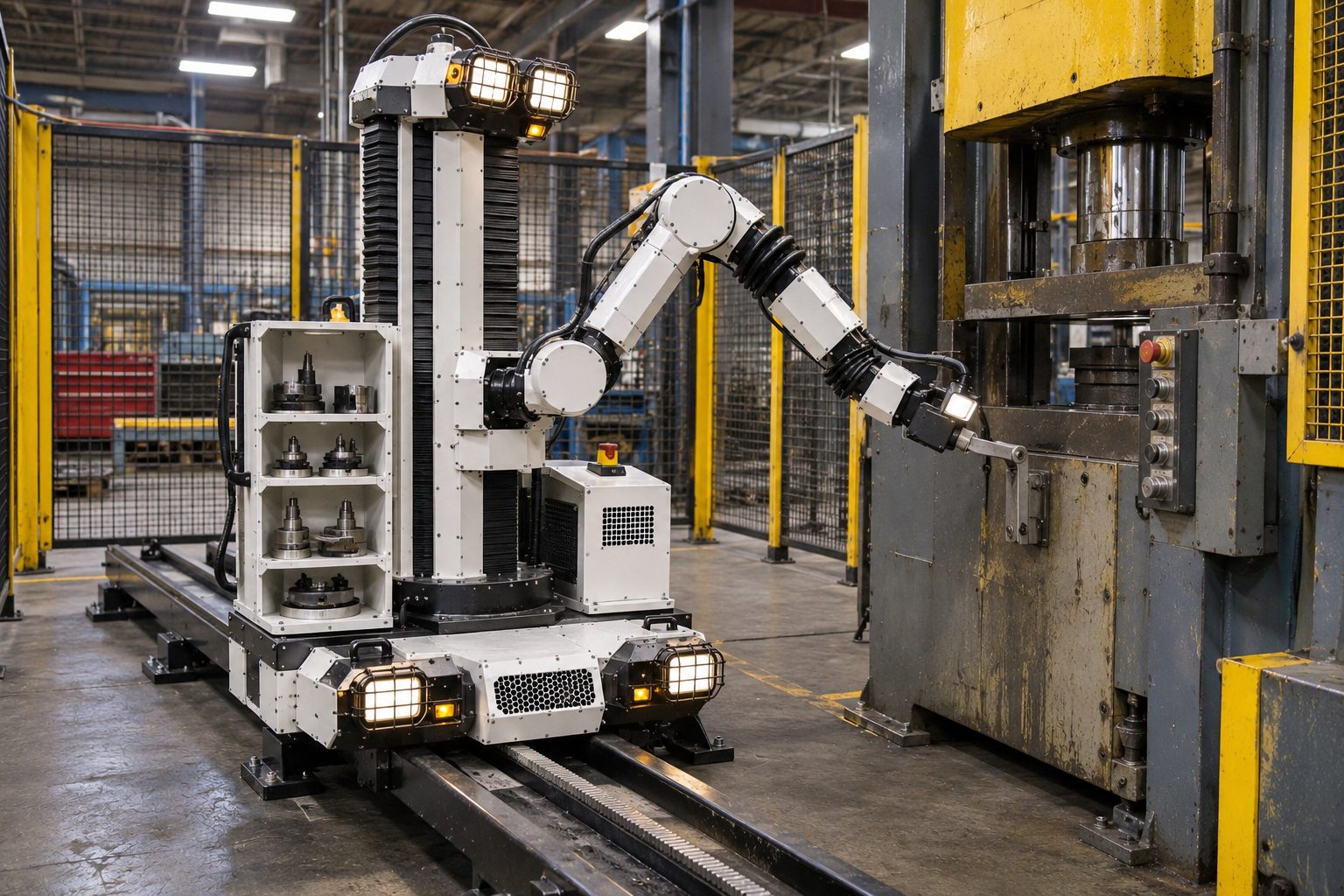
STE Plant Hand is a robot arm on a lift column, on a carrier, on a floor rail. It is designed to run the manual machines a plant already has, through the controls on the machine, the way a person does. No machine is replaced.
This is Millie.
Millie is our plant hand. Millie stands at the machines: the press, the drill press, the grinder, the ironworker. It is designed to load the part, press the button, pull the lever and work the pedal, the way a person does. The machines stay. The guards stay. A person keeps the key.
A hand for the fixed machine.
Most plants have good manual machines and not enough people to stand at them. A press, a drill press, a grinder, an ironworker, a sewing machine. Each one needs a person to load it, start it, feed it and unload it.
Plant Hand is designed to do that work at the machine as it stands. It loads the part, presses the button, pulls the lever, feeds the capstan, works the pedal and unloads. It is not a CNC retrofit and it is not a replacement machine.
- Fixed machines, whatever the sector. Metal fabrication, machine shops, textiles, and the next plant with a row of manual machines.
- The machine's own controls. Buttons, selector switches, dials, levers, handwheels, capstans, vises and pedals.
- One unit per area. Each Plant Hand works the machines of its own area from the rail those machines front on.
Watch Millie work.
Millie riding the rail to the next machine, then lining up a tool from the rack.
The jobs.
How Plant Hand is designed to run each kind of machine. People still do the setting-up that takes a person's judgement.
Hydraulic H-frame presses
Sets the part and the press tooling on the bed, backs out of the ram line, then works the ram control. The wrist camera reads the pressure gauge. Then it unloads.
Drill presses
Puts the part in the vise and closes it, starts the spindle, grips a capstan spoke and feeds under force control, pecking to clear chips. It works the chuck key for a drill change.
Pedestal and belt grinders
Switches the machine on, holds the part and presents it to the wheel or belt at a set contact force, then deburrs along a scanned edge.
Ironworkers
Holds the bar or angle against the station stop, under the hold-down, with the gripper outside the cut line. A bolt-on actuator works the foot switch, so the arm stays free to hold the stock.
Keyseaters and slotters
A person sets the cutter and bushing. Plant Hand loads parts within the arm's payload, closes the clamp, starts the stroke and works the feed lever. Heavier parts stay with the hoist and a person.
Industrial sewing machines
Vacuum pads feed and guide the fabric while an edge-guide camera holds the seam line. A bolt-on actuator works the speed pedal. Straight seams on flat panels come first, and a person does the threading.
How it is put together.
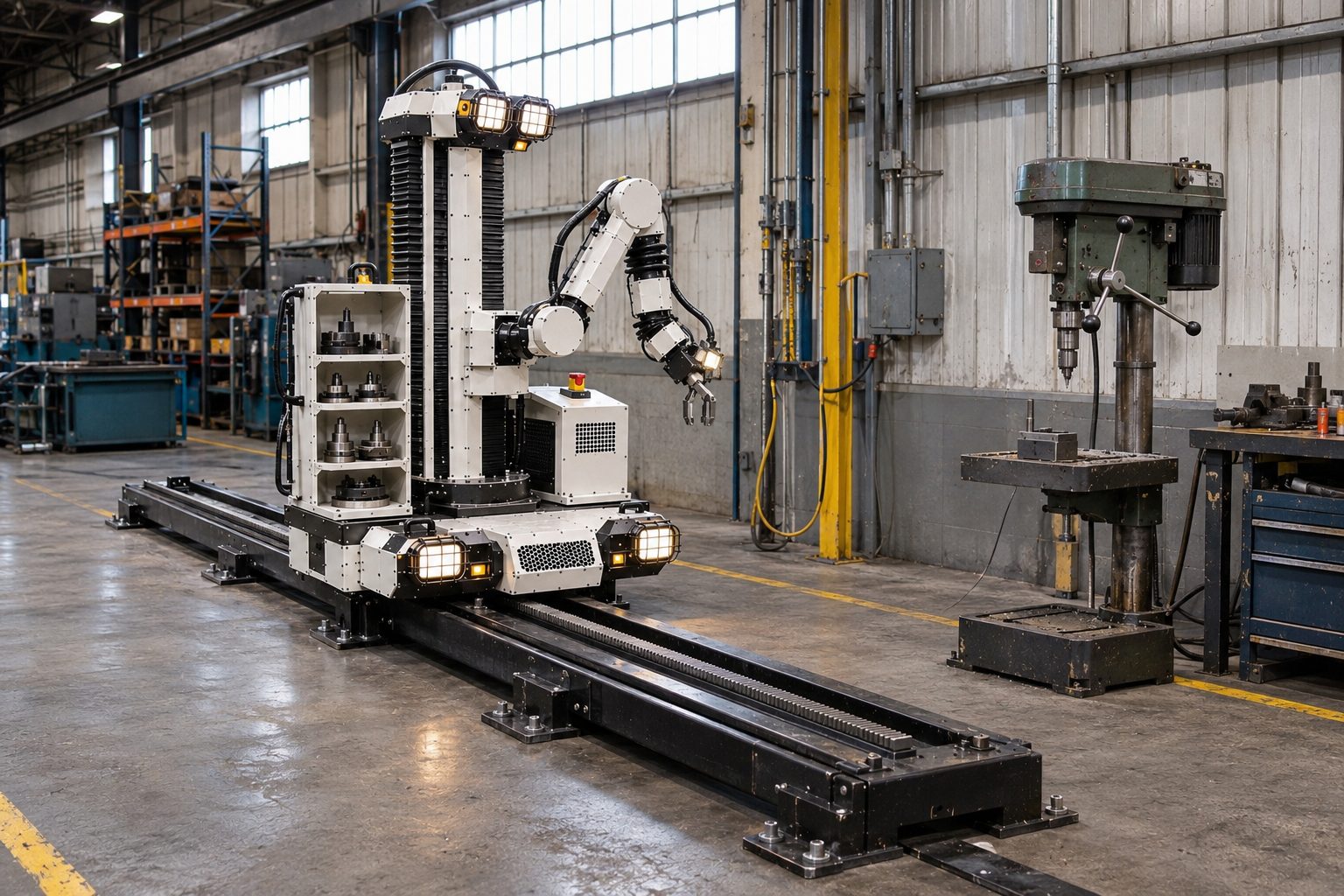
The carrier rides a fixed surface rail on plates anchored to the existing slab, driven by rack and pinion. A swivel turns the whole unit so the arm works either side of the rail.
A lift column stands on the carrier. The arm rides a carriage up and down the column, low enough for a floor pedal and high enough for the top of a tall machine. A battery pack on the carrier is designed to carry a shift between charges, and charges on contacts at the yard.
- Rail and carrier. Rack and pinion travel, two drive pinions so a turnout works either hand, and a 360 degree swivel.
- Lift column. Rack and pinion lift, two holding means and a red manual lowering release.
- Arm. A collaborative arm with built-in contact sensing, suited to a robot that pushes on things. 20 kg payload, 1,418 mm reach.
- Eyes. A wrist camera and light for scanning a part's edge and reading a gauge.
The tools it carries.
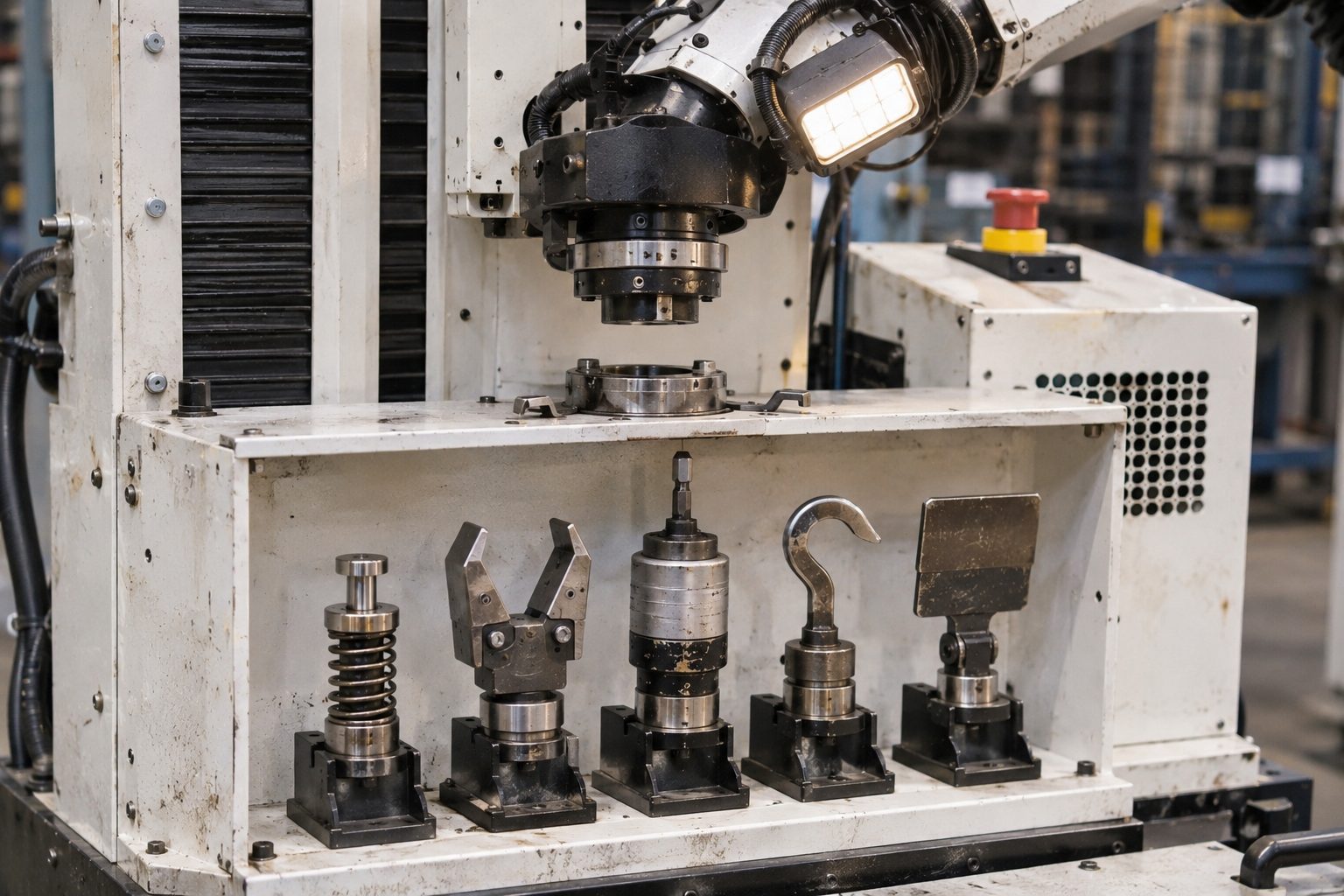
Plant Hand carries a rack of operator tools on the carrier and changes them at the wrist. Between them they work the controls on the machines above.
- Push finger. A sprung finger with a load-cell tip, for push-buttons, selector switches and dials.
- Lever and knob gripper. A parallel gripper with V-jaws, for valve levers, capstan spokes, knobs and knee lifts.
- Key and wrench driver. An electric driver with a reaction arm that bears on the machine, for chuck keys, vise handles and clamp bolts.
- Part gripper. A parallel gripper with change jaws for bar, plate and shaft, and a magnet pad for flat steel.
- Fabric hands. A pair of vacuum pads with an edge-guide camera, for feeding fabric through a sewing machine.
- Pedals. Each pedal gets a bolt-on actuator clamped over the existing treadle, inside its guard. The pedal and the guard stay as fitted.
The numbers.
The arm figures are the arm maker's published figures. Tell us the machines and we will work through the rest with you.
| Item | Value | Note |
|---|---|---|
| Arm payload | 20 kg | The tool on the wrist comes off this |
| Arm reach | 1,418 mm | From the arm's own base |
| Arm mass | 41 kg | Within the lift column's 52.4 kg arm limit |
| Carrier swivel | 360 degrees | The arm works either side of the rail |
| Drive | Rack and pinion, 2 drive pinions | A turnout works either hand |
| Lift | Rack and pinion carriage on a column | Two holding means and a manual lowering release |
| Power | LiFePO4 battery pack | Contact charging at the yard |
| Tools | Push finger, lever gripper, key driver, part gripper, fabric hands | Changed at the wrist from a rack on the carrier |
| Vision | Wrist camera and light | Edge scanning and gauge reading |
How it stays safe.
AI plans. Rules govern. Humans authorize. Safety has veto. Any stop stops motion, and sensing can only remove authority.
- The machine stops with the robot. A person who lets go of a button stops the machine. A robot that stops holds its position, and a button or pedal it holds stays held. So each machine's own stop is hard-wired into Plant Hand's safety loop. A stop on the cell cuts the machine too.
- Two-hand controls stay for people. They protect a person's hands, so the robot does not press them. A keyed selector sets the mode. In person mode the control works as bought. In robot mode a light curtain and a handshake with the arm take over, and the machine cycles only with the curtain clear and the arm out.
- Load, back out, then cycle. On a press, Plant Hand sets the part, backs out of the ram line and only then cycles the machine. On a drill press the vise holds the part, not the arm, while the drill turns.
- Guards stay. Wheel guards, tool rests, chuck guards and eye shields stay on the machine. A person sets them and the arm works around them.
- Each station is a robot cell. A fence and interlocked gate, or area scanners sized from measured stopping times. The station guarding, the stop tie-in and the selector circuit go to a licensed engineer.
- It stays on the rail. Hold-down rollers run under a continuous rail lip, designed to stay engaged through every switch, bend and joint. A switch proves the pinion is in mesh. No proof, no travel, and the brake applies.
- A person can move it by hand. Travel, lift and swivel each carry a manual release.
What changes in your plant.
Very little, and that is the point. The machines stay where the work is. The rail goes down on the slab you have. The changes at each machine are small and each one is named before any work starts.
We start with a walk through the plant and a list of the machines. Some will sit within the arm's reach from the rail. Some will need a short rail spur, or a move toward the rail. We will tell you plainly which is which, and where a rail and an arm would not earn their place.
- On every machine. Its stop is tied into the robot's safety loop.
- On pedal machines. A bolt-on actuator over the pedal.
- On machines with a two-hand control. A keyed selector, and a light curtain where the machine has none.
- On the floor. A surface rail on anchored plates, with turnouts and spurs to bring the arm within reach.
Plant Hand is a rail robot that runs a plant's manual machines through their own controls. Your machines stay. Their guards stay. Their stops are wired to the robot's, and a person keeps the key.