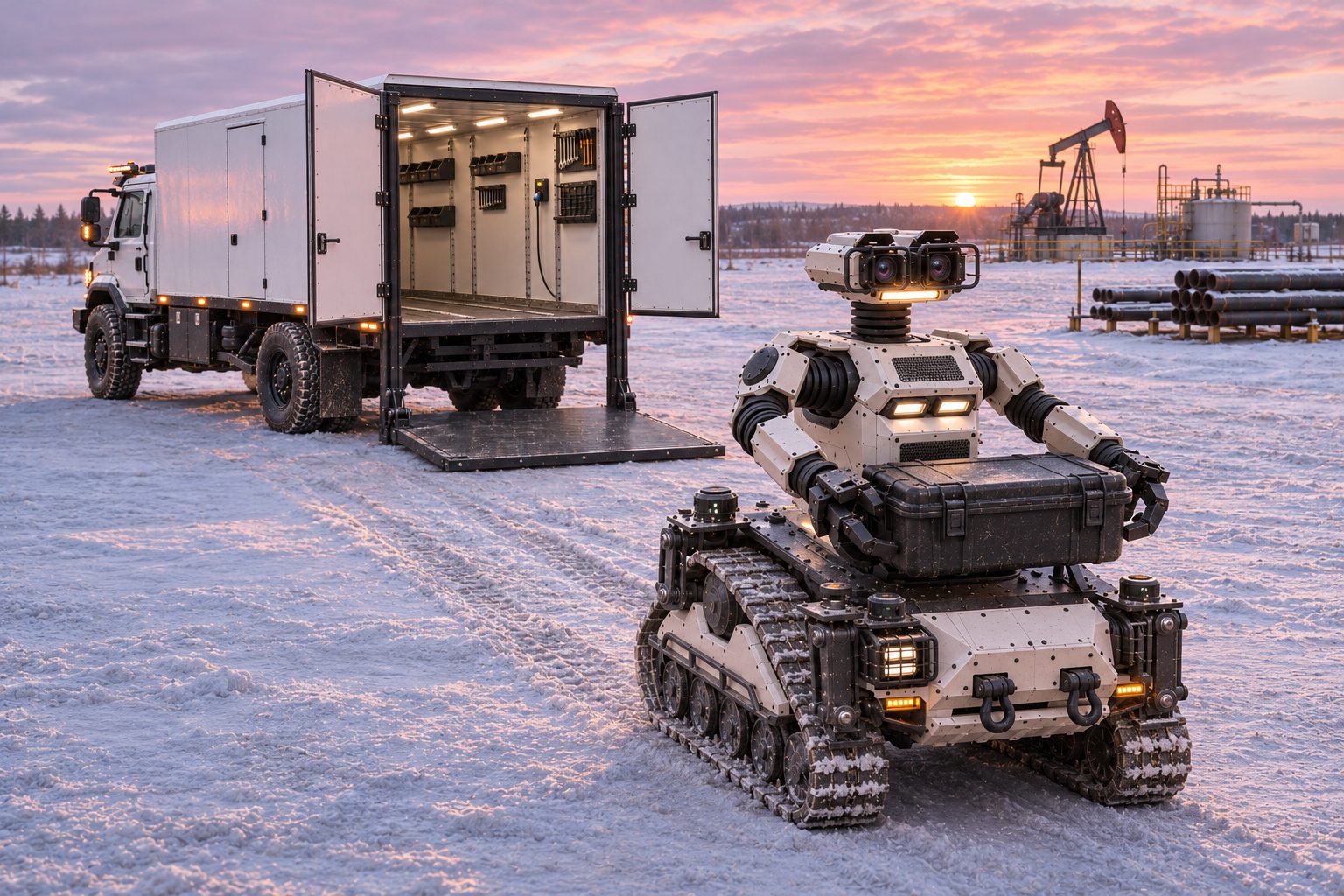
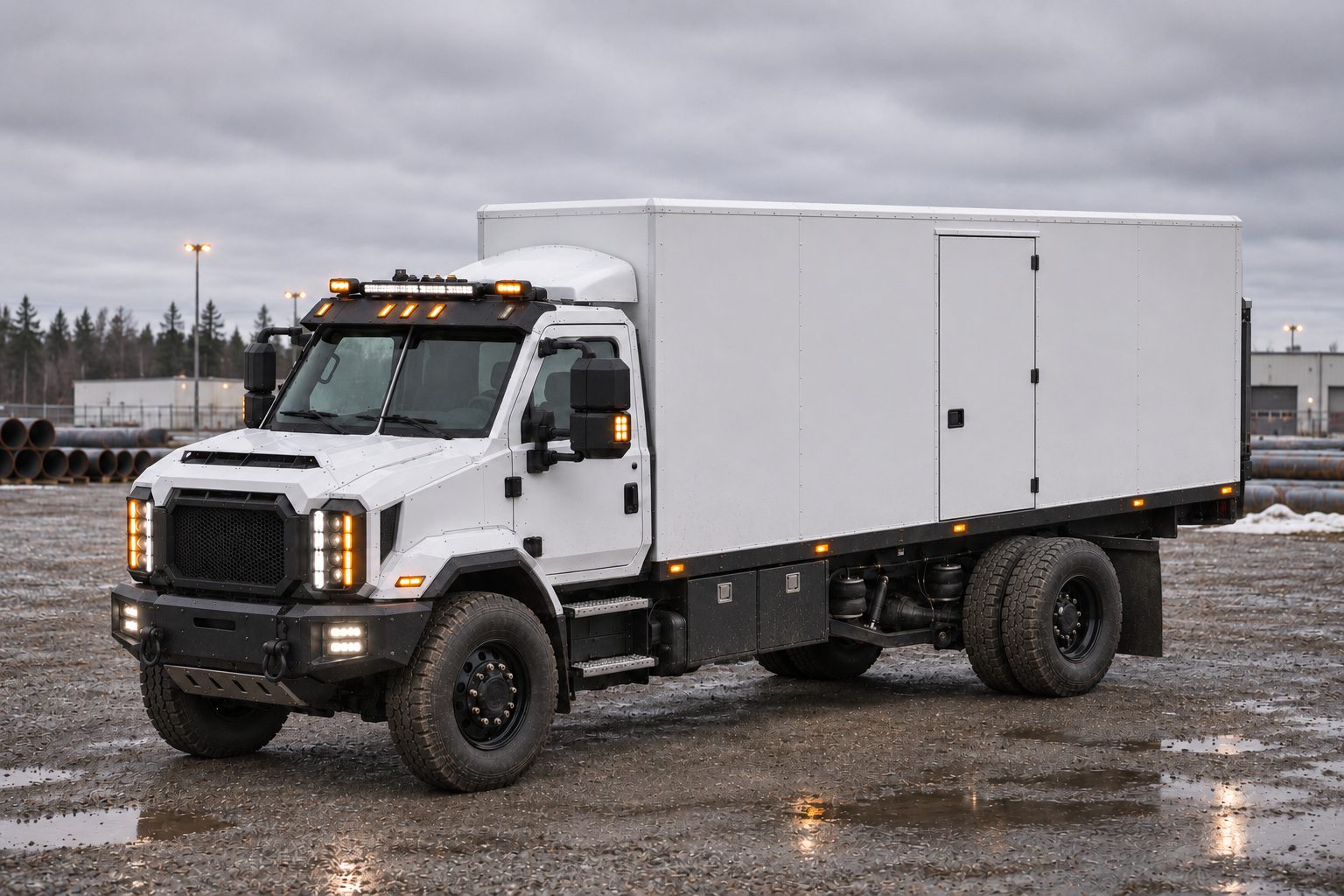
The truck that takes the robots to work and brings them home.
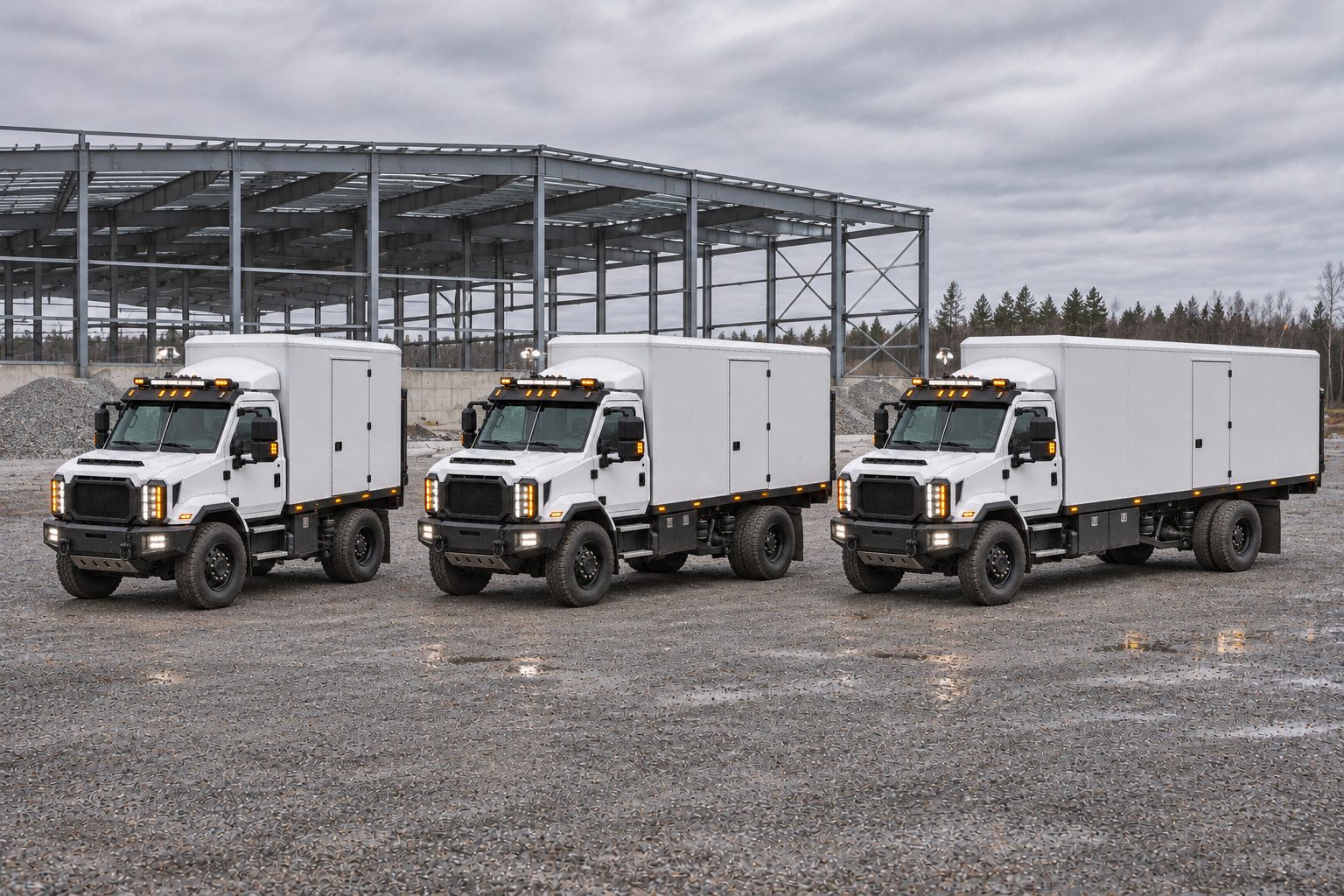
Robots that work on a site have to get there, stay charged and come home. The Robot Support Van is an enclosed body for a Class 6 or Class 7 truck, designed to carry a crew of robots the way a crew bus carries people. The crew rides in the cab and runs the job.
This is Van Hauling.
Van Hauling is our crew bus. Robots that work on a site have to get there, stay charged and come home. Van Hauling carries them locked down in an enclosed body, charges them, is designed to keep them warm or cool, and sets each one on the ground with a liftgate. Your crew rides up front in the cab and runs the job.
A crew bus for robots.
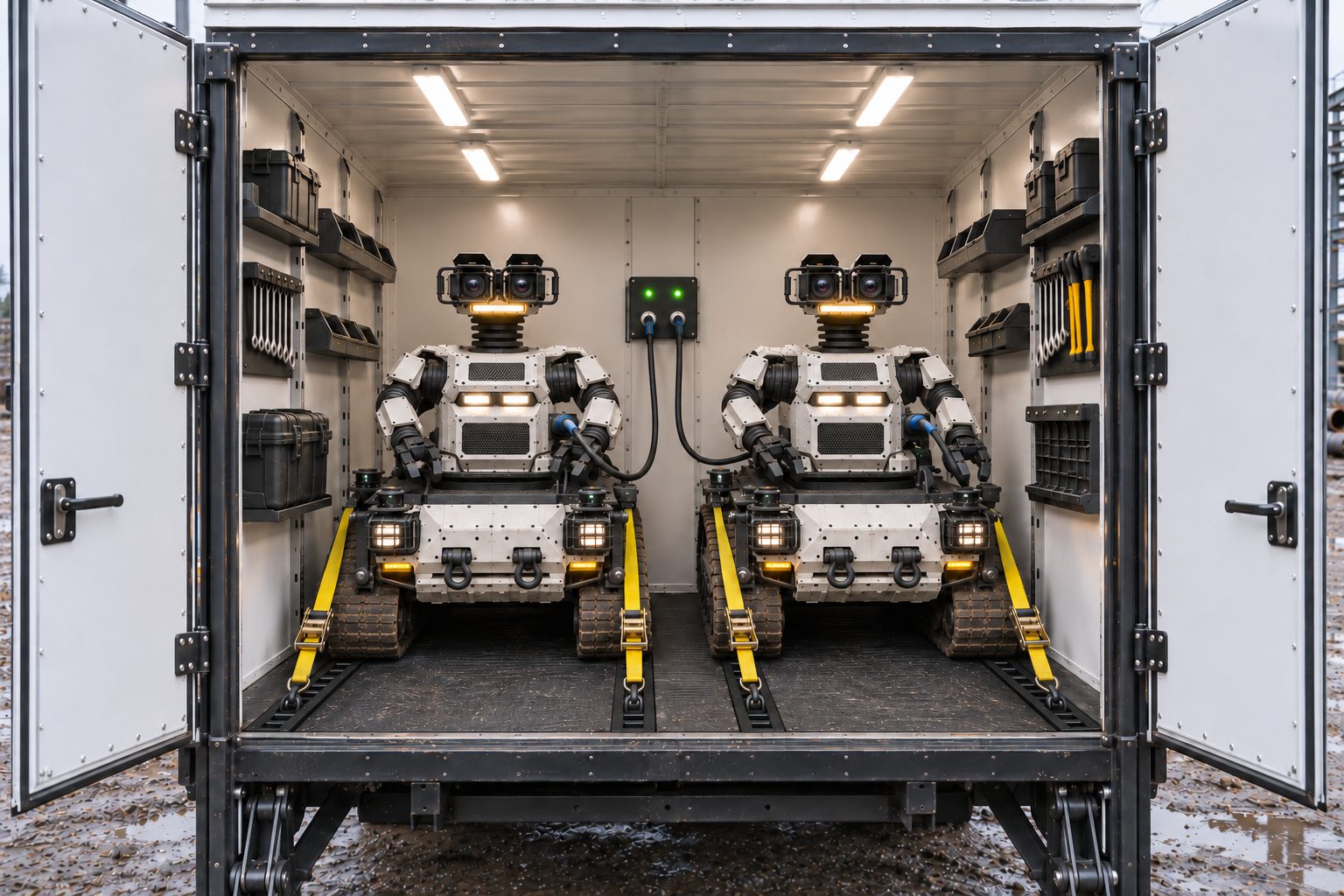
Inside, every robot has a position on the floor rails and a charging supply of its own. A rail liftgate at the rear lowers each robot to the ground and lifts it back in at the end of the job. A service bench, a tool cabinet and a battery rack ride at the back.
The body is ours. The truck under it is Ripple Rock's, built by Anvil Trucks. Tell us the crew of robots, the sites and the distance, and we will tell you plainly which body fits the work.
- Who it is for. Crews that send robots out to yards and sites, shops and plants, and want them back charged, dry and locked down.
- What rides in it. STE Site Hand robots with their attachments first. The same floor takes dock seats for humanoid robots.
- Who is in charge. The crew. The robots work for them, and nothing in the body locks out a professional.
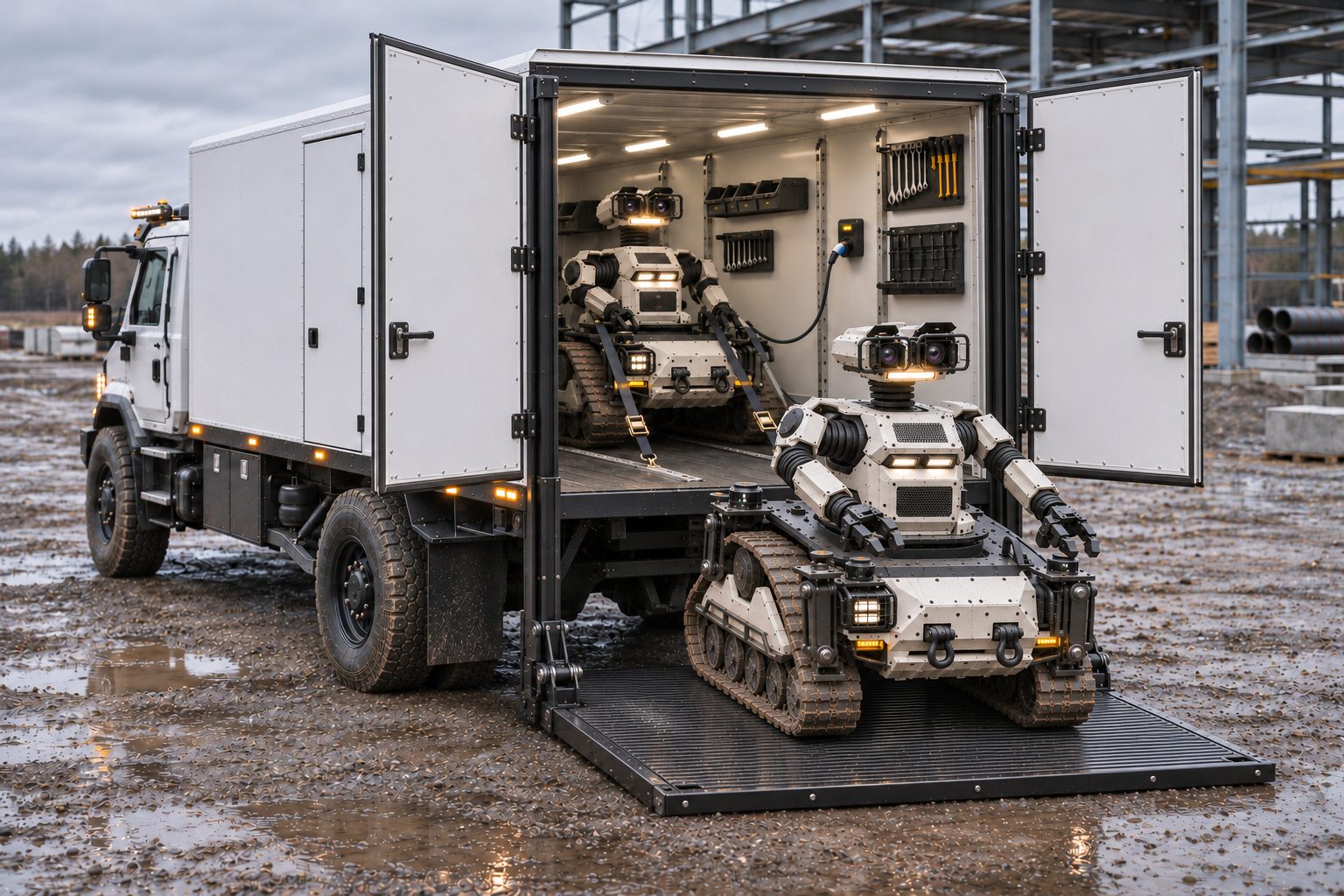
Watch Van Hauling work.
Eddie off the ramp at the job, then Van Hauling on charge for the night.
What the body does.
Four jobs, every day the robots go out.
Carry
Robots ride locked to flush floor rails in an enclosed body. The truck is designed not to start with a robot loose, a door open or the liftgate down.
Load
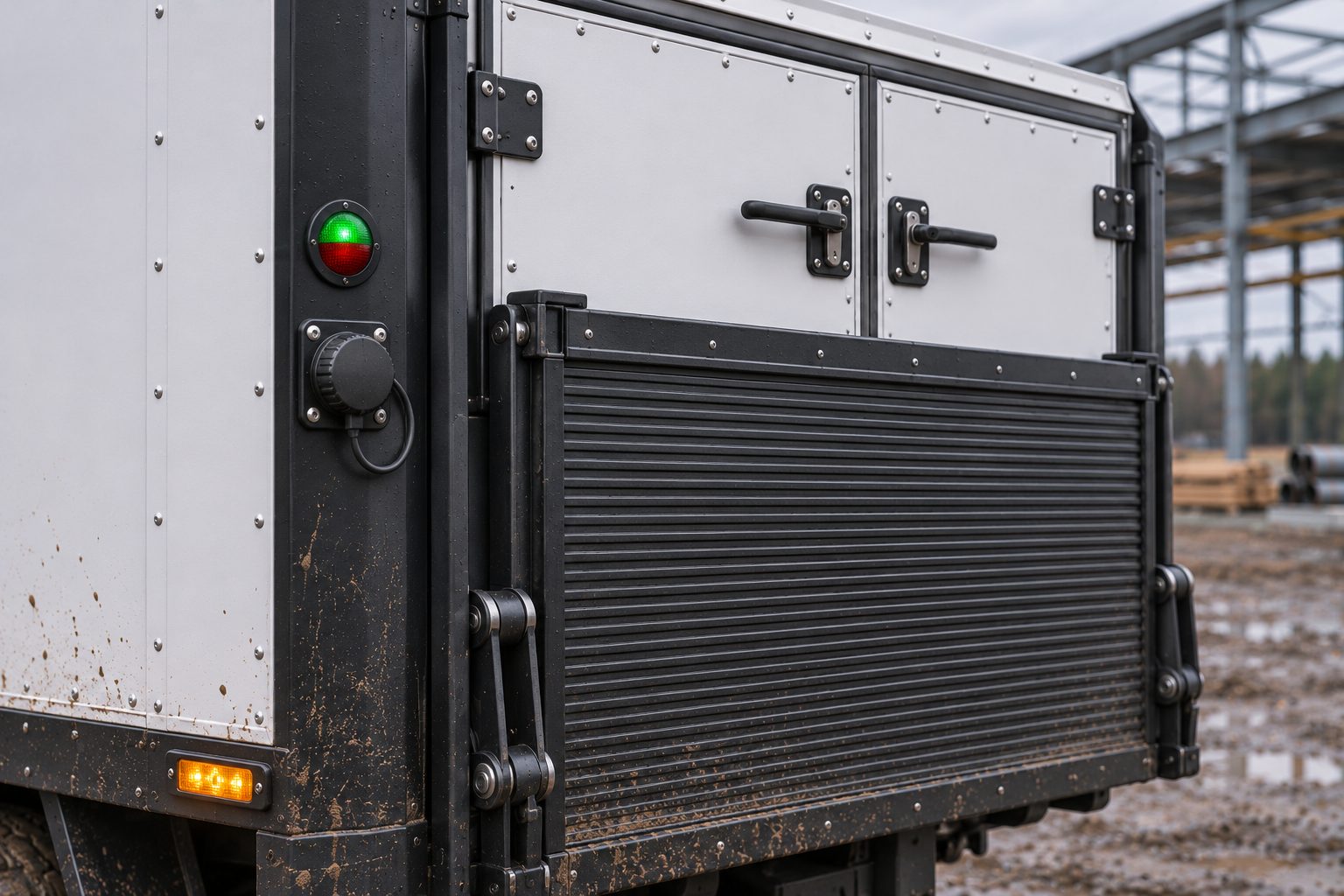
Parked, the rear liftgate takes each robot to the ground and back. The platform is 2,100 x 1,500 mm. A robot drives on and off under its own power.
Charge
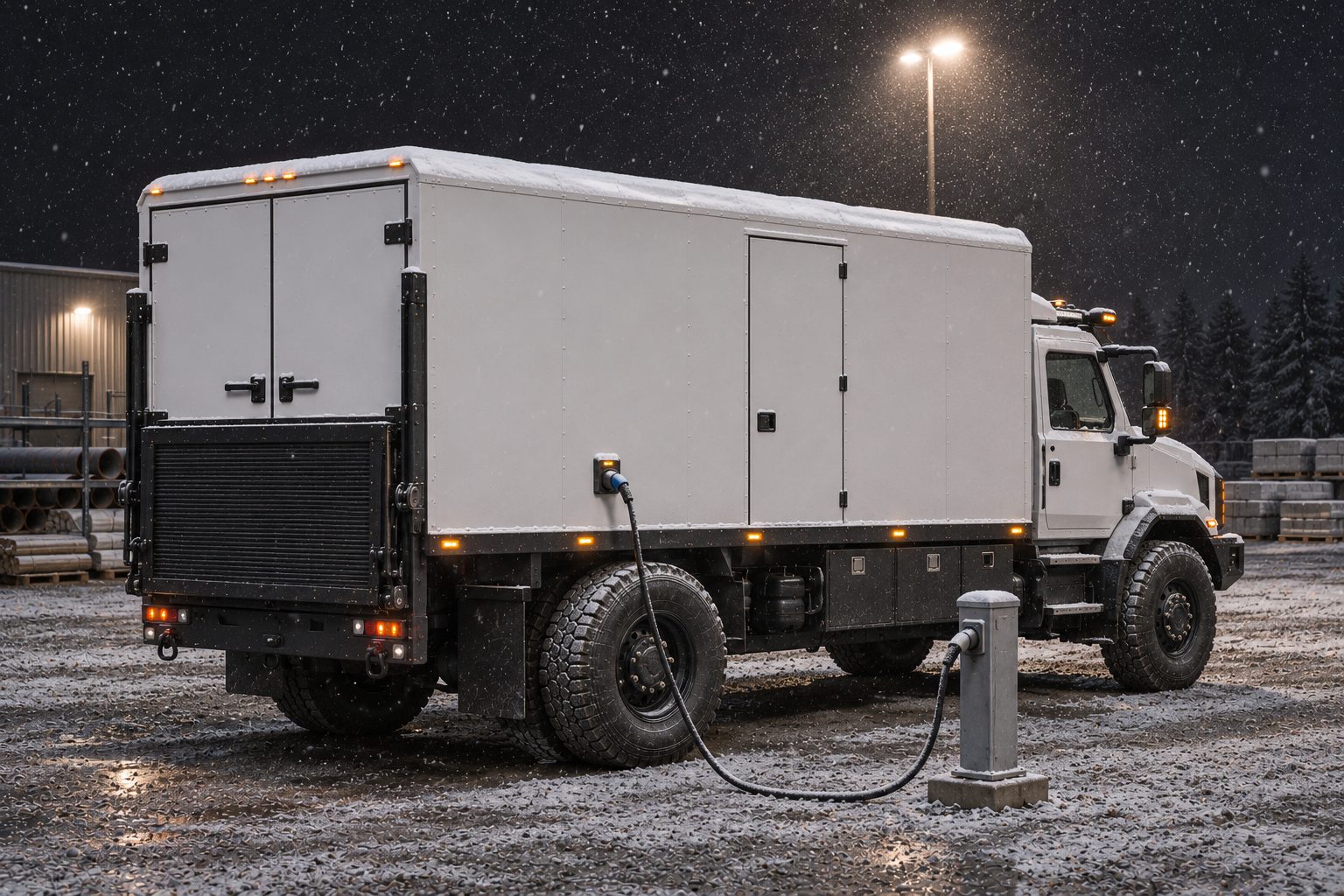
Every position has its own supply, fed from the truck. A 240 V 50 A shore inlet charges the robots overnight at the yard without waking the truck's high-voltage system.
Shelter
A roof heat pump is designed to hold the body between 10 and 25 °C, and the body warms up before any charge starts in the cold.
Laid out first for Site Hand.
The main load is a crew of Site Hand tracked robots and the attachments they swap between jobs. Flush lock rails on a 50 mm grid cover the whole floor, so robot bays bolt down wherever the load needs them. Each robot sits on four locks.
On site the truck parks as close to the work as the site allows. A robot works on its own battery, or on a cord paid out from a reel under the body.
- Attachment rack. An overhead shelf along the street-side wall, 700 mm deep, holds attachments in quick-release cradles. Each cradle has a latch and a sensor that knows the attachment is there.
- Change cradle. At floor level at the rear, a robot drops one attachment and picks up the next. It is the crew's swap point too.
- Heavy attachments. Anything over about 40 kg rides on the floor in a lane bay.
- Cord reels. Powered reels under the body carry power, network and the stop circuit on 25 m of cord. Two reels on the Class 7 bodies, one on the Class 6.
- Spare packs. A steel locker outside the body holds spare battery packs, with its own heat and gas detector.
One body, three lengths.
The same body section in three lengths, to suit the truck and the size of the crew. Width, height inside and the aisle are the same on all three.
| HCB-6 | HCB-7 | HCB-7L | |
|---|---|---|---|
| Truck | Class 6 crew cab, cab-to-axle 84 in | Class 7 regular cab, cab-to-axle 120 in | Class 7 regular cab, cab-to-axle 144 in |
| Seats in the cab | 5 belted | 2 belted | 2 belted |
| Robot positions | 4 | 8 | 10 |
| Body length | 3,456 mm | 4,828 mm | 5,958 mm |
| Interior length | 3,281 mm | 4,653 mm | 5,783 mm |
| Interior width | 2,340 mm | 2,340 mm | 2,340 mm |
| Interior height | 2,050 mm | 2,050 mm | 2,050 mm |
| Outer width | 2,440 mm | 2,440 mm | 2,440 mm |
| Aisle | 740 mm | 740 mm | 740 mm |
| Overall height on the truck | 3,550 mm | 3,590 mm | 3,590 mm |
| Body mass | 2,079 kg | 2,573 kg | 2,914 kg |
| Payload | 730 kg | 1,310 kg | 1,600 kg |
| Liftgate | 750 kg, rail type | 1,000 kg, rail type | 1,000 kg, rail type |
| Robot lock rating | 4.0 kN working load limit | 4.0 kN working load limit | 4.0 kN working load limit |
| Tie-down load case | 2.0 g horizontal, 1.0 g up | 2.0 g horizontal, 1.0 g up | 2.0 g horizontal, 1.0 g up |
| Supply at each position | 240 V, 16 A socket | 240 V, 16 A socket | 240 V, 16 A socket |
| Supply from the truck | 22.0 kW | 40.0 kW | 50.0 kW |
| Body inverter, minimum | 16.3 kW | 30.5 kW | 37.9 kW |
| Shore power inlet | 240 V 50 A, 9.6 kW continuous | 240 V 50 A, 9.6 kW continuous | 240 V 50 A, 9.6 kW continuous |
| Overnight charge on shore power | about 2.0 h | about 4.7 h | about 6.7 h |
| Purge fans | 2 fans, 2,400 m³/h each | 2 fans, 2,400 m³/h each | 2 fans, 2,400 m³/h each |
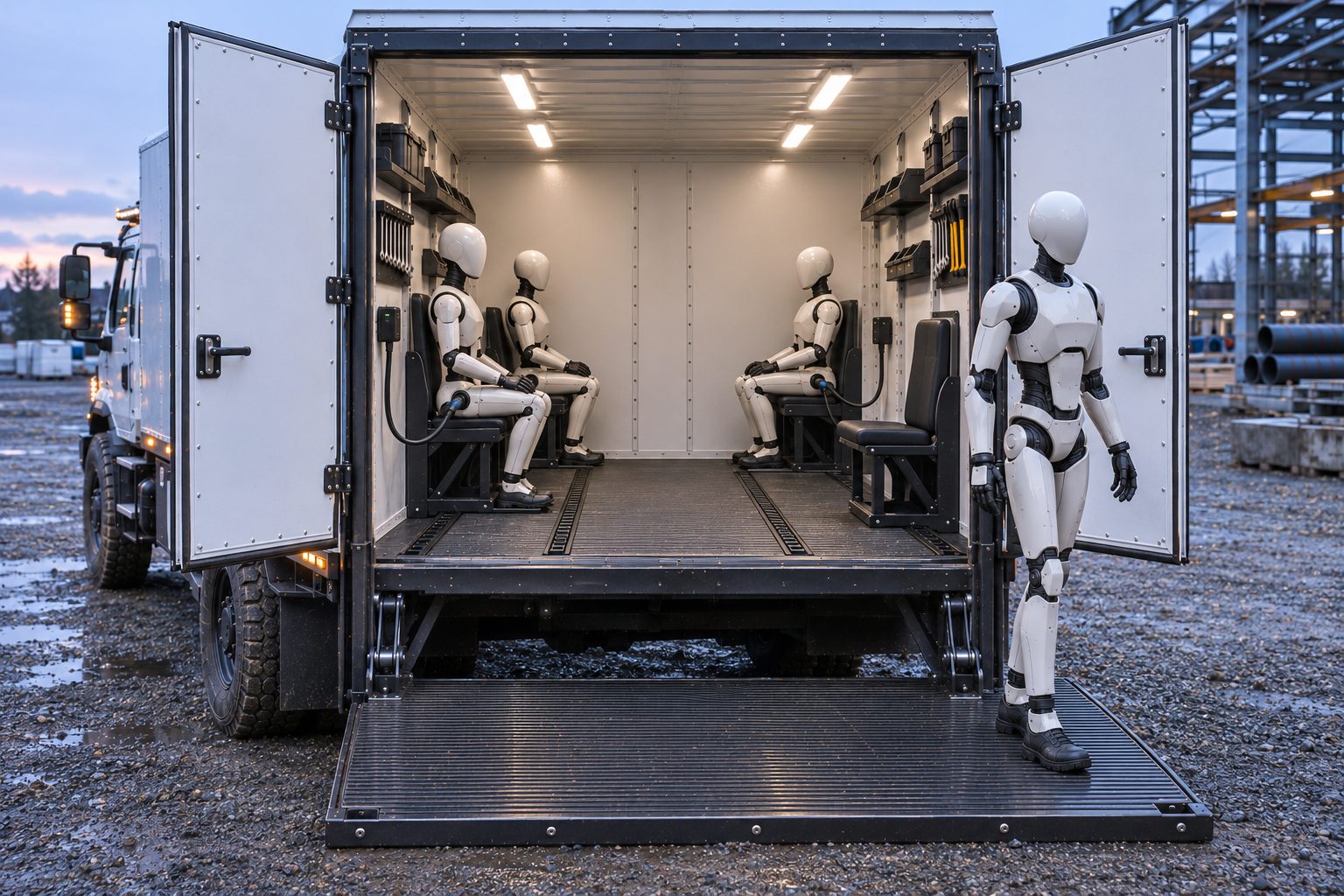
A dock seat for humanoid robots.
The same floor grid takes a dock seat at each position, for crews that add walking robots to the work. The seats sit in two rows with their backs to the walls, 750 mm apart, with a 740 mm aisle between them.
The seat is designed to a size that bounds the walking robots in use: up to 1,900 mm tall and 130 kg. A robot is taken by its size and mass, not by its name. A heavier one takes two positions.
- The seat. A fold-down seat, a padded backrest with side bolsters, a powered hip clamp with a manual back-up, a chest strap and a sensor that reports locked.
- The socket. A 240 V, 16 A socket at every seat for the maker's own charger or dock, capped at 3.3 kW.
- On the road. Robots ride seated, which keeps the weight low and works for a robot that is powered down.
Power and charging.
The truck is the hub. It moves the robots, charges them and keeps them warm or cool.
- From the truck. The truck's high-voltage battery feeds the body through an isolated supply: 22 kW on the HCB-6, 40 kW on the HCB-7 and 50 kW on the HCB-7L.
- At the yard. Plug in the 240 V 50 A shore inlet and the robots charge overnight at up to 9.6 kW, with the truck's high-voltage system asleep.
- On site. Parked, the body draws on the truck's battery and its generator. It is a small load on either.
- On the road. Site Hand robots and their packs charge while the truck is parked, not while it drives.
- Live only when locked. A Site Hand charge port is live only when the robot is locked down and its plug is mated.
- In the cold. A position will not charge below 0 °C, and it stops charging if a position or pack runs hot.
How it stops.
AI plans. Rules govern. Humans authorize. Safety has veto. In this body the rules are hard-wired interlocks, not software opinions. A body full of battery packs needs care, so the fire design comes first.
- Nobody rides in the body. The crew rides in the cab, in belted seats, and enters the body only when the truck is parked. Every door opens from inside without a key or power.
- No start until it is right. Liftgate stowed, doors closed and latched, every occupied position locked. The interlocks are designed to prevent a start. Once the truck is moving they warn and do not cut power.
- Any stop stops motion. Stop buttons at the doors and the bench sit in the robots' stop circuit. Each robot keeps its own safety controller and is designed to stop on its own, with no link to the truck.
- Detection. Gas, smoke and heat sensors in the body and a temperature sensor at every position. A lamp at every door shows green or red before anyone steps in.
- On an alarm. All charging goes off, docked robots are told to de-energize, both purge fans go to full, and the alarm sounds in the cab and on the crew's phones.
- Purge fans. Two spark-free fans at 2,400 m³/h each. Either one alone covers the 2,109 m³/h the design case calls for.
- Its own battery. Detection and the fans run on a separate life-safety battery, designed to run both fans for an hour and then keep detection going for more than 72 hours with the truck switched off.
- What it is built from. Mineral-wool cores in the walls and roof, no foam. A steel sheet over the floor. A steel and mineral-wool fire wall between the body and the cab.
- Water from the fire department. A 65 mm inlet at the rear feeds a dry spray pipe over both rows. Nothing is stored on board.
- Which packs come aboard. A robot is carried only when its maker shows that one failing cell does not spread to the next. Spare packs ride in the locker outside the body.
The truck, the crew and the day.
A crew of one or two takes the truck out. The HCB-6 sits on a Class 6 crew cab with five belted seats, so a crew and their robots go in one truck. The HCB-7 and HCB-7L sit on a Class 7 regular cab with two.
The body bolts to the truck at the truck's own body mounts. Nothing is welded to the frame rails and no holes go in the flanges. Every panel bolts on and off.
- Morning. Unplug from shore power at the yard. Robots are charged and locked.
- On site. Park, lower the liftgate, send the robots out. A robot leaves the truck only when the crew sends it.
- Between jobs. Robots come back to the rear of the truck to swap an attachment or a pack.
- End of day. Robots ride the liftgate back in and lock down. The truck starts when every position reports locked.
- Crew door. A 700 mm door on the curb side with three fold-down steps, for use when parked. The rear doors are the way out.