
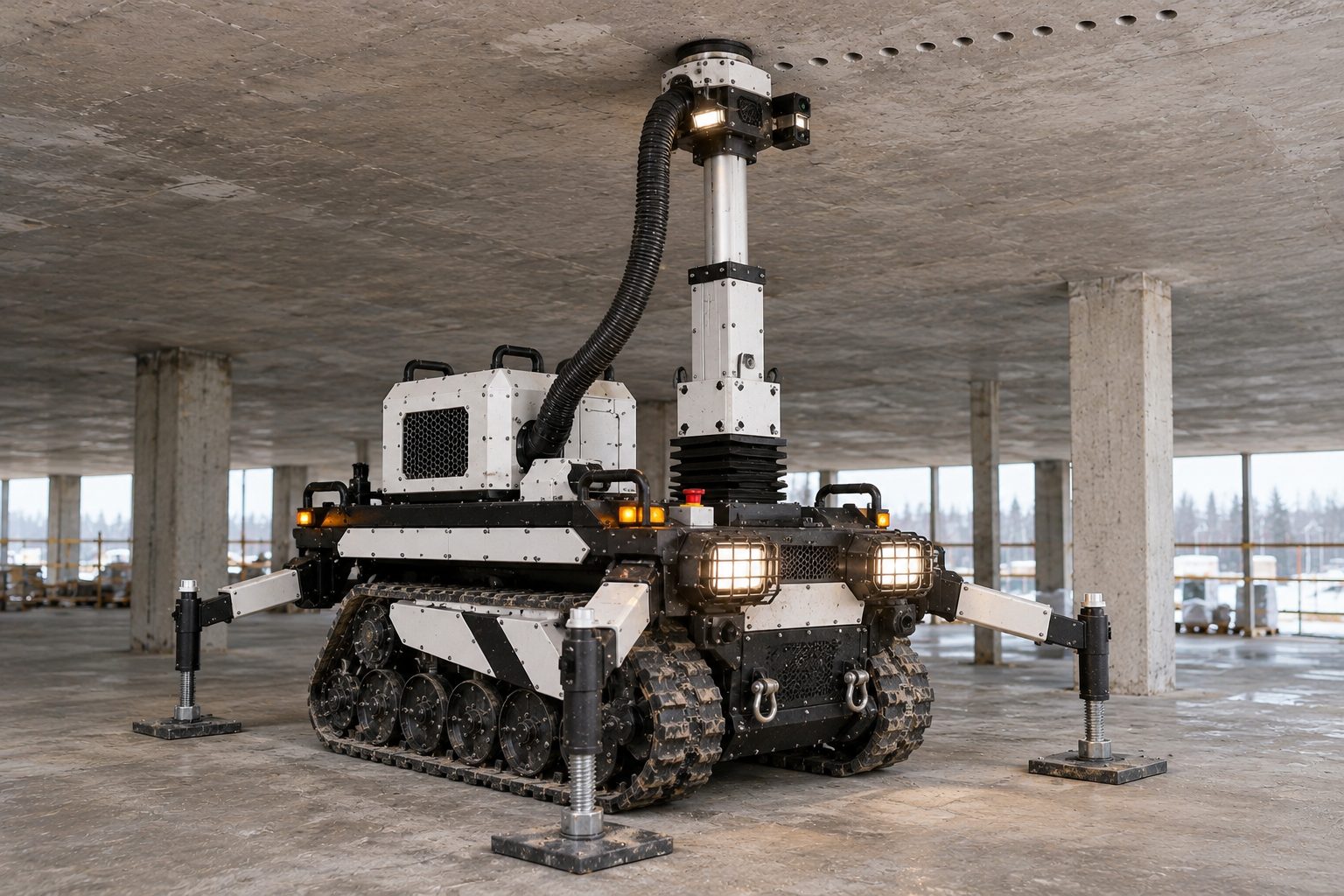
Anchor holes overhead. Dust at the bit.
The Overhead Drilling Robot is a drilling column, model OHD-A1, for the STE Site Hand Tradesman. It is designed to drill anchor holes up into concrete soffits from the drawings, take the dust at the bit and log every hole. Your crew decides where the work goes, and sets the anchors.
The arms-up part of the job.
Hole after hole from a lift or a ladder: arms up, hammer drill, silica dust in the face. Overhead drilling is hard on shoulders and lungs, and the trades who do it earn every hanger they set.
This attachment takes that part. It puts the drill on a column, the dust in a sealed extractor and the layout in the job file. The judgement stays with the trade.
- Threaded-rod hanger holes in concrete soffits
- Strut trapeze support anchors
- Sleeve and riser support anchors
- Seismic bracing anchors
- Mechanical, electrical and plumbing support anchors
One hole, start to finish.
The same steps on every hole, and a record at the end of each one.
- From the drawings. The job computer on the truck turns the drawing into a hole list. The robot carries the job file into the building and is designed to run it on its own battery pack.
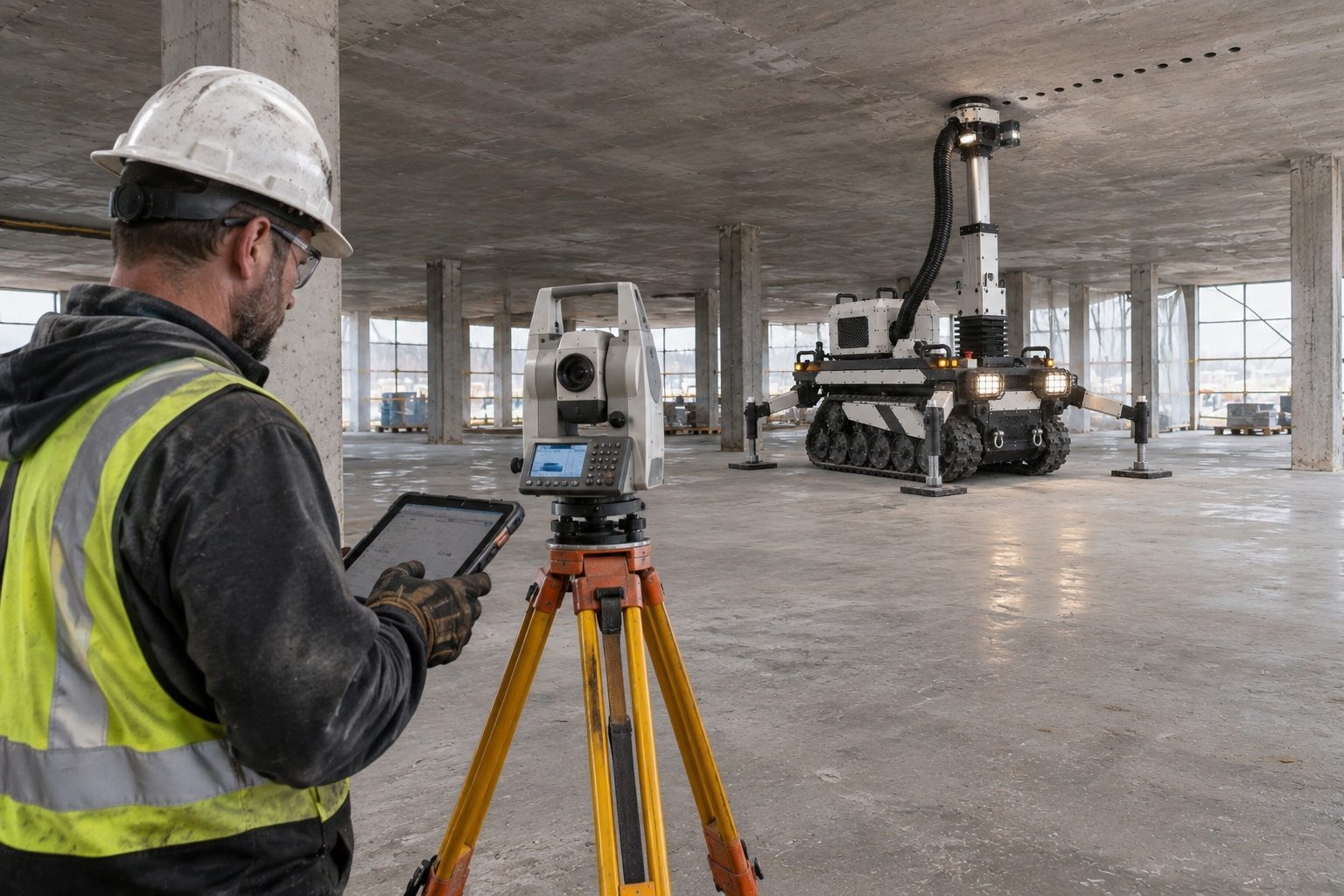
- Position fixed. A robotic total station tracks a 360° prism on the head. The robot is designed to find each hole from it, and a head camera checks the soffit.
- Checked before it drills. Each hole is scanned for steel and live cable, or drilled to a signed scan map loaded into the job. A drill-signature stop backs both.
- Sealed and drilled. A spring-loaded shroud seats on the soffit and braces there. The rotary hammer feeds to depth under force control.
- Dust taken at the bit. A Class H extractor rides on the deck and pulls through the shroud on every hole.
- Marked and logged. Position, depth and result are logged for each hole and come back as an as-drilled report.
Plant the pads, then reach.
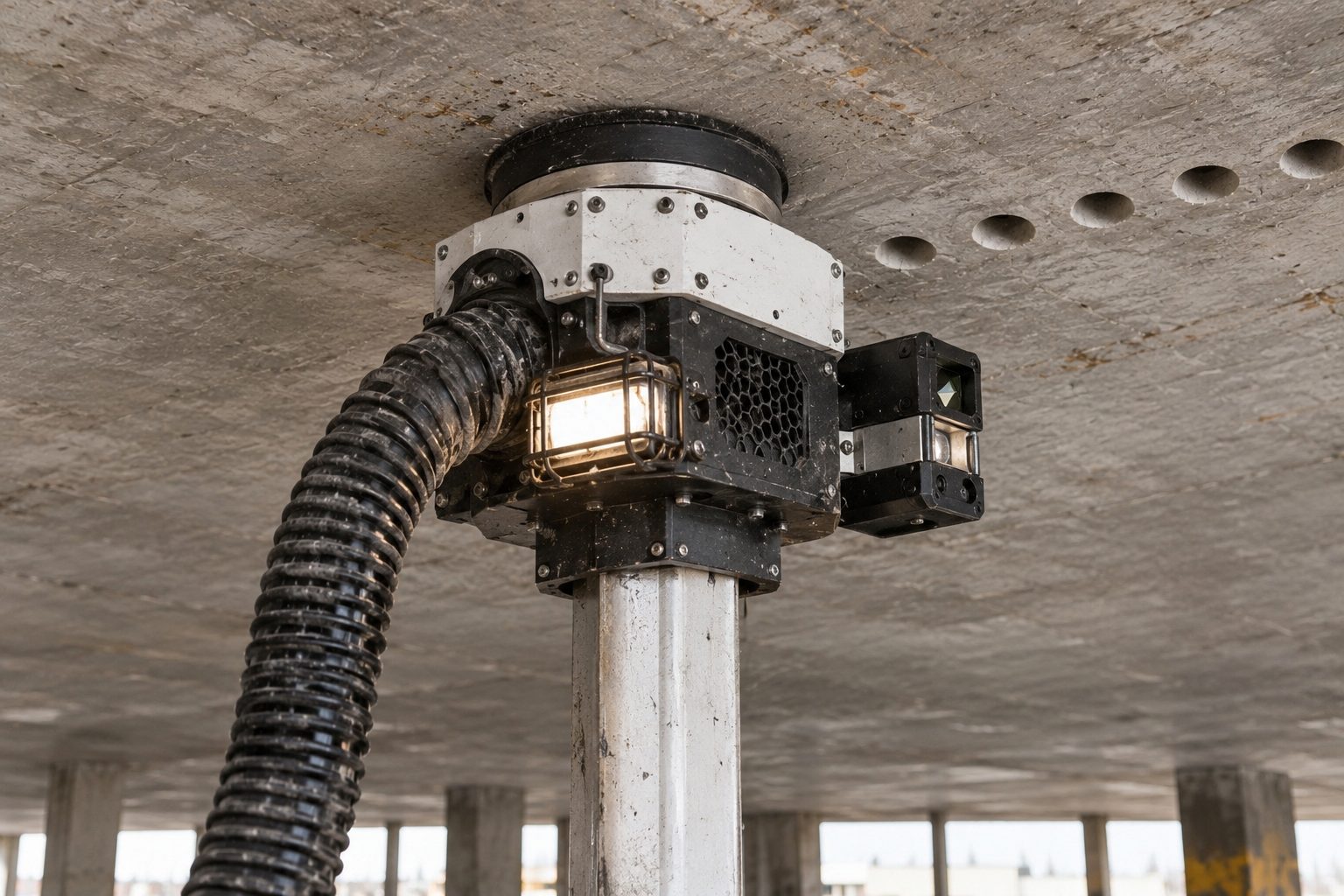
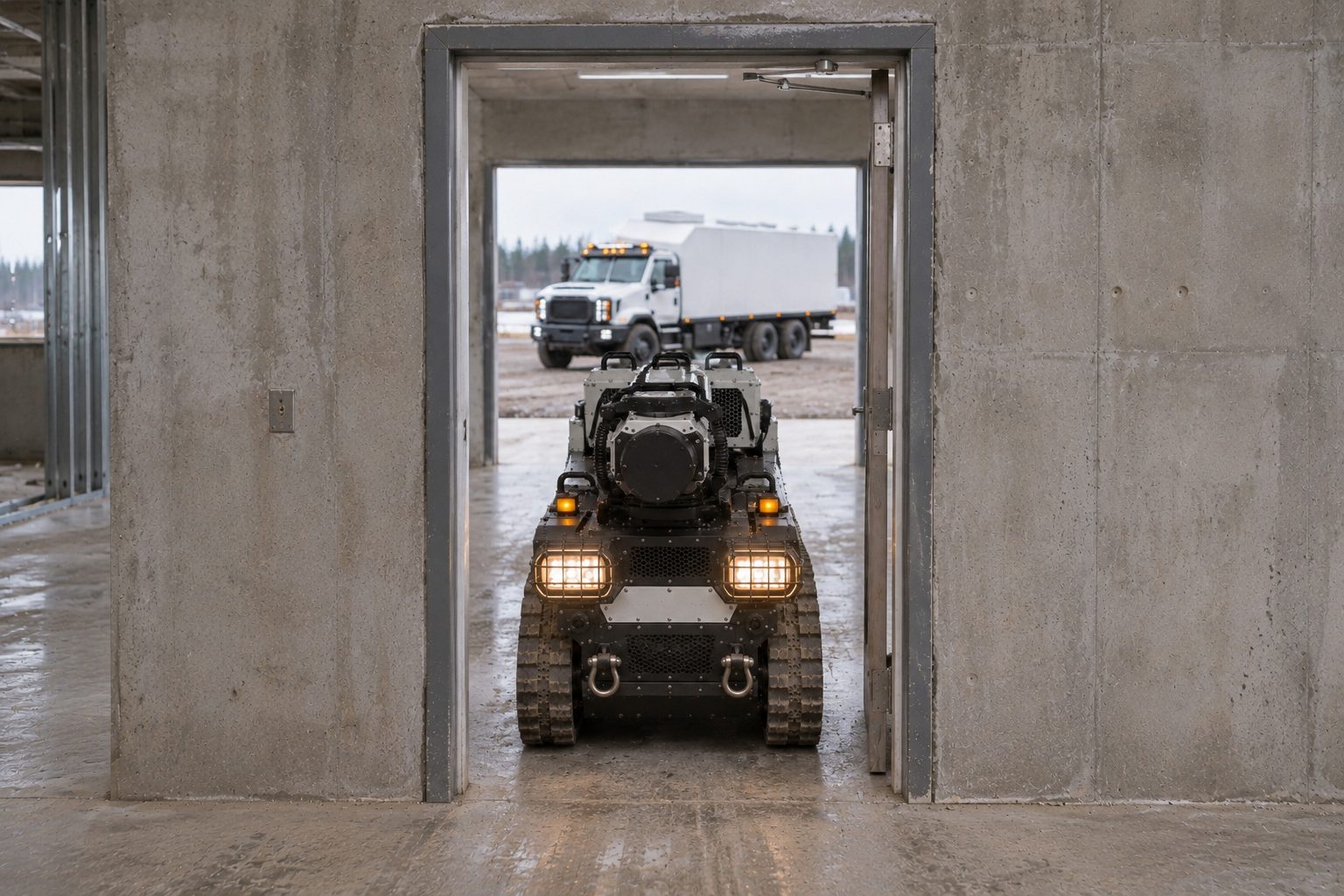
The column rides the Site Hand Tradesman, the door-width tracked base, fitted without arms. A three-stage column locks to the quick-attach on the mast head and carries the drill to the soffit.
The base drives to each set-up, plants its four outrigger pads and raises the column until the shroud seats. Full height and full reach are used only on the four loaded pads: 700 mm of radial slide on pads, 280 mm on tracks alone.
Bits change from a six-slot magazine on the hull, with an optical gauge to check the diameter.
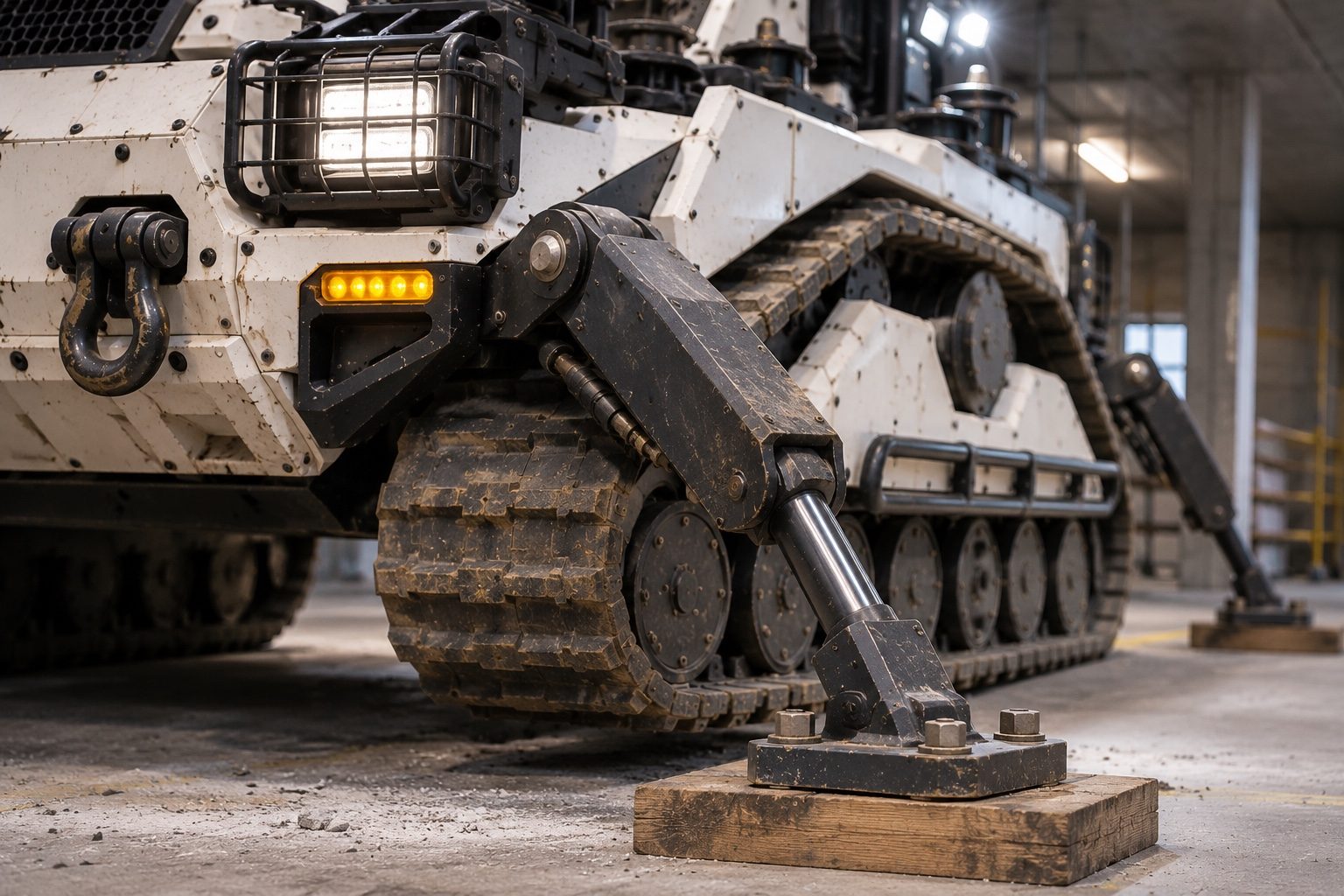
OHD-A1, the numbers.
Dimensions and masses are plain figures. Rates and tolerances are what the attachment is designed to hold.
| Item | Value |
|---|---|
| Soffit height above the standing floor | 2,400 to 5,000 mm |
| Design soffit height | 3,600 mm |
| Radial slide reach, on outrigger pads | 700 mm |
| Reach on tracks only | 280 mm |
| Bit diameter | 6 to 16 mm, SDS-plus |
| Hole depth | 25 to 100 mm |
| Drilling rate | Designed for 40 holes an hour, sustained |
| Hole position | Designed to hold ±10 mm, horizontal, on 95 holes in 100 |
| Hole depth | Designed to hold +3 / -0 mm |
| Bit magazine | 6 slots |
| Attachment mass | 87 kg (column, slide, tool, extractor, magazine, hose) |
| Tool mass at the head | 21 kg |
| Feed force | 80 to 200 N |
| Drill | SDS-plus rotary hammer, 2 to 3 J class |
| Dust extractor | Class H, on board, at least 219 m³/h, automatic filter cleaning |
| Battery pack | 10 kWh |
| Energy use at the designed rate | 1.27 kWh an hour, calculated |
| Site charging | 240 V, 30 A plug, about 7 kW, overnight from site temporary power |
| Crew | One operator for one or two robots; a second person sets anchors and hangers |
How it stays safe.
AI plans, rules govern, humans authorize, safety has veto. Sensing can only remove authority, never add it.
- The operator decides. One operator runs the work from a tablet: starts each job, clears every flag, and can pause, take over or re-plan.
- A flag stops the hole, not the judgement. A hit in the slab, a live-cable reading, an out-of-range soffit or a lost position fix flags the hole for the operator. A flagged hole is moved or sent to the engineer.
- Any stop stops motion. It does not matter where the stop comes from. More on the Site Hand safety page.
- Stable before it reaches. The column goes to full height only with all four pads loaded.
- If the link drops. Portable Wi-Fi mesh repeaters are carried in with the robot. Without the link, the robot runs its loaded job alone, inside the same rules.
- People set the anchors. A second person sets anchors and hangers once the drilled area is released to them.
How a shift runs, and what comes on the truck.
The truck brings the robot, the packs and the total station to site. The robot drives through a standard door, goes up to the floor and sets up under the first bay. Pads down, column up, and each hole is checked, drilled, marked and logged. Then the base moves to the next set-up. At the end of the shift the truck returns the as-drilled report.
The Robot Support Van page covers the truck side in full.
- Truck. Class 5 and up. It carries, charges and computes for the robot.
- Robots per truck. One as standard, two as an option.
- Loading. Self-drive up the truck ramp, or the body crane on the lift points.
- Battery packs. Two in the kit. A spare pack is an option for long days.
- Total station. One robotic total station with tripod.
- Job computer. On the truck: drawing to hole list, job files, logs and the as-drilled report.
- Consumables. Bit stock, Class H filter and bags, marking paint.
What it is not for.
Said plainly, so nobody finds out on site.
- Post-tensioned slabs without an engineer-signed scan map.
- Holes over 16 mm and core drilling.
- Walls, and soffits sloped over 5 degrees.
- Bare steel deck. That is fastening, not drilling.
- Setting anchors. The robot drills. People set.
- Outdoor or wet work, and floors open to the public.
A drilling column on the Site Hand Tradesman. It takes the arms-up hours and the dust, drills from the drawings, and hands back a record of every hole. The operator authorizes the work and the crew sets the anchors.