
The right film, and the record to show it.
A coating job is judged on film build. Too thin and it fails early. Too thick and it wastes product or cracks. The coating boom puts the gun on STE Site Hand, keeps the pump and the product on the truck, and writes down the film on every pass. The crew stays out of the overspray.
A mast, an arm and an airless gun.
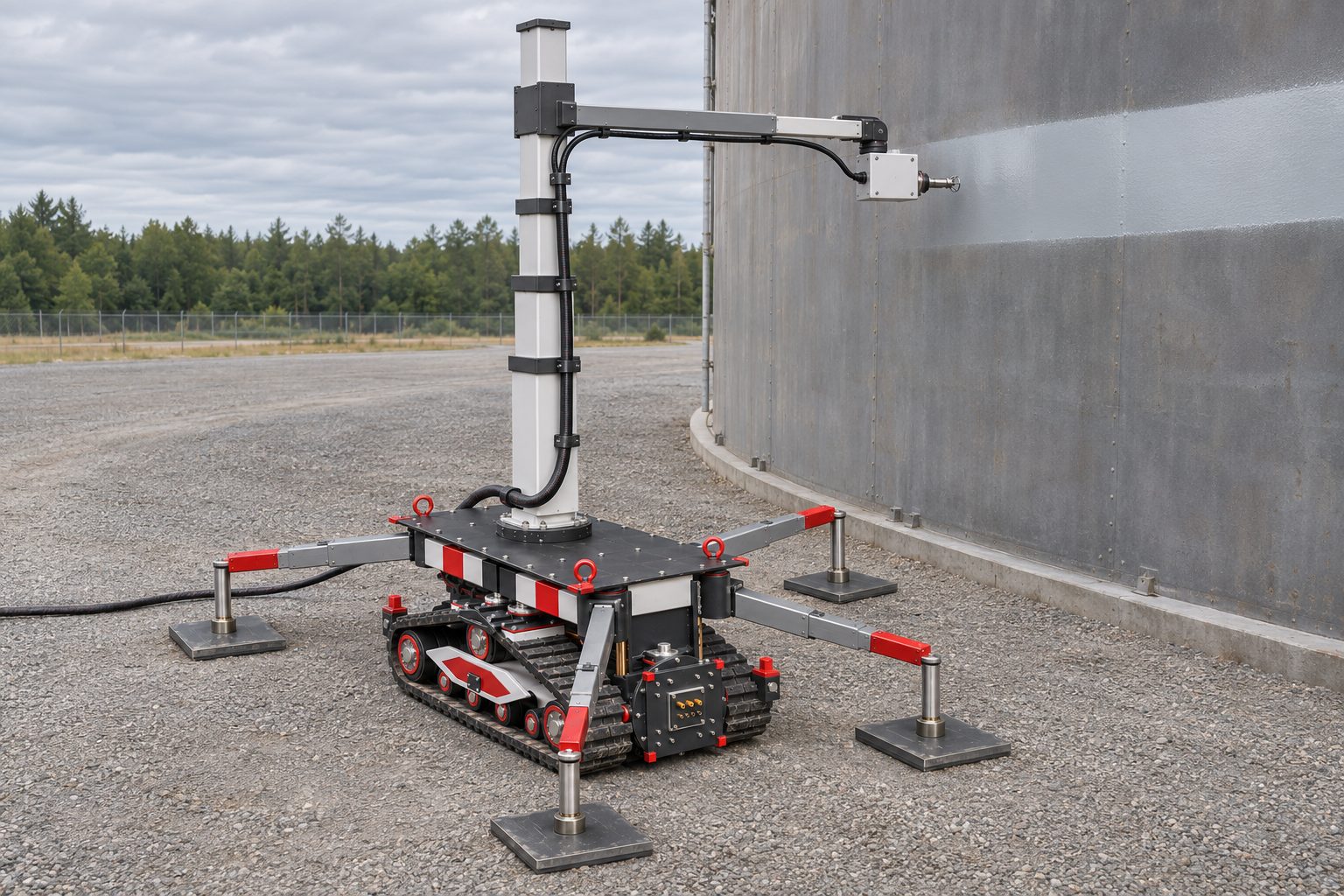
A tilting five-stage mast with a carriage, a telescoping arm, a two-axis wrist and a coating head. It mounts at the waist of the Site Hand Tradesman in place of the standard mast, and the carrier stands on its four outrigger pads while the mast is up.
An automatic airless gun rides the head. The truck is the rig: the pump, the hose reel, the product and the computing all stay on it, and one bundle runs out to the robot.
- Working height. Designed to work to 7,300 mm.
- Mast. Five stages, 1,700 mm nested and 6,250 mm extended.
- Arm reach. 400 to 1,400 mm out from the mast.
- Wrist. Pan ±170°, tilt ±120°, so the gun stays square to a curved shell.
The jobs it is for.
Vertical and curved steel, outdoors or in a shop, where a sprayer would otherwise work off a lift in the overspray.
- Production tank shells. The outside of the shell, from the ground to the working height, in even passes.
- Containment walls. Steel and concrete walls around tanks and process areas.
- Vessels and flat plate. Curved and flat steel within the reach of the mast and arm.
- After the blast. It coats steel the abrasive blast head has prepared, from the same surface map.
- What it sprays. Epoxies, primers and protective coatings with a flash point of 60 °C or above, such as all-solids epoxy and waterborne products.
- What it leaves alone. Solvent-borne products, wall paint on drywall, roof coatings and electrostatic spray are outside its scope. Spray foam has its own tool.
How a coat goes on.
Four steps, the same on every section. The operator releases the pattern from outside the zone and reviews each section when it is done.
Map
The surface is scanned and divided into cells. Every reading that follows is filed against its cell.
Check the weather
The robot is designed to refuse to spray when the surface is less than 3 °C above the dew point, when relative humidity is over 85 %, or when the surface or the material is outside the product data sheet.
Spray
The gun follows the released path while a flow meter on the gun line measures what goes through it.
Measure
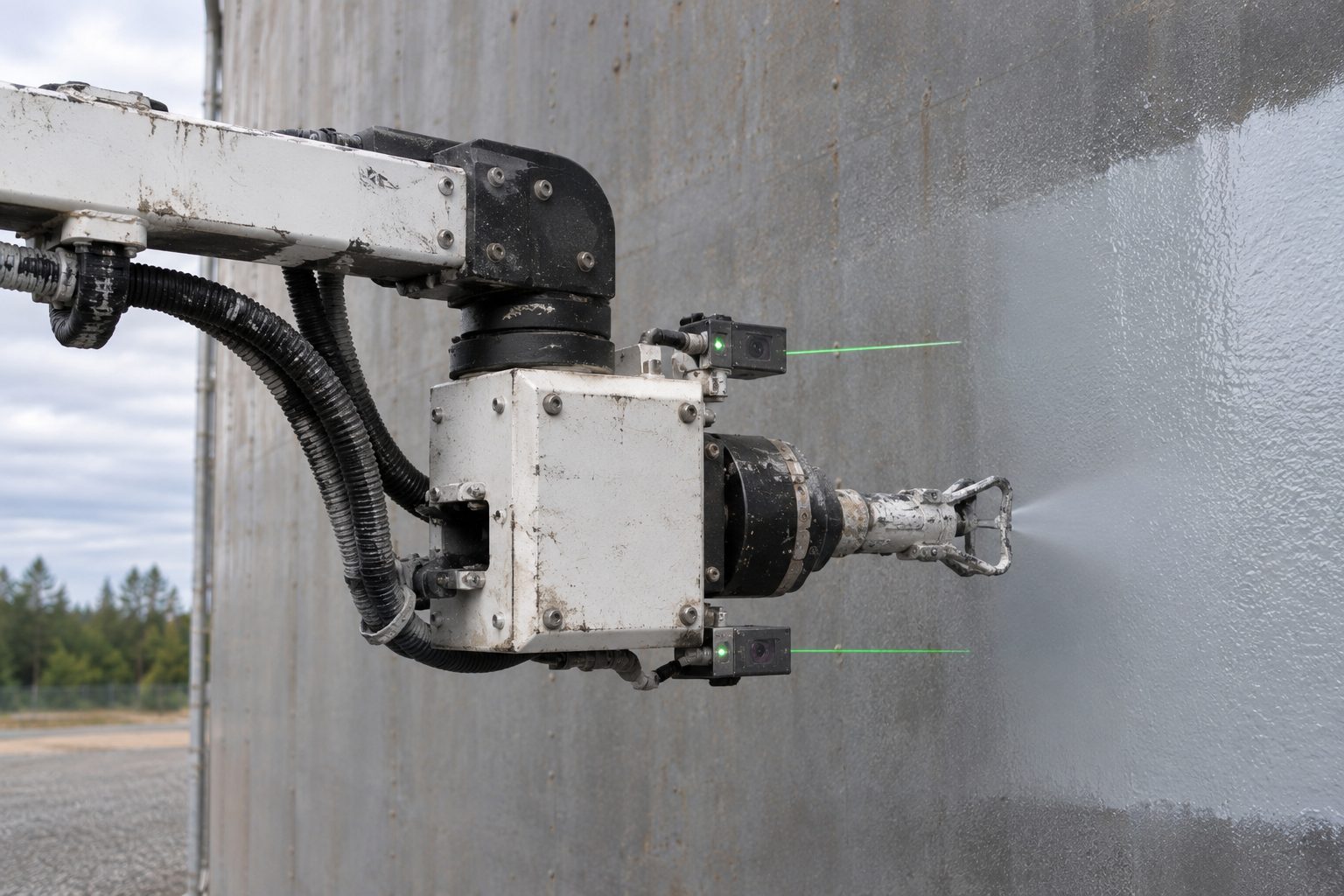
Line lasers read the surface ahead of the gun and behind it on each pass. After cure, the arm places a contact gauge on the film.
Three checks on the film.
The record is the product as much as the coating is. Each check is logged by map cell, with the surface temperature, dew point and humidity at the time.
- The flow model. Metered flow, the solids content of the product, gun speed and fan width give a predicted wet and dry film for every cell.
- The wet scan. A laser profile before the pass and another after it. The difference is the wet film. On a blasted profile it is averaged per cell.
- The dry gauge. After cure, the arm places a contact gauge on the spot plan the coating specification calls for: a magnetic gauge on steel, an ultrasonic gauge on concrete.
- The signature is a person's. The inspector reviews the readings and signs the cured film. The robot hands over the record. It does not sign it.
The truck is the rig.
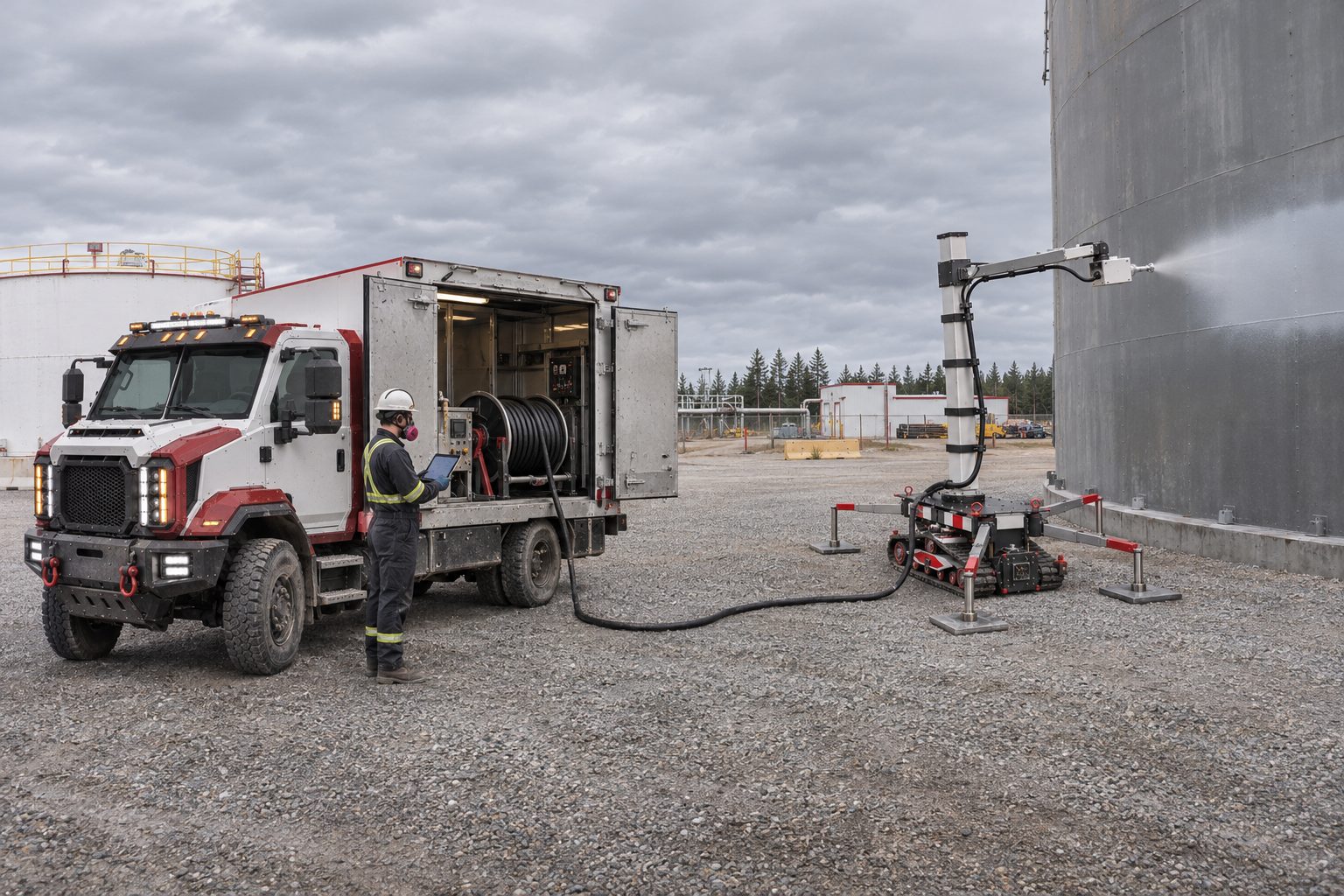
The robot carries the gun to the surface and little else. A 3.7 kW electric airless pump, the product and the computing ride the truck, parked at least 10 m back from the spray zone.
The robot works on a 60 m bundle from a powered reel, up to 30 m out before the truck moves. A battery pack moves it when it is off the tether. A crew of one or two runs the job: one operates from outside the zone, the other mixes, tends hose and details.
- One bundle. Fluid hose, power, purge air, data, the stop loop and the bond wire, on one reel.
- Product kept warm. A heated, ventilated cabinet holds a day's product.
- Flush loop. Solvent or water flush, into a closed waste drum.
- Enclosed rooms. An exhaust fan and duct run from the truck, with vapour sensors at the robot and at the zone boundary.
The numbers.
The coating boom on the Site Hand Tradesman. The spray figures are the reference set-up on an amine epoxy. Your product's data sheet sets the real ones.
| Item | Figure | Note |
|---|---|---|
| Working height | 7,300 mm | Designed to work to this height, on the four pads |
| Mast | 5 stages, tilting | 1,700 mm nested, 6,250 mm extended |
| Arm reach | 400 to 1,400 mm | Out from the mast |
| Wrist | Pan ±170°, tilt ±120° | Two axes |
| Mount | Waist of the Tradesman | In place of the standard mast |
| Gun | Automatic airless | Reversible tip and tip guard |
| Reference set-up | 0.019 in tip at 2,200 psi | 254 mm fan |
| Reference film | 200 µm wet | 100 to 150 µm dry on the reference epoxy |
| Airless pressure, maximum | 3,300 psi | Hose and gun rated above it |
| Pump | 3.7 kW electric | On the truck |
| Tether | 60 m | Works up to 30 m out from the truck |
| Truck standoff | 10 m or more | From the spray zone |
| Weather limits | 3 °C over dew point, 85 % relative humidity | The robot does not spray outside them |
| Product flash point | 60 °C or above | |
| Crew | 1 to 2 people per truck | Out of the overspray |
How it stays safe.
The Site Hand rules hold with a gun on the mast: AI plans, rules govern, humans authorize, safety has veto. Any stop stops motion, and sensing can only take authority away.
- Nobody in the spray zone. Zone scanners are designed to hold the spray while a person is inside.
- Vapour closes the valve. The spray valve is designed to close at 10 % of the lower explosive limit. At 20 % the robot stops.
- Purged enclosures. Drives, battery and controls sit in enclosures pressurized with purge air from the truck, and the sensor circuits are intrinsically safe. Loss of purge shuts off the spray and stops the machine.
- Planted before it reaches. The mast goes up only on the four loaded outrigger pads.
- A flash point is not the whole answer. It does not settle a job's hazards. The site's hazard assessment and the product data sheet still rule the work.
- The stop loop runs in the bundle. A stop at the truck or at the operator stops the robot at the wall. More on how Site Hand stays safe.
The truck carries the pump and the product. Site Hand carries the gun up the wall. You get a coated section and a film-build record for the inspector to review and sign, and nobody stood in the overspray to get it.