
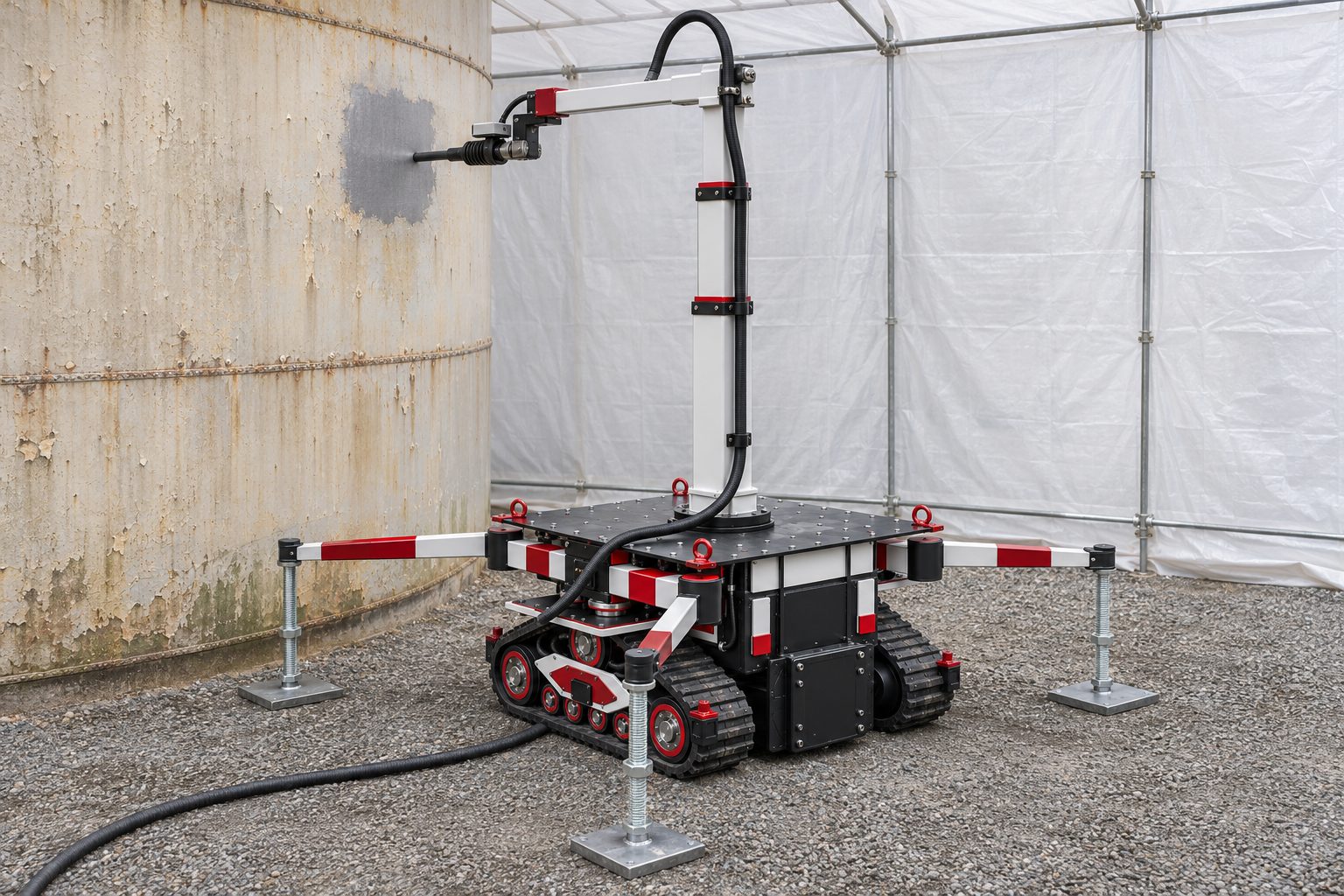
The nozzle works inside the containment. The crew stays outside.
The abrasive blast attachment puts STE Site Hand to work on steel and concrete. A blast head rides the Heavy base inside the sheeted area. The pot, the air and the abrasive stay with the truck, and the crew runs the job from outside the dust.
Hard work for a person. Steady work for a machine.
Inside a blast containment there is dust, noise and a nozzle that pushes back all shift. This attachment takes the person off the nozzle and keeps them in charge of the work.
The blast head is carried by Site Hand Heavy, on tracks, parked on its outrigger pads. One operator and one helper work outside the containment. They build and accept the work area, release each bounded section, and can stop the blast at any point.
Plainly, the attachment works inside a containment the crew builds. It is not the whole set of dust and exposure controls for a job.
Four parts, one kit.
The chain runs truck, hose tender, carrier, blast head. Each part carries its own code so it can be serviced on its own.
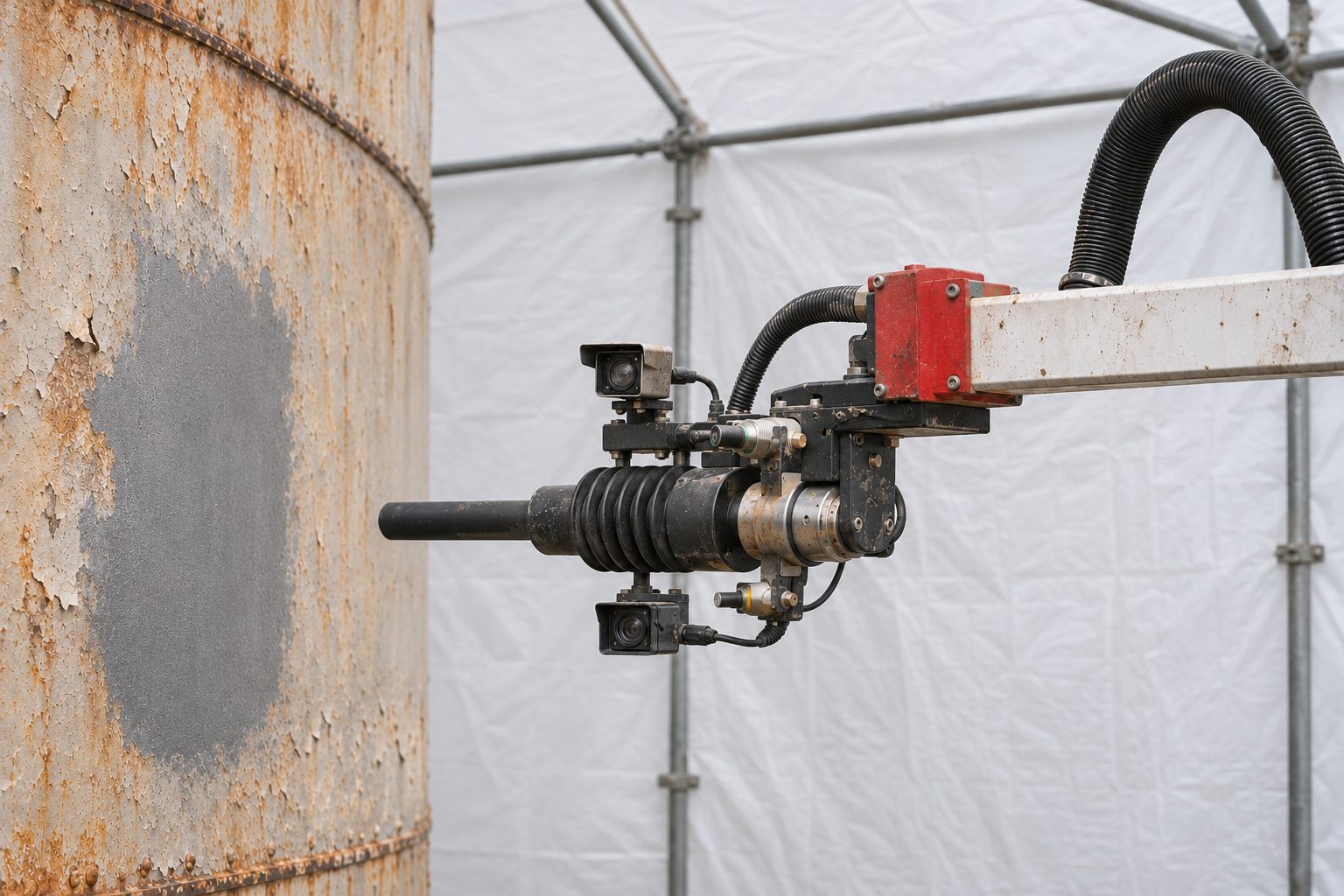
Blast head
A nozzle holder on a two-axis wrist, with standoff sensors, two cameras and a profile gauge. The wrist sweeps the nozzle 30 degrees either side and tilts it 60 to 90 degrees to the surface.
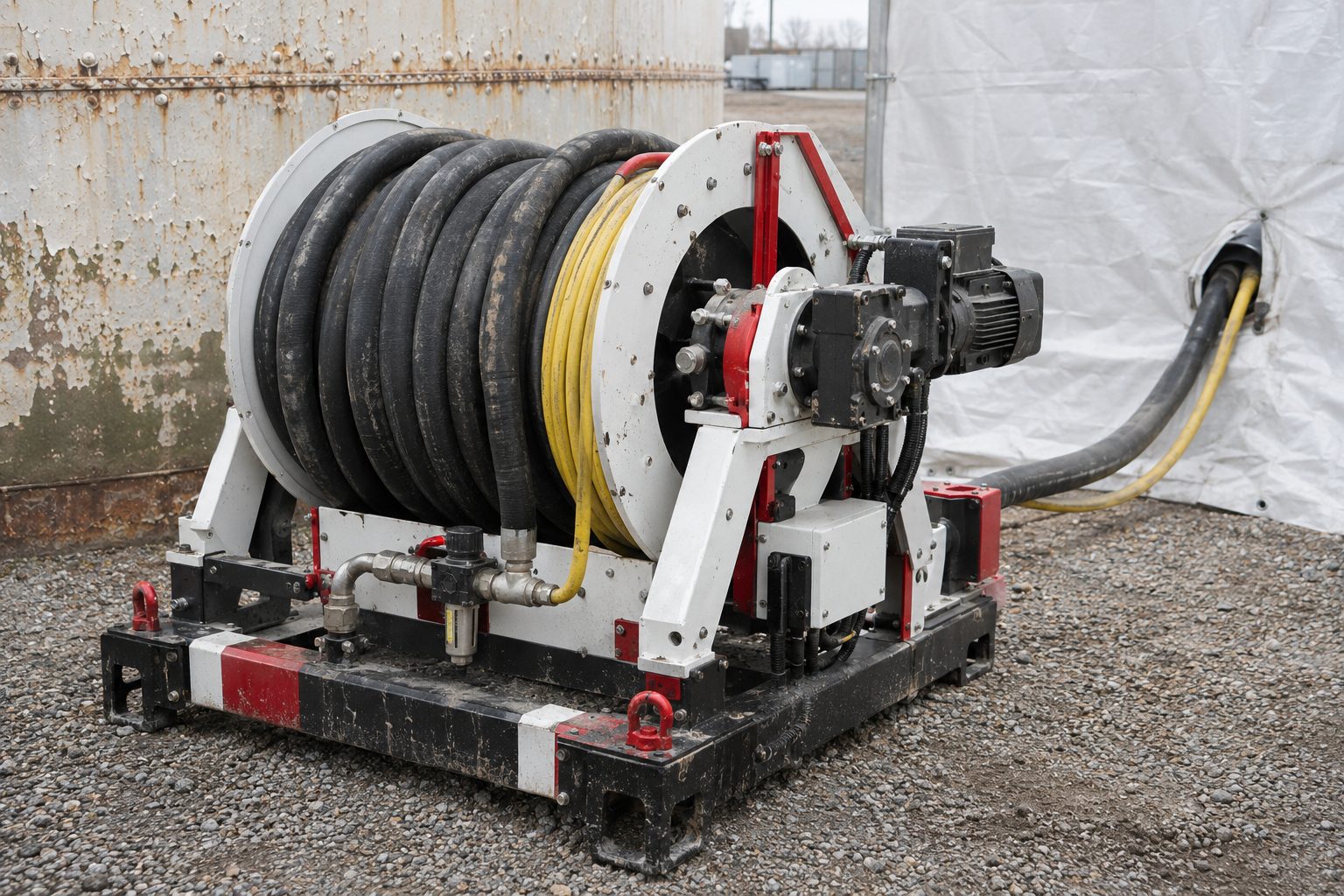
Hose tender
A motorised hose reel, with saddles on the boom for the blast and air hoses. It pays the hose out and takes it back as the machine moves, so nobody drags hose inside the zone.
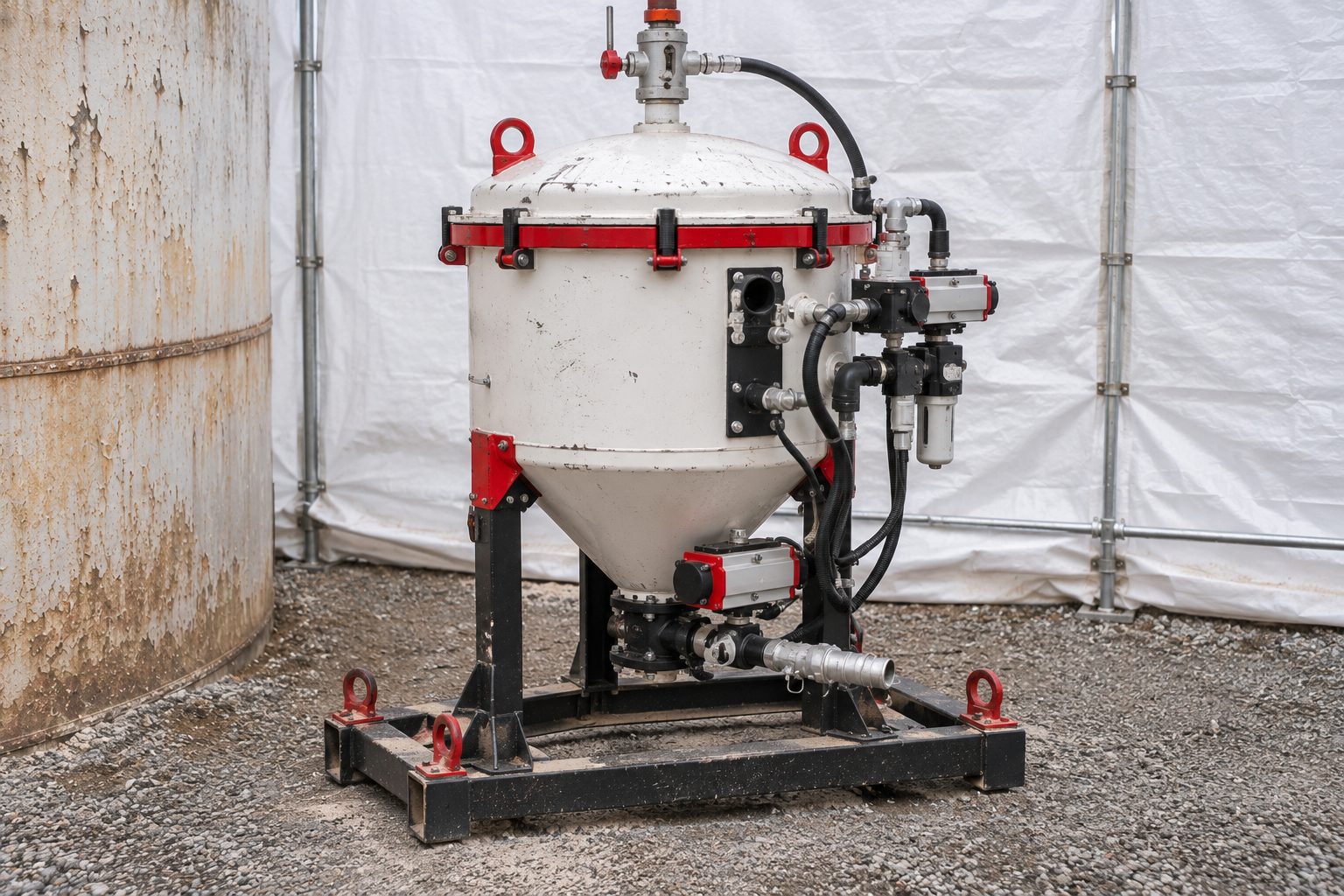
Blast pot
A 6 cubic foot pot on a skid, with remote valves that sit closed until the safety controller lets them open. The pot stays within 15 m of the work.
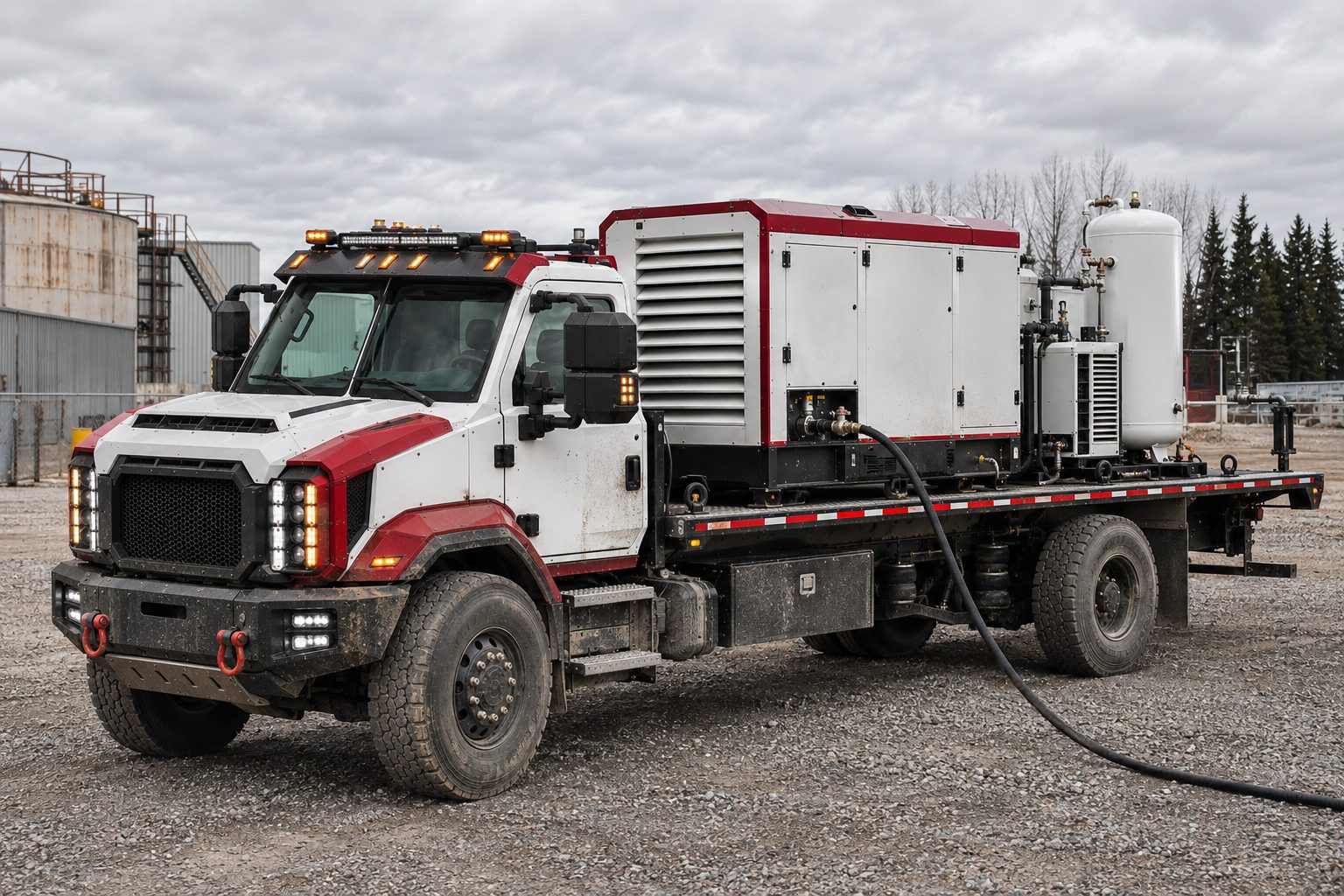
Air plant
An electric rotary screw compressor on the truck deck, run from the truck's generator. It is sized for one No. 6 nozzle with reserve.
Where it works, and where it does not.
It is for steel and concrete within the machine's reach, to a working height of 6 m.
- Structural steel. Girders, columns and frames.
- Tanks. Steel tank exteriors and walls within reach.
- Bridge steel. Within reach from the ground.
- Concrete. Walls, columns and soffits.
- Ahead of the coating. The same carrier takes the coating tools, served from the same truck.
- Not for. Floors, tank interiors, other confined spaces, or work above 6 m.
Scan, review, blast, check.
Every section follows the same four steps, and a person signs off between them. AI plans. Rules govern. Humans authorize. Safety has veto.
On steel the attachment is designed to blast to SSPC-SP 10. Lighter grades run faster.
- Scan. The mast lidar maps the surface, and the crew places the job-frame targets.
- Review. The machine works out the blast path from the scan. The operator reviews it on the tablet before any blast.
- Blast. The head holds its standoff and its traverse speed. The blast valve stays open only while the safety controller allows it.
- Check. The cameras and the profile gauge on the head record the surface for the inspector. The crew inspects before any coating goes on.
The numbers.
From the abrasive blast data sheet. Reach, air, thrust and stop figures are what the attachment is designed to do.
| Item | Value |
|---|---|
| Carrier | Site Hand Heavy, on tracks, on outrigger pads |
| Working height | Designed to work to 6 m |
| Horizontal reach | 1.4 m |
| Nozzle | One No. 6, at 100 psi at the nozzle |
| Largest nozzle on the robot | No. 7, with a larger towed compressor |
| Air at the nozzle, No. 6 | 229 cfm |
| Air plant sizing, with reserve | 298 cfm |
| Abrasive flow, No. 6 | 1,152 lb/h |
| Standoff | 450 mm, adjustable from 300 to 600 mm |
| Nozzle traverse speed | 300 mm/s, adjustable from 100 to 600 mm/s |
| Nozzle thrust | 52 N steady at 100 psi. The head is designed for 250 N. |
| Blast hose | 1.25 in bore, with 8 m carried on the boom |
| Media on steel | Steel grit, G40 to G50, recycled |
| Media on concrete | Garnet, recovered |
| Air plant | Electric rotary screw on the truck deck, 56 kW electrical load |
| Other air supply | Towed diesel compressor, 375 cfm for a No. 6 |
| Crew | One operator outside the containment, and one helper |
Any stop shuts the blast.
Blasting runs in the bounded zone only: a sheeted area with nobody inside and a supervisor holding the stop. Twelve safety functions are defined for the attachment. Sensing can only remove authority, never add it.
- Deadman blast valve. The valve is normally closed. Any stop request is designed to close it within half a second and vent the pot.
- Nobody in the zone. Door switches and zone scanners watch the containment. They are designed to close the blast valve if anyone enters.
- Standoff stop. The head is designed to stop the blast if the nozzle comes closer than 150 mm to the surface.
- Sealed for grit. Joints, motors and connectors in the zone are designed dust-tight, with replaceable abrasion covers on the boom and wrist.
- No silica sand. Steel grit on steel, garnet on concrete. Silica sand is not used.
- The job's controls stay. The containment, the ventilation and the exposure controls are still the crew's to build and keep. How Site Hand stays safe.
It comes off the truck, and it is fed by the truck.
The truck carries the kit, powers it, and supplies the air and the abrasive. A blast nozzle needs far more air than a truck's own work air gives, so the air plant rides the deck as part of the kit.
The carrier tracks between bays with the mast down, then plants its pads and goes back to work.
- In the kit. Blast head, hose tender, blast pot skid, air plant, the scan kit with the operator tablet, and the containment door switches and zone scanner posts.
- From the Site Hand line. The Heavy carrier and its boom. One carrier serves more than one trade.
- Alongside. The vacuum recovery unit and the dust collector ride their own trailer. Most crews already own or rent them.
- Towed air if you have it. A towed diesel compressor couples in at the pot in place of the deck air plant.
Steady Eddie puts the blast head inside the containment and keeps the blaster outside it. The crew builds the area, releases each section, holds the stop and inspects the steel. The truck brings the air.