
The unit is designed to go on the roster. A person puts it to work.
A unit files; a person accepts. Only a typed human name turns ready to ask into cleared to work.
STE SIS, the unit's own paperwork, is designed to make a machine a member of the crew: it puts a unit on the roster and gives its day its limits.
What it is designed to do, and never to do.
The lists are the same length on purpose.
- Register every unit with its own number and its own inbox for paperwork.
- Receive the tailgate your crew already signs, and turn it into the day's limits.
- Trace every limit back to the line it came from.
- Hold the unit's own declaration at ready to ask until a person types their name.
- Authorize anything. A unit files; a person accepts.
- Send anything back out. The part that reads the tailgate can only read it.
- Stop a machine. The wired stop set on the machine does that, and this sits beside it.
- Offer an override, or any path around the typed name.
A unit is registered as a person is.
Each one is designed to be registered as a person is, with a number and a mailbox of its own, so the signed tailgate your crew already produces reaches the unit and becomes the day's limits, each limit tracing back to the line it came from.
It is designed to change nothing about your morning. The crew holds the tailgate meeting it already holds, somebody signs it, and it is designed to go to the unit's own address. The roster and the pre-start meet at the STE Site Foreman.
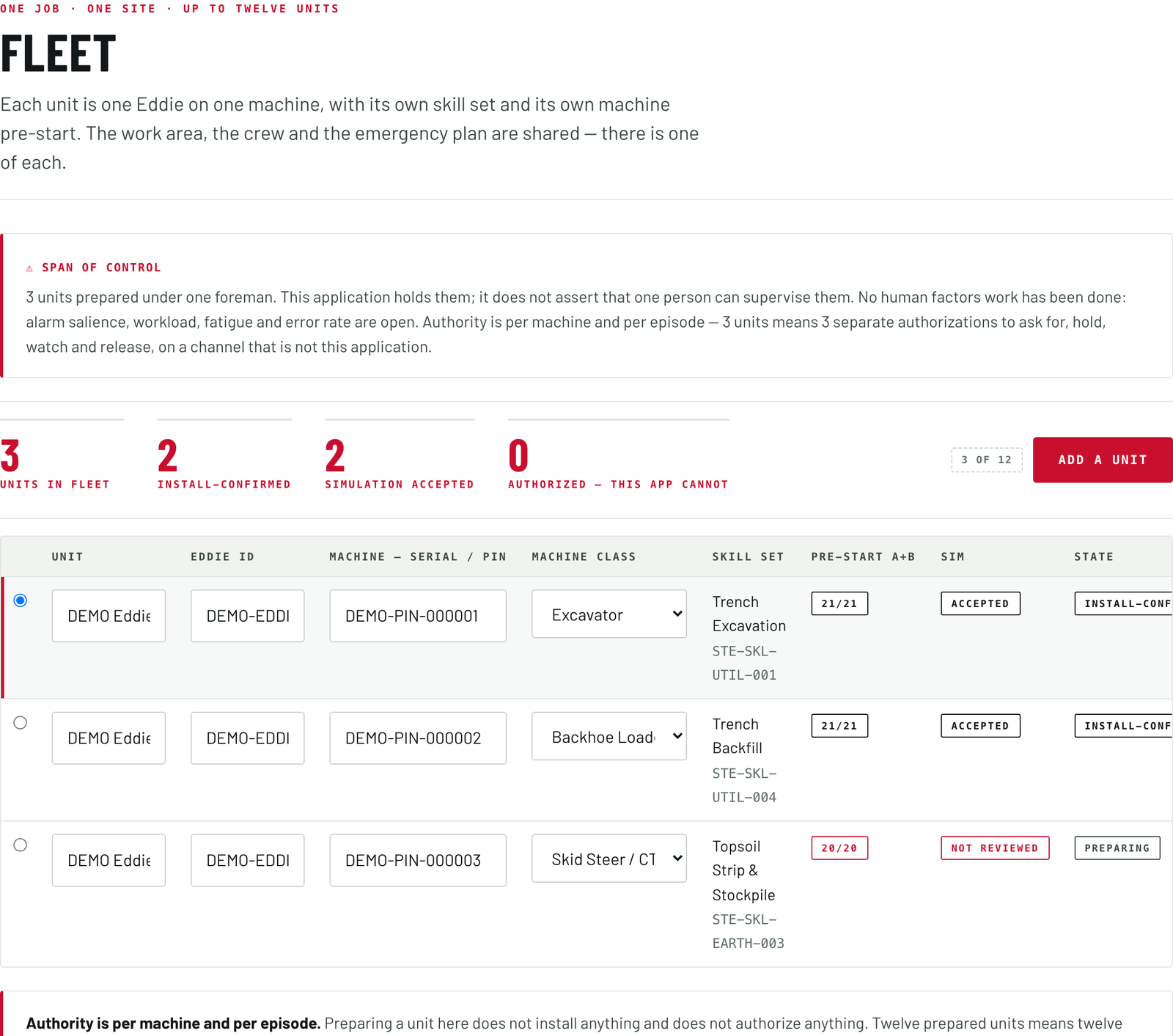
A unit prepares its own paperwork. A person accepts it.
The line never moves: a unit prepares its own paperwork and a person accepts it by typing their name, as the pre-start says. The design carries no override and no path around that name.
A unit's own hazard assessment is a submission, never a certification. The highest state it is designed to reach on its own is ready to ask. Accepted is a person's word.
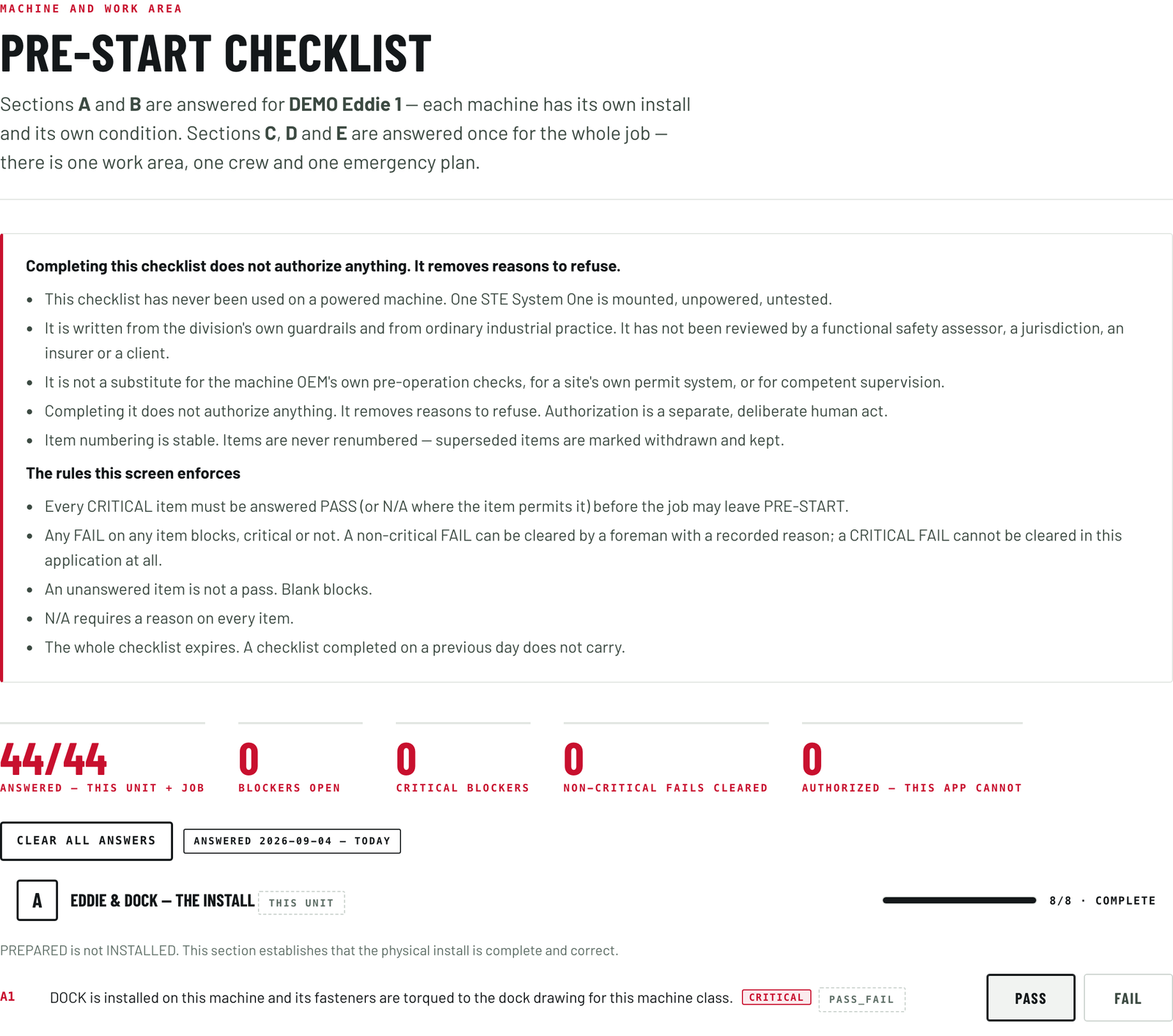
We were asked for one device, and built two products instead.
We were asked for a device with an emergency stop on it, and built two products instead. That story is told once, on the family page.
The same refusal shapes this one. A record that could clear itself would have been the easier product and the worse one, so the part that reads is designed to read and nothing else. A signed tailgate goes in, limits come out, and nothing comes back but a narrower day.
It may propose, and nothing else. No tick is ever substituted for a typed human name.
One of five, and the four it works with.
The five are designed as one set, so that each agrees with the other four instead of solving its own corner.
The carried hold.
A handheld a person carries that asks a machine to stand down. A request, never an emergency stop.
STE Approach Intrusion SensingThe zone on the machine.
A zone the machine watches for itself, wired to the safety side.
STE SIGNALWhat a crew reads.
Lights, sound and a swing-direction indicator, for a crew reading an empty seat.
STE CABThe other machine's cab.
A device in the other machine's cab, so the driver knows what our machine is doing.
Those four are designed to act in the minute a person needs them. This one settles the day before it starts, and it is designed to run no wire to the machine's safety or control side. How the five meet.
Where this stands.
STE SIS is designed, specified and written down in full, from the number a unit carries to the gate that ends in a person's typed name. That engineering is what we will put in front of your safety people, and they can read all of it. No assessment against ISO 13849 or ISO 17757, the standards we design against, has been performed. We would rather you read that here than find it out for yourself later. A person walks around the machine, completes the pre-start inspection, starts it and clears it for operation. Only then does Eddie engage the controls: every session, every machine, no exceptions. Eddie never starts, wakes or inspects a machine. A corrected tailgate is recognized by its content, not its filename. No tailgate means no limits and no work. A mis-read counts as a failure, never a pass. We claim the design and nothing past it. Your machine's warranty, its conformity and your liability position are for your counsel.
The three a safety officer asks first.
No. It is designed to prepare its own declaration and stop at ready to ask. What happens next is a person, reading it and typing their name.
No. The mailbox is designed to take a signed tailgate in, and a narrower day is the reader's only output. It can take permission away. It never grants it.
No. A stop in a unit's record is an account of one, and never the thing that produced it.