
Designed so a person on the ground can ask the machine to stand down.
It is not an emergency stop. It does not protect you. It asks.
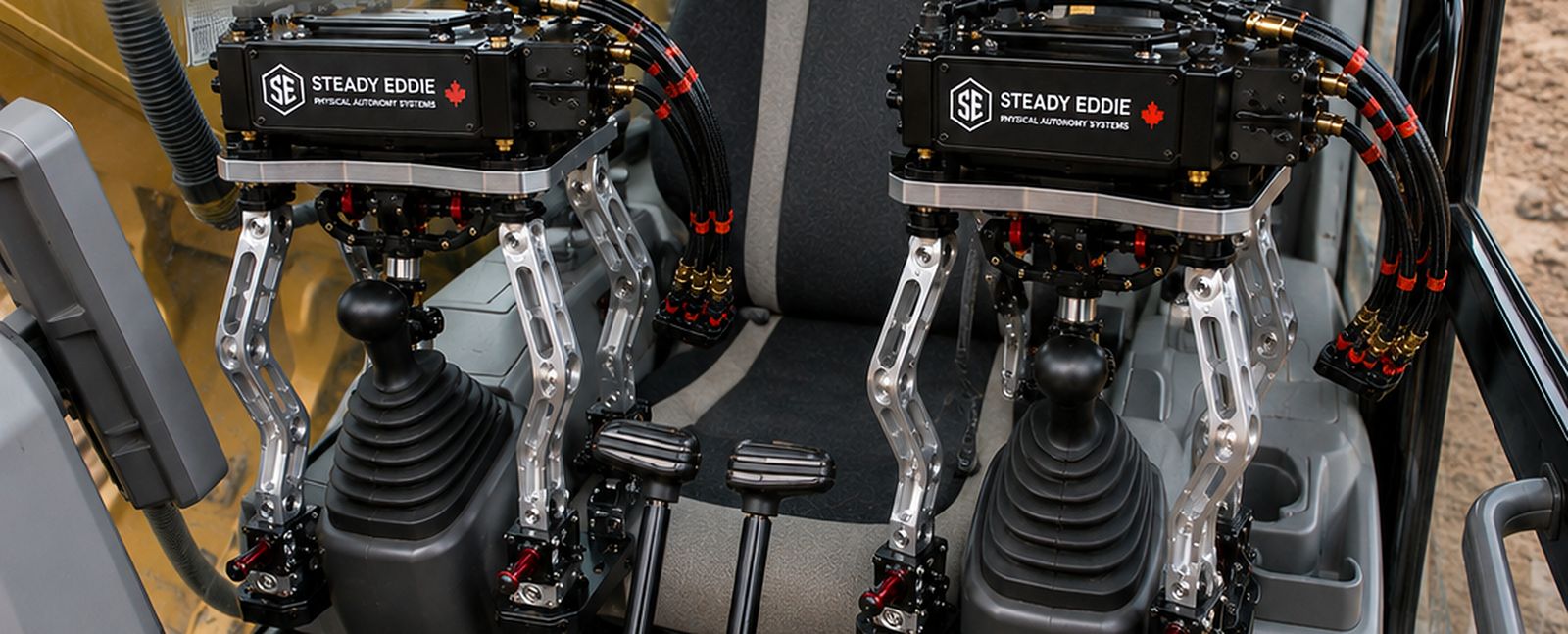
A machine with nobody in the seat works next to people who used to read an operator's face. STE RHR, the carried hold request, is designed to give them something to do about it: a handheld a person carries that asks a machine to stand down, and latches until somebody at the machine clears it. What stops a machine is the stop set on the machine, wired and local, and that is where it stays. The three ways to take control away by hand are on the machine today, and we will demonstrate every one of them for you.
What it is designed to do, and what it does not do.
A person who believes a device protects them stands closer than one who does not, so both lists are set at the same size.
- One guarded button, designed to be pressed deliberately in a winter glove and not by somebody leaning on it.
- It is designed to be issued to anybody on site rather than kept for supervisors.
- The request is designed to latch: a controlled stop that stays stopped, with no timer and no resuming by itself.
- It is designed to be cleared only by a person at the machine, never by the person who pressed it.
- Every request is designed to say who sent it.
- A lost link is designed to leave the machine as it was and to show on the device that it was lost.
- It does not stop the machine. It asks, and the machine's own systems act on the request.
- It does not protect the person carrying it. Stand where you would stand without it.
- Nothing in it senses where anybody is standing.
- It is not personal protective equipment, and carrying one changes nothing about what you are exposed to.
- It never stands in for a stop that works.
- It is not an emergency stop, and the device is designed to carry the words NOT AN EMERGENCY STOP on its own face.
We were asked for something else.
The person who first sees a problem is almost never the person at the console. We were asked for a device that could be issued to all of them with an emergency stop on it. We did not build that. Twenty people each carrying a stop that travels by radio means twenty links a life depends on, and a machine that stops for a pocket. Our own rules forbid it: wireless never carries the safety loop.
So it was split in two, and both halves designed properly. The request is this product: a person on site deliberately asks a machine to stand down, and it is attributable to them. The other half is a zone the machine is designed to watch for itself, wired to the safety side and designed to be safety-grade. That is STE Approach Intrusion Sensing, a different product with a different grade.
The refusal is the engineering. A device that felt like protection and was not would be worse than no device at all.
Two different things get called a lanyard, and the difference is the whole point.
One is the cord at the machine, designed to be wired into the machine's own stop, so that pulling it takes from every drive the energy that moves it.
The other is the cord around a person's neck, and it carries nothing. It is designed to come apart under load: a cord near a rotating upper structure is an entanglement hazard, so the breakaway is deliberate rather than a convenience. A cord that has parted is never re-tied.
The two are kept apart in the hardware, in the legend printed on each, and in the words we use, because nobody's safety should rest on being wrong about which is in their hand. The stop set is ranked on the safety page.
One of five, designed as one set.
What is sensed on the machine is designed to be safety-grade, what is carried is a request, and the ranking keeps them in that order.
The zone the machine watches for itself.
Wired to the safety side, and designed only ever to take authority away.
Three · STE SIGNALWhat a crew used to read off the operator's face.
Lights, sound and a swing-direction indicator so a crew can read a machine with nobody in the seat.
Four · STE CABThe truck backing in to load out.
A device in the other machine's cab, so the driver knows what our machine is doing.
Five · STE SISThe unit on the roster.
The paperwork that makes a machine a member of the crew, accepted by a person's typed name.
Where this stands.
The first thing you are told, because everything after it depends on it.
STE RHR is designed and specified: what it is, what it may never do, the hazards it answers and the checks that would prove them. The engineering is written down in full and your safety people can read all of it, including the questions we have left open. We would rather you read this here than find it out for yourself later. A person walks around the machine, completes the pre-start inspection, starts it and clears it for operation. Only then does Eddie engage the controls: every session, every machine, no exceptions. Eddie never starts, wakes or inspects a machine. No assessment against ISO 13849 or ISO 17757, the standards we design against, has been performed. We claim the design and nothing past it. Your machine's warranty, its conformity and your liability position are for your counsel.
For the buyer, the safety officer and the crew.
No. It asks, and the request is designed to latch until somebody at the machine clears it. Had we built a stop that travelled by radio, we would have put a life on a link nobody can prove.
Sometimes this. Sometimes the zone on the machine. Often both, and once in a while neither. A site with a carried device and no zone on the machine has a request and nothing watching the ground.