
The machine is designed to keep its own distance.
Designed to be safety-grade, and described as designed until it is assessed.
An operator in the seat watches the ground around the machine, and nobody wrote that job down because nobody had to. STE Approach Intrusion Sensing is that job written down. Sensing stations on the machine are designed to watch a defined envelope around it, and to stop the machine when somebody walks in: decided on the machine, wired to its own safety side, with no radio in the path.
What it is designed to do, and what it is designed never to do.
- Decide on the machine. It is designed as a wired input to the machine's own safety side, and nothing off the machine has to agree.
- Count unknown as occupied. Where the envelope cannot be seen, the design treats it as though somebody is standing there.
- Remove authority, never create it. The machine is designed to hold, and to go to its safe stop if somebody stays inside. A stop ends in the machine's minimum-risk condition: what this machine, on this task, does when it stops.
- Leave the restart to a person. Walking out is designed to restart nothing. Somebody at the machine restarts it, deliberately.
- Give permission. It can only ever take authority away. Sensing is designed only to take authority away, never to create it.
- Know who you are. It is designed to notice that somebody is inside the envelope, not who they are.
- Stand in for your site. The wired stop set is what stops a machine, and the plan is still gates, spotters and barriers.
- Follow you. The envelope is designed to be set on the machine. Step outside it and the design knows nothing about you.
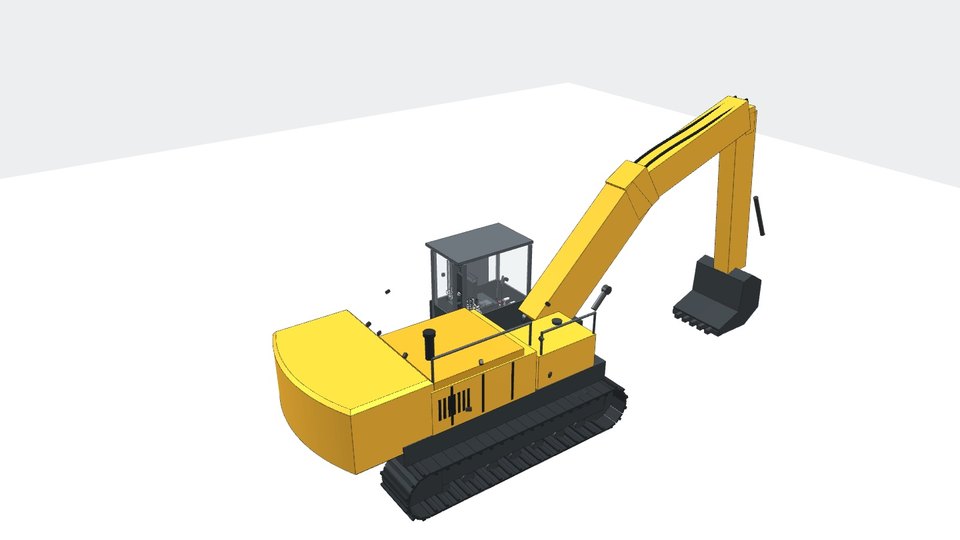
Drawn from the swing, not from where the boom is pointing.
The obvious way to draw a zone is around where the machine reaches right now. We did not draw it that way.
An excavator's upper structure swings, and it swings faster than most people expect. Between noticing somebody and coming to a stop, the upper structure turns through an angle, and everything inside it was reachable, whether or not the boom was pointing there when the person stepped in.
So the zone is designed to come out of how far the upper structure swings while that machine is stopping, taken from the manufacturer's own published figure for how fast the machine we work on swings, and from a stopping time we carry as an assumption until one is measured. That angle, rather than the reach, rules the shape. It is duller than a circle, and it is the right one.
Why a tag on a vest was not good enough.
There is an easy version of this product: give everybody a tag, and have the machine look for tags. We refused it outright.
The person this is designed for is the one carrying no tag: the visitor, the driver who got out for a minute, the new starter, the person whose battery went flat. A system that watches for the tagged and is blind to the untagged has picked exactly the wrong people to watch for.
A tag may be part of an answer. It can never be all of one. How it senses a person is still being chosen. That it must find somebody carrying nothing at all is settled.
One of five, and the one designed to be wired to the safety side.
We were asked for a device to hand out on site with an emergency stop on it. We built two products instead.
Twenty people carrying a kill for the machine is twenty radio links that a life rests on, and a machine that stops for a pocket. So the thing a person carries asks, and the thing on the machine is designed to be safety-grade, wired and local. A request is not protection. Two different things get called a lanyard, and the difference is the whole point: the one at the machine is wired into the stop set, and the one a person carries asks over the air.
- STE RHR. A handheld a person carries that asks a machine to stand down, and never an emergency stop.
- STE SIGNAL. Lights, sound and a swing-direction indicator, so a crew can read a machine with nobody in the seat. There is no green light.
- STE CAB. A device in the other machine's cab, so the driver knows what our machine is doing and keeps every decision.
- STE SIS. The paperwork that makes a machine a member of the crew, accepted by a person's typed name.
Where this stands.
The first thing you are told, because everything after it depends on it.
STE Approach Intrusion Sensing is designed, specified and written down in full, and your safety people can read all of it. It is designed to be safety-grade, and we describe it as designed until it has been assessed against ISO 13849 and ISO 17757, the standards we design against. The most useful thing you could give us is a measurement taken on your own machine while it comes to a stop. A person walks around the machine, completes the pre-start inspection, starts it and clears it for operation. Only then does Eddie engage the controls: every session, every machine, no exceptions. Eddie never starts, wakes or inspects a machine. We claim the design and nothing past it. Your machine's warranty, its conformity and your liability position are for your counsel.
For the buyer, the safety officer and the crew.
The only one of the five designed to be safety-grade, and we describe it as designed until it is assessed. What separates it from the carried device is where the decision is made: on the machine, wired, with no radio.
Sometimes the request. Sometimes the zone on the machine. Often both, and once in a while neither. A site with a carried device and no zone on the machine has a request and no protection, and we would rather say that than sell you the easier half.